B 74

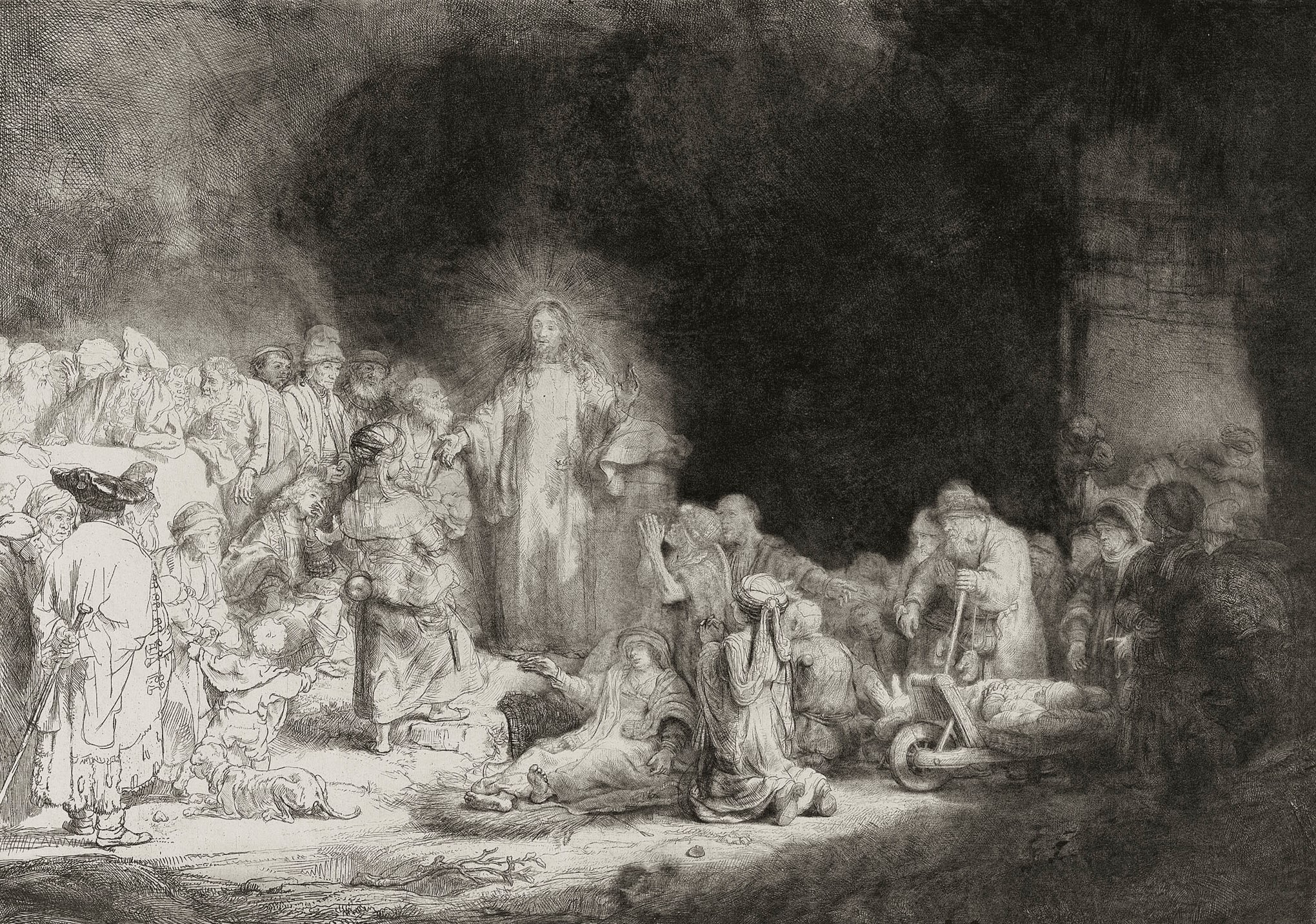
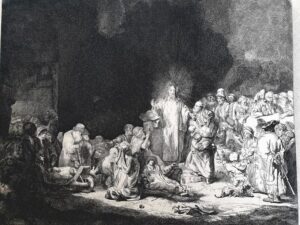
Christ healing the Sick: The hundred guilder print

  • French title:
    La pièce de cent florins
  • German title:
    Christus heilt die Kranken
  • Dutch title:
    Christus predikend – De Honderd Gulden prent
  • New Hollstein:
    239
  • Rembrandt in Black & White:
    6

Etching, drypoint and burin. Ca 1648.
Size: 278 x 388 mm. Surface: 1079 cm2.
Not signed, not dated.

NH 239 – 2nd state of IV

Copper Plate

The copperplate was initially owned by an unknown person in Holland and sold around 1775 to the painter and etcher John Greenwood, who resold it the same year to Capt. William Baillie (1723-1810). He heavily reworked and adapted the plate and printed about 100 copies of it. He then cut the plate in four pieces. Separate prints of these were made and published by Boydell. Each individually quite interesting prints. None of the plates has survived.


Rarity of impressions

  • In auctions (2000-2025): very frequent                                                                                    Early: 33 – Late: 36                     ⦿⊙⊙⊙⊙⊙

  • In collections (New Hollstein 2013): very frequent                                                                  Early: 121 – Late: 32                     ⦿⊙⊙⊙⊙⊙

  • Catalogue Nowell-Usticke (1967): C1-, a comparatively common print, but fine impressions are much sought after. ⦿⦿⊙⊙⊙⊙


Story

This etching shows the complete story of Matthew XIX. From left to right: the Pharisees, with whom Jesus has a debate about marriage and divorce (verses 3 till 12). Then, with his hand before his mouth, the rich young man whom He advised to sell his worldly goods to help the poor (verses 16 till 26). The camel at right refers to the quote by Jesus that it is easier for a camel to pass through the eye of a needle than for a rich man to enter the gate of heaven (verse 24). Peter is positioned to the left of Christ, with whom he discusses at the end of the chapter (verses 27 till 30). Then there are the children that He asked to come towards Him (verses 13 and 14) and finally the lame woman which He heals (verses 1 and 2). According to Tümpel the running boy refers to verse 29.
Some scholars see many more references to other parts of the Gospels.
But some parts may also refer to other gospels. The lame woman may also be the one that was sick for 18 years  as described in Luke 13:11. And the person on the wheelbarrow may be the dead body of only son of a widow from Naïm, as described in Luke 7:12.
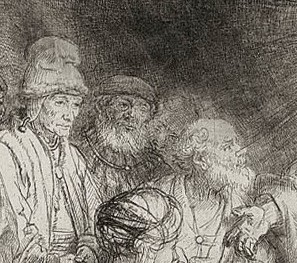
Socrates (right) and Erasmus (left)?

Hofsteede de Groot suggested that the person next to Jesus is in fact a portrait of Socrates and the man behind Him looks like the portrait of Erasmus, which Anthony van Dyck made around 1630. They are supposedly a reflection of the old, respectively the new wisdom.


Subject/Sitter

Dating
Traditionally it was assumed that Rembrandt worked on this plate for a long period, maybe up to ten years. The stylistic variations between several parts of the etching would be the indicator for that. The group of sick people, for instance, can also be seen in a drawing from 1639 (Benesch 188).
Benesch sees similarities with more drawings, like his nrs. 183 till 187, 189, 388 and 543.
Recent scholars, including Schatborn and Hinterding think that the period was much shorter. Watermark research has shown that the print was completed in 1648 (HD).


Picture

This plate is one of the most famous and best etchings by Rembrandt. Already during his lifetime a lot of money was paid for this print and copies were quickly coming to market. In this etching Rembrandt used all available techniques to achieve the effects of light and dark. Some figures are drawn in much detail whereas others are only sketched in contours. The same variety in techniques also leads to rapid deterioration of the quality of the printing, especially visible in later impressions. As much as this etching can be considered the most ambitious, complex and time-consuming composition Rembrandt has made as an etcher, there remain a noticeable large number of areas which seem to be unfinished. The raw, mechanical shading upper left and the figure with his back to the viewer front left, of which only the hat and hands are completed.


Title

The nickname Honderd Gulden prent originated already in Rembrandt’s time. In 1649 a Dutch collector of curiosities, Ernst Brinck (1582-1649) described in one of his notebooks that Rembrandt himself sold at least one impression for that price.
Another transaction is documented in a letter of  9 June 1654 (published in 1880,) sent by the art-dealer Jan Meyssens in Antwerp to the bishop of Bruges, Charles vanden Bosch.
It has been suggested that Rembrandt himself paid a hundred guilders at an auction to get a print in his possession, but there is no proof of that.
Gersaint was the first to use the name ‘La Piece de Cent Florins’ in his catalogue of 1751 and suggested that Rembrandt traded an impression for a painting by Marcus Anthoneus.


Animal Farm

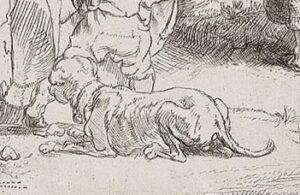
There are three animals visible. The camel under the arch at right, clearly referring to the text of the Gospel. In the dark, lower right corner a donkey is visible. It may be the one on which Jesus entered Jerusalem. The dog at left seems to be watching something. Or is it playing with the pebbles? Note the remnants of another animal: the shell with a pearl, just below the sick lady.


Inspiration

Rembrandt may have seen a woodcut by Lieven de Witte (1537) of the same subject.
He has certainly used the child with the stretched arms (“let the children come to Me”) and the dog as they can be seen in a engraving by Johannes Sadeler, after a design by Joos van Winghe (ca 1600).


Related

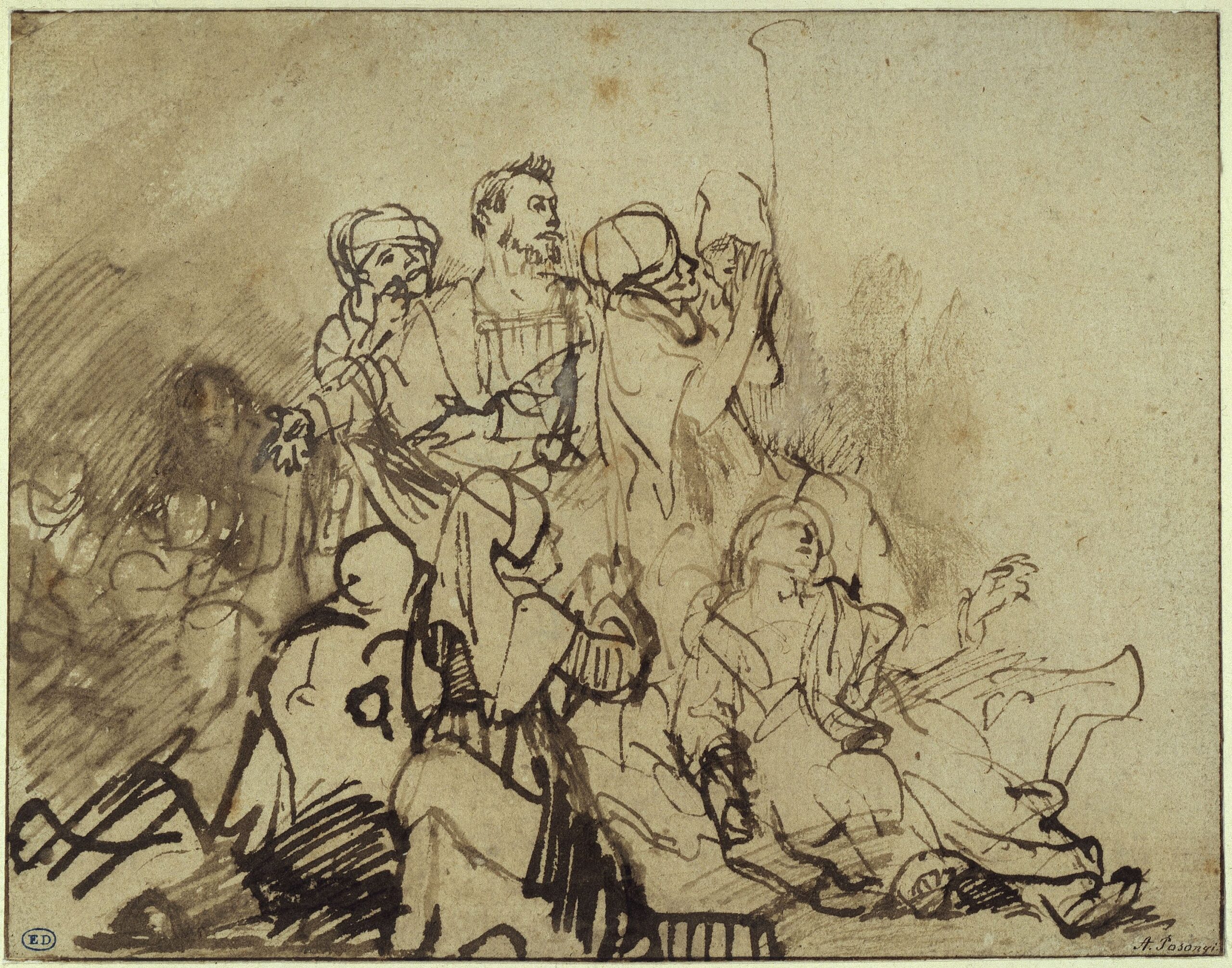
RembrandtStudy for the HGP – ca. 1639/40 – 122×98 mm –  Musée du Louvre – Benesch 185

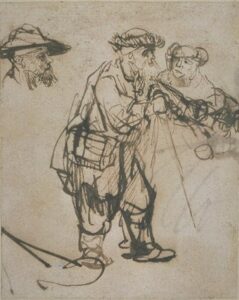
Contrary to his regular methods, Rembrandt made several preliminary drawings. Like two in the Louvre (Benesch 185 and 543), one of the group of  sick people, in reverse (Benesch 188), one in the Courtauld Institute (Benesch 184) and another in the Clement Moore Collection (New York, Benesch 388). And a study of a sick woman, in two versions (in the Rijksmuseum, Benesch 183).
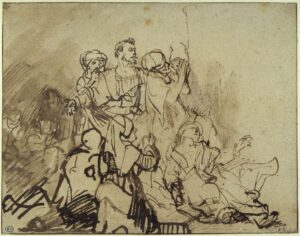
RembrandtGroup of sick people – ca. 1639/40 – 144×185 mm – Küpferstichkabinett Berlin – Benesch 188

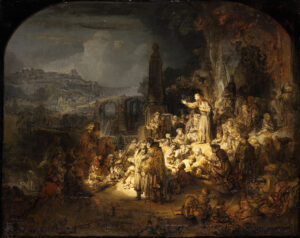
RembrandtJohn the Baptist preachingGemäldegalerie Berlin – Corpus A106

Rembrandt made a painting of John the Baptist preaching. It has a similar setting in reverse (Corpus A106,  in the Gemäldegalerie in Berlin).


Copies
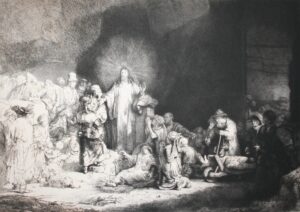
B&W 359 – Leopold Fleming – Copy I of NH 239 / B 74 – Christ healing the sick 

The New Hollstein lists ten copies, of which three in the same direction. Copy C is in mezzotint and drypoint by Thomas Worlidge signed T.W. (three states, 1758, 276 x 390 mm, WB 1).
Copy I is by Leopold Fleming (1873, 288 x 396 mm, WB 2), on commission from Charles Blanc for his third book abotu Rembrandt, published in 1873. An impression is in the collection “Rembrandt in Black &White”, nr 359.
Copy J is by Hermann Nitsch (290 x 390 mm).
Seven copies are in reverse. Copy A is by Melchior Küsel, numbered 27 (94 x 139 mm). Copy B is by Michael Wening numbered 57. Copy D is by Captain William Baillie (two states, 151 x 112 mm, WB 4a). Copy E is another one by Capt. Baillie (87 x 107 mm, WB 4b).
Copy F is by Jacques Philippe La Bas, published by P.F. Basan, included in the Recueil of H.L. Basan (c. 1776, 250 x 288 mm, WB 3), in the collection Rembrandt in Black & White’, nr 346).
Copy G is an anonymous one (85 x 169 mm).
B&W 346 – Jacques Philippe le Bas – Copy F of NH 239 / B 74 Christ healing the Sick – in reverse.

Attributions and reviews

This etching is considered as special by almost all authors.


States

The New Hollstein list four states, the final two by Capt. Baillie. Most other authors list two states, Nowell-Usticke five, from his 4th state there are later impressions. After the 3rd state (NH) the plate is cut in four pieces.
In the 1st state (NH, WB, R238) the shading on the neck of the ass is not present.
In the 2nd state (NH, WB, R239) diagonal shading is added on the neck of the ass. The left side of the chin is not clear°. Early impressions have much burr, like around the hat of the man upper left and on the dress of the woman with the baby looking at Jesus. Later impressions of this state are much weaker.
In the 3rd state (NH) the plate was heavily reworked by Capt. Baillie. Many outlines of figures and faces were redrawn. Like the face of Jesus and the right eye of the camel. The shading of the shoulder in profile in the lower left foreground now reaches the left edge.
The 4th state (NH) refers to the four individual pieces after the cut-up of the plate.
In the 3rd state (NU only) the pupils are retouched and the right one is now smaller than the left. Also, the cheek is strongly outlined.
The 4th state (NU only) is probably retouched by Watelet. There is much additional shading like in the parting of the hair of Christ and between the raised left hand and his cloths.
In the 5th state (NU only) even more retouches are added, with rust spots, especially on the cloths of the large man on the left side. The impressions are poor. This is the last state before the plate was cut by Capt. Baillie.
Biörklund thinks that from the 2nd state Rembrandt continuously made changes, especially in the face of Christ.


Prints and collections

New Hollstein lists ten impressions of the 1st state, of which one maculature (Rijksmuseum) and one counterproof (British Museum).
An impression of the 2nd state on Japanese paper, formerly in the collection of Samuel Josefowitz, was sold at Christie’s London in December 2025, hammerprice £ 550.000.
More than 100 impressions of the 1st and 2nd state are on Japanese or Chinese paper, including a maculature of the 2nd state (Rijksmuseum). There are also two impressions on silk.
The plate was used well into the 18th century.
Of the 3rd state (NU 5th state) Capt. Baillie made at least a hundred impressions. Many of these are undertitled by using a separate plate. THE HUNDRED-GUILDER PRINT. Engraved by Rembrandt about year 1640 after a few impressions were printed was by & thought to be lost. The Work was almost Effaced by Time&c. It was restored to its present , by Capt. BAILLIE in the Year 1775.
Several impressions are on fake Japanese paper.


Watermarks

In the 1st state: Strasbourg lily.
In the 2nd state mainly Strasbourg lily (at least 6 editions); Double-headed eagle; Eagle; Horse and rider.


Literature

H 236, BB 49-1, G 75, M 244, Mz 217, RA 238-241, Cl 78, W 78, Bl 49, Du 77, CD 194, S34.
Special: Amy Golahny, Rembrandt’s Hundred Guilder Print – His Master Etching, Lund-Humphries, London 2021, 128 pages.
Others: Rembrandts passie, p. 96-99; Tümpel 2006, p. 69-70; Schwarz p. 66; Slive, An unpublished head of Christ by Rembrandt in Art Bulletin 1965, p 407; Hoekveld-Meijer 2005, p.103-130; Rohde 2005, p. 105; Hinterding 2006, p. 114-118; Hinterding 2008, p. 155ff; vd Wetering 2009, p. 16-21; Zeist 2012, p. 32-33; Rutgers/Standring 2018, p. 122; Golahny 2021, complete essay; Roscam Abbing, Some notes on Ernst Brinck, in Oud-Holland 2022 – vol. 135, p. 205-224.


Rembrandt in Black & White: 6

New Hollstein: 2nd state of IV/White-Boon: 2nd state of II
A very good impression of the 2nd state (NH), before the rework by Capt. Baillie, recognizable in the face of Christ.
Very wide margins of more than 30 mm, all around.
Watermark: Strasbourg Lily (Ash-Fletcher B.b).


Provenance

Collection Francis Calley Gray (1790-1856, Cambridge MA). His collection donated by will to the Fogg Art Museum of Harvard (Lugt 1101 and 4836, inventory number 3238). Fogg Art Museum (double), Harvard University (Lugt 936).


Exhibitions

The Rotunda at Exchange Square, Hong Kong, January 2008;
Rembrandt in Zwart-Wit, Westfries Museum (Hoorn), Het Markiezenhof (Bergen op Zoom), Stedelijk Museum Zutphen, Het Hannemahuis (Harlingen), Museum Gouda, Jan ten Horne Museum (Weert), Stadsmuseum Harderwijk, March 2013-August 2015; Stedelijk Museum Vianen, October 2017 – January 2018;
Rembrandt in Black & White, Schloß Britz (Berlin), Bozar Expo (Brussels), Chateau des Penthes (Geneva), November 2015- October 2016;
Rembrandt, fotograaf avant-la-lettre, Museum De Reede (Antwerp), January – May 2023;
Rembrandt, 17th century photographer, Daegu Art Museum (Korea), November 2023 – March 2024;
Rembrandt, de fotograaf, Westfries Museum (Hoorn), June 2024 – January 2025.
Rembrandt, Smits & Hansken, Jakob Smitsmuseum (Mol), May-October 2025;