B 276

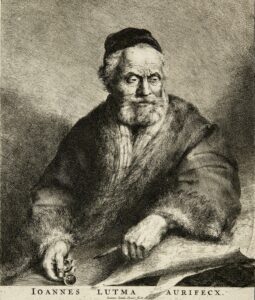
Jan Lutma, goldsmith

  • French title:
    Jean Lutma
  • German title:
    Jan Lutma
  • Dutch title:
    Jan Lutma
  • New Hollstein:
    293
  • Rembrandt in Black & White:
    151

Etching, drypoint and burin (in 2nd state). 1656.
Size: 196 x 150 mm. Surface: 294 cm2.
Signed and dated (in the 2nd state) in the upper part of the window: Rembrandt f. 1656

NH 293 – 1st state of VI – Maculature

Copper Plate

The plate was initially owned by Lutma and then passed to his son Francois, who re-printed it (3rd state). It was then acquired by the Polish etcher Michael Plonski (1778-1812) and sold to Henri-Louis Basan in 1810. It stayed in the set of plates subsequently owned and used for printing Recueils by Auguste Jean (c. 1809), Auguste Bernard, Michel Bernard, Alvin-Beaumont and Robert Lee Hunter. It was sold at the Artemis sale in 1993 and is now in the Rembrandthuis, probably on loan from a private collection in the United Kingdom.


Rarity of impressions

  • In auctions (2000-2025): very frequent  Early: 19     Mixed: 38     Late: 13     Unknown: 20    ⦿⊙⊙⊙⊙⊙

  • In collections (NH – 2013): very frequent              Early: 113     Mixed: 15     Late: 29            ⦿⊙⊙⊙⊙⊙

  • Catalogue Nowell-Usticke (1967): C2-, fine impressions are of considerable rarity, poor ones are common. One of the most liked of Rembrandt portraits  ⦿⊙⊙⊙⊙⊙


Subject/Sitter

B&W 392 – Joan Lutma Portrait of his father Jan Lutma

Jan Lutma (1584-1669) was a goldsmith in Amsterdam. The objects on the table refer to his profession. The silver basin is very similar to a basin in the Rijksmuseum, known to be by Lutma. His importance as an artist is confirmed by several poems and a grafschrift (in memoriam) Vondel made in honour of him. Lutma turned blind in his later years. His fading sight may be the reason that he is portrayed with his eyes half-closed.
His son, Joan Lutma, made an etched portrait of his father. An impression is included in the collection “Rembrandt in Black & White”, number 392. 


Related

His son, Jan Lutma the Younger, was an etcher himself who made a portrait in the same year. It is included in the collection “Rembrandt in Black&White” as number 393. He may also be the calligrapher that made the inscription in the 2nd state.


Copies

NH lists eight copies of which four in the same direction. Copy C is anonymous, signed Rembrandt f | 1656 (both 6’s reversed, 195 x 146 mm, WB 1). Copy D is signed by Ignace Joseph De Claussin (head only? 1809, 60 x75 mm, not traced by NH, WB 2). Copy E is an anonymous wood engraving of the head only (77 x 69 mm). Copy G is signed by Charles Blanc (193 x 148 mm).
There are four copies in reverse. Copy A is signed by Hertel (two states, 195 x 145 mm, WB 3). Copy B is by Francesco Novelli (three states, his nr 22 and 24, 93 x 79 mm, WB 4). Copy F is signed in the 2nd and final state, by Edmund Girling (196 x 147 mm). Copy H of the head only is by Honoré Coussin inscribed h.c.f. and rembran (93 x 75 mm).


Attributions and reviews

The etching is considered as special by Bartsch, Middleton, Rovinsky, De Claussin, Wilson and Blanc.


States

NH lists five states, the final two not by Rembrandt. Most other authors list three states, Nowell-Usticke six. From his 3rd state there are later impressions by Watelet, P. Basan, Basan, Jean, Bernard and Beaumont.
In the 1st state (NH, WB, R735, NU) there is no window in the background and no signature or date*.
In the 2nd state (NH, WB, R736) the window, the niche, a water bottle at the window sill, signature and date are added*. To the right of the elbow an inscription is added Joannes Lutma Aurifex / natus Groningaeº. Also below the table: F.Lutma ex. , but not in all impressions.
In the 3rd state (NH only and with some hesitation) the address of Lutma’s son (1626-1664) is added in the lower right corner. Very difficult to see, especially in dark impressions. Münz and Biörklund think that the inscription is by the same hand as the earlier one and do not consider this a separate state.
In the 4th state (NH/3rd state WB (final), R737, NU) the address of Lutma’s son is erased. There is heavy rework, almost certainly not by Rembrandt (NH), in the area beneath the table, lower right*. Slightly curved diagonal lines are added to the small triangular shaded area at the top right*.
In the 5th state (NH/4th state NU) the plate is entirely rebitten and reworked. The diagonal lines in the upper right corner are still plain, but the horizontal lines are worn out. The grey spot on the beard is reworked. There are clear vertical lines added to the right thumb and horizontal lines to the left hand.
In the 5th state (NU) there is further rework (by Bernard?)
In the 6th state (NU) the plate is completely retouched, probably by Bernard. There is clear vertical shading under the right thumb and regular horizontal and diagonal shading on the right hand.


Prints and collections

Despite the fact that the 1st state seems to be unfinished, Rembrandt probably felt it was, since he made more than 60 impressions. They are printed on Japanese and Chinese paper, vellum and six different types of Western paper.  NH identified four counterproofs of this state, to one of which black chalk is added, probably used by the artist to prepare the 2nd state (in the Rijksmuseum, the others are in Lausanne, the Bibliothèque Nationale and in Munich). There are also three maculatures (Dutuit collection, the Albertina and in this collection) and possibly three more (in the Rembrandthuis, the British Museum and the Bibliothèque Nationale).
The 2nd state was frequently reprinted.
Of the 2nd and 3rd state there are also impressions on Japanese paper, on oatmeal and on yellow oatmeal paper.
The 3rd state (NH) was reprinted by Lutma’s son Francois, who recorded this in the lower right corner.
Nowell-Usticke considers the impressions in the Recueil de Basan, to be fairly good.


Watermarks

In the 1st state: Arms of Amsterdam (2 ed. 1656); Foolscap with seven-pointed collar (3 ed. 1656), Foolscap with five-pointed collar (1656); Double-headed eagle (1656-57); Countermarks IB and PB.
In the 2nd state: Arms of Amsterdam (1656); Foolscap with seven-pointed collar (3 ed. 1656); Double-headed eagle (1656-57); Countermark GK; Fleur-de-Lys; Strasbourg lily.
In the 3rd state: Arms of Amsterdam (1656); Foolscap with five-pointed collar (1656); Foolscap with seven-pointed collar (1656); Strasbourg lily.


Literature

H 290, BB 56-C, G 256, M 171, Mz 77, RA 734-737, Cl 273, W 278, Bl 182, Du 265, CD 247, S 118-122.
Dickey 2004, p. 130-131; Hinterding 2008, p. 492 ff.


Rembrandt in Black & White: 151

NH: 1st state of V/WB: 1st state of III.
A maculature, a working impression from the printing plate with traces left from the previous printing. This sheet may have been a working document to prepare for the alterations in the 2nd state as can be seen on a counterproof in the Rijksmuseum (see Prints and collections).
Sheet 200 x 152 mm, thread margins of 1 to 2 mm all around (+3%).
Watermark: Arms of Amsterdam, dated to 1656 (Hinterding 2006, p. 317), vertical chain lines at approx. 26 mm.


Provenance

In the collection of Chambers Hall (Southampton 1786-1855 London, Lugt 551), his collector’s stamp in black ink verso.
Probably in the sale of his collection with Christie’s London in March 1856.


Exhibitions

Rembrandt in Zwart-Wit, Het Markiezenhof (Bergen op Zoom), Stedelijk Museum Zutphen, Het Hannemahuis (Harlingen), Museum Gouda, Jan ten Horne Museum (Weert), Stadsmuseum Harderwijk, July 2013 – August 2015; Stedelijk Museum Vianen, October 2017 – January 2018;
Rembrandt in Black & White: Schloβ Britz (Berlin), Bozar Expo (Brussels), Chateau de Penthes (Geneva), November 2015-October 2016;
Rembrandt, fotograaf avant-la-lettre, Museum De Reede (Antwerp), January – May 2023;
Rembrandt, 17th century photographer, Daegu Art Museum (Korea), November 2023 – March 2024;
Rembrandt, de fotograaf, Westfries Museum (Hoorn), June 2024 – January 2025;