B 19

Self-portrait with Saskia

  • French title:
    Rembrandt et sa femme
  • German title:
    Rembrandt mit Saskia
  • Dutch title:
    Zelfportret met Saskia
  • New Hollstein:
    158
  • Rembrandt in Black & White:
    3

Etching. 1636.
Size: 104 x 95 mm. Surface: 99 cm2.
Signed and dated, in the upper left corner: Rembrandt. f. 1636.

NH 158 – 1st state of IV

Copper Plate

The copperplate was in the sale of Jean de Bary (1759, lot 56) and sold to Ottens. Later it came in the possession of Claude-Henri Watelet (1718-1786). It then became part of the set of plates subsequently owned and used for printing Recueils by Pierre-François Basan (1723-1797), Henri-Louis Basan (his nr 1374), Auguste Jean (ca 1809), Veuve Jean, Auguste and Michel Bernard (1846), Alvin-Beaumont (1906) and Robert Lee Humber (1937). It was sold at the Artemis sale in London (1993) to a private collector in the Netherlands. At the Tefaf in 2014 it was sold to another Dutch private collector, Baron van Dedem (via Helmut Rumbler).


Rarity of impressions

  • In auctions (2000-2025): very frequent                          Early: 14     Mixed: 33     Late: 53    ⦿⊙⊙⊙⊙⊙

  • In collections (New Hollstein 2013): very frequent          Early: 42     Mixed 41     Late: 48    ⦿⊙⊙⊙⊙⊙

  • Nowell-Usticke (1967): C2-, one of the commonest and most popular portraits                   ⦿⊙⊙⊙⊙⊙


Description

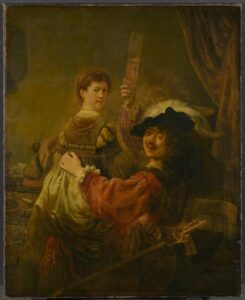
This is one of the best known self-portraits of Rembrandt. He is depicting himself as an artist with his wife Saskia on his side, with whom he married two years earlier. Rembrandt wears a 16th century beret with a brim. It is very unusual to see a self-portrait with another person.


Related

Rembrandt –  Saskia seated in an armchair – 1633 – Musée du Louvre – 147 x 110 mm – Benesch 429


RembrandtThe prodigal son in the inn (Rembrandt and Saskia) – c. 1635 – Gemäldegalerie Dresden – Corpus A111

Hind suggests a comparison of the bust with a red-chalk drawing (Benesch 429).
There is also a similarity with a drawing in the Kupferstichkabinett in Berlin (Benesch 432).
The only painting in which both Rembrandt and Saskia are pictured is The prodigal son in the inn (Corpus A111, Gemäldegalerie in Dresden).
The only known man-wife double portrait is a 15th century engraving by Israhel van Meckenem (1440-1503). Rembrandt may have known and been inspired by that print.


Copies

The fact that more than twenty copies were made of this etching proves its early popularity. Of these only five are in the same direction. Copy B is by T.B.Glomy, Rembrandt only, signed J.B.G. scul 1750. It is included in the Gersaint catalogue of 1751 (103 x 78 mm, WB 2).
Copy C was previously attributed to Thomas Worlidge, Rembrandt only, used as frontispiece of the Gersaint catalogue of 1752 (157 x 98 mm).
Two copies (R and S) were made by Ignace Joseph de Claussin. In one of these Saskia is replaced by Rembrandt’s mother, as in the 3rd state (116 x 100 mm, WB 1).
P is an anonymous wood engraving, Rembrandt only (96 x 75 mm).
There are sixteen copies in reverse. Copy A is a copy by Johan George Hertel (two states, 102 x 93 mm). Copy D is by S. Fokke, Rembrandt only, (1755, 57 x 73 mm).
Copy G is by Claude-Henri Watelet, Rembrandt only. It is included in the Recueil de H.L. Basan, which is in the collection ‘Rembrandt in B&W’, number 54,  page 15. (1758, 74 x 62 mm, WB 5). Copy U is by John Burnet, signed Rembrandt f.
Other copies are by John Hinde, Elias Stark, Dominique Vivant Denon’s workshop, Thomas Reeves, Edmund Girling, Damiano Pernati and five anonymous ones.


Attributions and reviews

The etching is considered as special by Rovinsky and Wilson.
According to Seidlitz the plate was made by a pupil.


States

NH list four states, of which only the first and possibly the second are by Rembrandt. Most other authors list three states, Nowell-Usticke six, from his 3rd state there are later impressions by Watelet, P.Basan, Basan, Jean, Bernard and Beaumont.
The 1st state (NH, WB, R69, NU) can be recognized by the short scratch on Saskia’s forehead. There is a sharp vertical line near Rembrandt’s right hand. In later impressions the shading is blurred.
In the 2nd state (NH, WB, R70, NU) the scratch is gone, but the shading is still weak. In later impressions a new scratch appears above the breast of Saskia. This state may already be posthumous (NH).
In the 3rd, most common state (NH, WB, R71) there is heavy crosshatching under the hat, just right of the left eye. There is an acid spot right of the collar. The vertical line through Rembrandts hand is still visible, the line above Saskia’s breast almost disappeared. In later impressions of this 3rd state Watelet and the Basan family made alterations.
In the 4th state (NH, NU Jean) part of the left cheek has been reworked. There is a long vertical line (ca 3 mm) from the left side of Rembrandts hat. The line in the hand is almost gone.
In the 5th state (NU only) Bernard has reworked the part under the hat and has added extra shading on the vest. The impressions are dark and heavy.
In the 6th state (NU only, Beaumont?) the line on the hand is only visible with a magnifying glass. The impressions are good and sharp, although the lower part of the sleeve, close to the edge, seems to be burnished out.


Prints and collections

According to NH at least forty impressions of the 1st state are known.
Based on this high number, Hinterding thinks that the 2nd and certainly the 3th state may well be by another hand, because the scratch on the forehead of Saskia obviously was not a reason for Rembrandt to adjust the plate before printing an ample number of copies.
Counterproofs of the 2nd state are in the Fitzwilliam Museum (Cambridge, UK, not listed in NH) and in the Albertina.

Combination of B 19 (3rd state) and B 349. 

There are impressions of the 3rd state (R72) in which the head of Saskia is replaced by that of Rembrandt’s mother (B349). Some consider this to be the work of Watelet, but since Gersaint already mentions this version it must have been printed earlier (JM).
Nowell-Usticke considers the impressions in the Recueil de Basan, unchanged from the 3rd state, as fair.


Watermarks

In the 1st state: Strasbourg lily (2 ed.).
In the 2nd state: Arms of Amsterdam (3 ed.).
In the 3rd state: Arms of Amsterdam (4 ed.); Seven Provinces (1749 or later).


Literature

H 144, BB 36-A, G 24, M 128, Mz 21, RA 69-72, Cl 19, W 19, Bl 203, Du 19, CD 108, S 1
Rembrandt by himself 1999, p. 162; Rembrandt’s Women 2001, p. 121; Dickey 2004, p. 28f; Hinterding 2008, p. 56; Broos 2012, p. 69; Giltaij 2023, p. 90;


Rembrandt in Black & White: 3

New Hollstein: 1st state of IV/White-Boon: 1st state of III
A very good, contemporary impression. The small scratch on the forehead of Saskia, typical for the 1st state, is well visible.
Sheet 105 x 95/94 mm, no margins, cut near or on the platemark (+1%).
Unidentified watermark, horizontal chain lines.


Provenance

In the collection of the Parisian jeweller Henri Vever (1854-1943, Metz – Paris, Lugt 1381a, 1381b, 2491bis and 2491ter);
It probably remained in the possession of his heirs for a long period.


Exhibitions

The Rotunda at Exchange Square, Hong Kong, January 2008;
Rembrandt in Zwart-Wit, Westfries Museum (Hoorn), Het Markiezenhof (Bergen op Zoom), Stedelijk Museum Zutphen, Het Hannemahuis (Harlingen), Museum Gouda, Jan ten Horne Museum (Weert), Stadsmuseum Harderwijk, March 2013-August 2015; Stedelijk Museum Vianen, October 2017- January 2018;
Rembrandt in Black & White: Schloß Britz (Berlin), Bozar Expo (Brussels), Chateau de Penthes (Geneva), November 2015-October 2016;
Rembrandt, fotograaf avant-la-lettre, Museum De Reede (Antwerp), January – May 2023;
Rembrandt, 17th century photographer, Daegu Art Museum (Korea), November 2023 – March 2024;
Rembrandt, de fotograaf, Westfries Museum (Hoorn), June 2024 – January 2025;