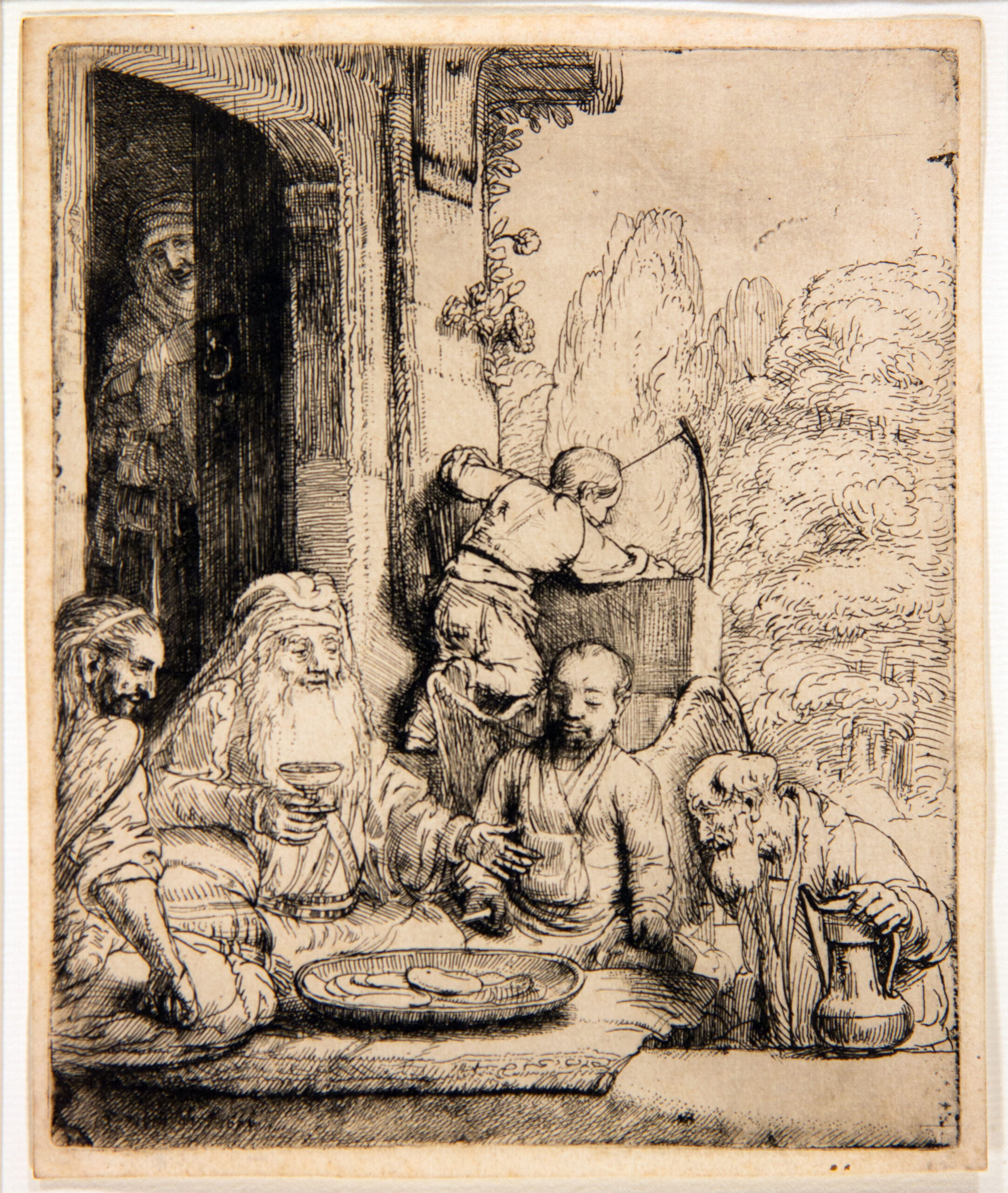
The copperplate was discovered in 1997 at Christie’s London at the backside of a river landscape by Pieter Gysels or a follower (d. 1691). A possible explanation is that the etching dates from the year of Rembrandt’s bankruptcy. Although no plates were listed in his inventory, Rembrandt may have hidden some plates as they could provide him with a source of income in the years to come. It has never been reworked or used for later impressions. The Gysels painting was in the collection of an antique shop in Yorkshire and sold in 1946 to an unknown owner. At an auction in 1997 the plate was sold to the National Gallery (Washington DC), hammerprice £ 210.500.
Rarity of impressions
In auctions (2000-2025): frequent Early: 36 ⦿⦿⊙⊙⊙⊙
In collections (New Hollstein 2013): common Early: 64 ⦿⦿⦿⊙⊙⊙
Nowell-Usticke (1967): C1-, not rare, but a very desirable print ⦿⦿⊙⊙⊙⊙
Story
Genesis 18, verses 1-15
The etching tells the story of the prophecy brought to Abraham by God, that his wife Sarah will soon give birth to a son, despite the old age of the couple. Various versions of the Bible mention either three angels or two angels and God Himself coming to Abraham, all dressed as ordinary men. Rembrandt has obviously used the latter interpretation (from the Statenvertaling 1637?) as he portrays God in a traditional way. The chalice and His invitational gesture with the hand may well be meant as a referral to the last supper.
Picture
Instead of the tent mentioned in the Bible Rembrandt used a solid house as background. Sarah is standing in the doorway, listening to the conversation, maybe even laughing about the prophecy. The boy with bow and arrow is Ishmael, son of Abraham and the slave Hagar. He turns his back to the scene, preluding that he and his mother will eventually be sent away when the new son is born.
Some scholars consider this print to be a representation of the Trinity. They see a Chinese face in the angel at right, who would then represent the Holy Spirit. And an Indian face in the angel at left, representing Jesus.
Related
Rembrandt – Abraham receiving the three Angels– Bredius 515 – Corpus V-9
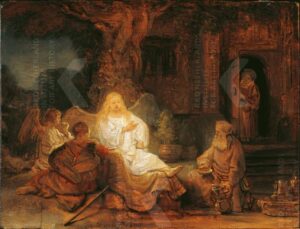
In 1646 Rembrandt made a painting, Abraham serving the Angels (Bredius 515, Corpus V9, previously in the collection of the Aurora Trust in New York, auctioned at Sotheby’s NY in Jan 2021). When he decided to dress the three visiting men in Oriental dress, Rembrandt made a drawing with a comparable composition Four Orientals seated under a tree (Benesch 1187, now in the British Museum) resembling a print now in the Albertina. Royalton-Kisch dates this drawing between 1656 and 1661, which would be after this etching.
Rembrandt may have been inspired by Mughal miniatures, Indian prints from the early 17th century. His estate in 1656 mentions a book with ‘merkwaardige miniatuur tekeningen’ (peculiar miniature drawings), which proves his interest in this subject.
Copies
The New Hollstein lists only one anonymous copy in reverse (160 x 136 mm).
Attributions and reviews
The etching is considered as special by Singer.
Hoekveld-Meijer considers this print to show the dogma of the Trinity and, at the same time, the ‘proof’ that Rembrandt was an ‘anti-trinytist’. She points at the location of Ishmael, in a central position above the ‘sacred’ group of men. Ishmael is considered to be a prototype for Israel, or the Jewish community.
States
All authors list one state only.
Prints and collections
According to Nowell-Usticke the first impressions show much burr and considerable inking on the edges. In later impressions the shading on Sarah’s nose and left cheek has disappeared. Even later impressions become lighter, the burr disappears and the edges are clean. There are impressions on regular paper (with watermark), Japanese paper and thick paper (no watermark). There are counterproofs in the British Museum and the Bibliothèque Nationale.
Watermarks
Arms of Amsterdam (1656); Foolscap; Foolscap with seven-pointed collar; Strasbourg lily.
Literature
H 286, BB 56-B, G 30, M 250, Mz 185, RA 108, Cl 35, W 36, Bl 2, Du 36, CD 245. Broos 1985, p. 78; Tümpel 2006, p. 34-35; Tromp & Maas 1999, p. 37-46; Spijkerboer 2006, p. 20; Schapelhouman 2006, p. 24; Hoekveld -Meijer 2005, p. 13-22; Hinterding 2008, p. 71; Rosenberg 2017, p. 62;
Rembrandt in Black & White: 16
New Hollstein/Whiet-Boon: Only state.
A good impression with delicate tones.
Sheet 166/167 x 139/137 mm, margins of 3 to 5 mm all around (+11%).
No watermark, horizontal chain lines.
Exhibitions
Rembrandt in Zwart-Wit, Museum Gouda, Jan ten Horne Museum (Weert), Stadsmuseum Harderwijk, March 2013-August 2015; Stedelijk Museum Vianen, October 2017- January 2018; Rembrandt in Black & White, Schloß Britz (Berlin), Chateau des Penthes (Geneva), November 2015 – October 2016; Rembrandt, de fotograaf, Westfries Museum (Hoorn), June 2024 – January 2025;