B 35

Abraham’s sacrifice

  • French title:
    Le sacrifice d’Abraham
  • German title:
    Abrahams Opfer
  • Dutch title:
    Het offer van Abraham
  • New Hollstein:
    287
  • Rembrandt in Black & White:
    129

Etching and drypoint. 1655.
Size: 156 x 131 mm. Surface: 204 cm2.
Signed and dated, in the lower right corner: Rembrandt f 1655.

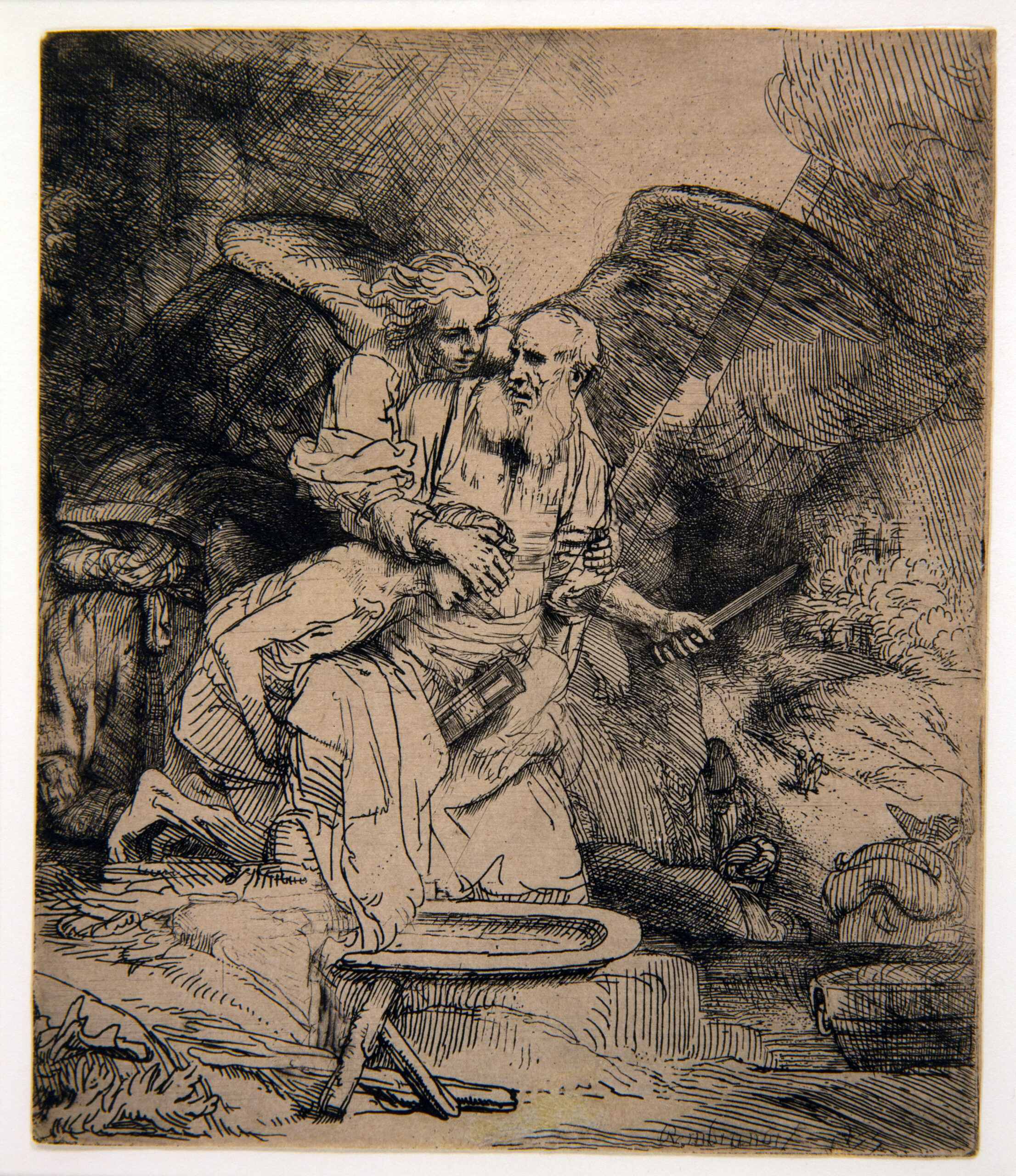
NH 287 – Only state

Copper Plate

The copperplate was in the auction inventory of Pieter de Haan (1767 as lot 6) and sold to Sluyter. It has not been seen since and is probably not anymore in existence.


Rarity of impressions

  • In auctions (2000-2025): frequent                                                         Early: 31                                         ⦿⦿⊙⊙⊙⊙

  • In collections (New Hollstein 2013): frequent                                      Early: 69                                        ⦿⦿⊙⊙⊙⊙

  • Nowell-Usticke (1967): C2-, a very popular common plate                                                                         ⦿⊙⊙⊙⊙⊙


Story

Genesis 22, verses 9-12
Ten years after he made an etching on the same subject (B34) Rembrandt returns to the story of the sacrifice by Abraham of his son Isaac, as ordered by God.


Picture

Although the Bible states that the angel ‘only’ called out to Abraham, Rembrandt follows the traditional way of depicting this dramatic moment and has the angel grasping Abraham’s arm to stop the killing. The drawing is full of tension and movement, like the wings of the angel still fully exposed, the position of the arms and legs of Isaac and the frown on the face of Abraham. The notion that it is all over has not yet reached him. Schwarz points at the way Rembrandt has positioned the three main figures in a strict and compact group, illuminated by a powerful light. In contrast we see servants and a donkey waiting in the dark for the outcome of what was expected to be a disastrous moment. Two travellers, unaware of the scene above them, are walking on a path in the valley. Others have pointed at the rays of light that come from the top right corner. Three major elements are touched (and thus connected) by the two lines, the holster of the knife, the hand of the Angel and the bowl, meant to catch the blood of Isaac.


Related

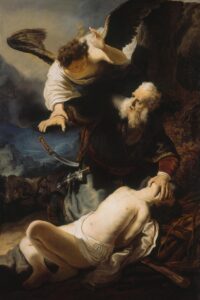
Rembrandt or studioAbraham’s sacrifice – 1636 – Alte Pinakothek


Although made ten years later, there is a definite link with B 34, both in size as in subject. Münz suggests that, regarding the way Abraham holds the knife, Rembrandt may have been inspired by a picture by Pieter Lastman. The painting itself is lost but it is known through a mezzotint copy by Jan van Somer and a drawing (now in the Lugt Collection). Muller pointed out that Rembrandt used Lastman’s example when he painted the same subject twenty years before this etching (Corpus A 108, now in the Hermitage). He was obviously not fully content with that version, since he painted a second one a year later (1636, now in the Alte Pinakothek). In the same period he also made a drawing of the scene, in black and red ink (now in the British Museum). Hinterding suggests that Rembrandt may have prepared the group of figures in a drawing (now in the Musée Vivenel in Compiègne), which drawing is not generally accepted as authentic. In the same year 1655 Rembrandt made a intriguing painting of his own son, ‘Titus, in a pensive mood’ (Boymans van Beuningen), a year later he made an etching of him (B 11, NH 297).


Copies

B&W 370 – Only copy of NH 287 – WB 38


Both NH and WB list one copy in reverse, earlier attributed to Gerard Dou (156 x 127 mm) An impression is included in the collection ‘Rembrandt in Black & White, number 370).


An etching by Ferdinand Bol shows the same scene, but is not mentioned by the New Hollstein, nor White-Boon. Although it is probably made during the time Bol was a pupil of Rembrandt, between 1638 and 1640. An impresssion is included in the collection “Rembrandt in Black & White”, number 373. (405 x 327 mm).


B&W 373 – Ferdinand BolThe sacrifice of Abraham – Hollstein 1 

Attributions and reviews

The etching is considered as special by Seidlitz.


States

All authors list one state only. Early impressions show considerable burr and many fine horizontal scratches.


Prints and collections

There are many impressions on Japanese paper and at least nine counterproofs.


Watermarks

Countermark FC; Foolscap with seven-pointed collar (2 ed., one 1656); Strasbourg lily (2 ed.); Foolscap.


Literature

H 283, BB 55-B, G 33, M 246, Mz 184, RA 115, Cl 36, W 39, Bl 6, Du 40, CD 241, S 6 and 7.
Tümpel 2006, p. 36-37; Tromp & Maas 1999, p. 56-65; Spijkerboer, p. 35-36; Hinterding 2008, p. 78-80; Verdi 2014, p. 210-211; Rosenberg 2017, p. 84-89.


Rembrandt in Black & White: 129

New Hollstein/White-Boob: Only state
A very good impression with burr beneath the bowl at lower left and on Abraham’s tunic. Light plate tone and delicate wiping marks. Printed on somewhat coloured paper.
Sheet 155 x 132 mm, no margins, trimmed on or slightly within the platemark (= 0%).
No watermark, horizontal chain lines.


Exhibitions

Rembrandt in Zwart-Wit, Westfries Museum (Hoorn), Het Markiezenhof (Bergen op Zoom), Stedelijk Museum Zutphen, Het Hannemahuis (Harlingen), Museum Gouda, Jan ten Horne Museum (Weert), Stadsmuseum Harderwijk, March 2013-August 2015;
Stedelijk Museum Vianen, October 2017 – January 2018;
Rembrandt in Black & White, Scholz Britz (Berlin), Bozar Expo (Brussels), Chateau des Penthes (Geneva), November 2015 – October 2016;
Rembrandt, fotograaf avant-la-lettre, Museum De Reede (Antwerp), January – May 2023;
Rembrandt, 17th century photographer, Daegu Art Museum (Korea), November 2023 – March 2024;
Rembrandt, de fotograaf, Westfries Museum (Hoorn), June 2024 – January 2025;