B 42

The blindness of Tobit, the larger plate

  • French title:
    Tobie la père, aveugle
  • German title:
    Der blinde Tobias
  • Dutch title:
    De blinde Tobit
  • New Hollstein:
    265
  • Rembrandt in Black & White:
    32

Etching and drypoint. 1651.
Size: 161 x 129 mm. Surface: 201 cm2.
Signed and dated, lower centre and lower right: Rembrandt f 1651.

NH 265 – 1st state of II

Copper Plate

The plate was part of the collection of de Haan (1767), but not of any of the later collections or sales and is almost certainly not in existence.


Rarity of impressions

  • In auctions (2000-2025): rare                                                                   Early: 15                                      ⦿⦿⦿⦿⊙⊙

  • In collections (New Hollstein 2013): frequent                                       Early: 79                                         ⦿⦿⊙⊙⊙⊙

  • Nowell-Usticke (1967): C1+. Rather uncommon, a popular plate                                                             ⦿⦿⊙⊙⊙⊙


Story

Tobit 11, verses 5-11
Rembrandt was fascinated by the story of Tobit. He made no less than twenty drawings, five paintings and three etchings of it. Tobit turned blind during his exile in Babylon. As a result he dwindles in poverty. Eventually he sends his son Tobias on a trip to Medea to collect an old debt. His dog and the Archangel Raphael accompanied him on this journey. The Angel advised Tobias to catch a fish and keep the intestines. On his way Tobias married Sarah, a distant relative, despite the fact that her first seven husbands did not survive the wedding night. By burning the intestines Tobias succeeded in conquering the curse, staying alive. Later, the same material was used to cure his father’s blindness.


Picture

Tobias’ trip took quite some time and consequently the old father was surprised and probably somewhat overjoyed when he heard that his son and new wife were coming home. The etching shows the moment when Tobit walks over to the door to welcome them. Overturning the spinning wheel in his path. He seems to be so excited that he misses the door. Note the shadow of Tobit on the wall he is approaching, caused by the fire in the chimney.
Schwartz points out that Rembrandt follows the strict text of the Dutch bible from 1629: “Ende Tobias quam uyt after the deure and stiet hem daer aen” (Tobias went to the door and bumps into it). 


Animal Farm

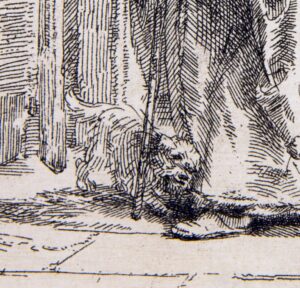
B 42 – NH 265 – Detail: The dog of Tobias

The dog entering the room is the crucial element of this etching. Despite his blindness Tobit recognizes it as Tobias’ dog and realises his son has returned.


Related

A painting, probably made in 1627 shows a very similar composition (in reverse, Corpus C4, private collection USA). It is assumed that Rembrandt started the painting, Jan Lievens took it further and Gerard Dou completed it, based on a recently discovered dating and two monograms.
A similar motif can be found in a painting by a pupil of Rembrandt around 1629 (now in the Boymans van Beuningen, Rotterdam).
According to Charles Blanc, followed by Münz and Schwartz, Rembrandt may have been inspired for the posture of Tobit by The Blinding of Elymas, an engraving by Aghostino Veneziano, in itself made after a tapestry drawing by Raphael.
Rembrandt made at least ten drawings of Tobias journey and another etching of the moment the angel leaves the family (B 43).


Copies

There is a copy in reverse made by Sardi, signed Rembrandt Sc. Sardi inc. 1971 (should be 1791, 158 x 129 mm).


Attributions and reviews

The etching is considered as special by Coppier and Singer.
Several other authors, like Ch.Holmes and van Gelder, also consider this etching to be one of the best works by Rembrandt.


States

The New Hollstein lists two states, only the first by Rembrandt. Most other authors list only one state.
In the 1st state (NH, WB, R144, NU) there is a light spot on the left cheek of Tobit, below the eye.
In the 2nd state (NH/2nd state NU) the light spot is gone.


Prints and collections

Of the 1st state there are early impressions on Japanese paper. An impression in the Bibliothèque Nationale is touched with pen and brown ink.
There are counterproofs in the Rijksmuseum, the Albertina, the Bibliothèque National, Darmstadt and the Fitzwilliam Museum (Cambridge).
There are later impressions by de Haan (1767).


Watermarks

In the 1st state: Arms of Amsterdam; Countermarks AD and IP; Foolscap with five-pointed collar (2 ed., one c. 1651-52); Foolscap with seven pointed collar; Paschal lamb (c. 1651); Seven Provinces.


Literature

H 252, BB 51-D, G 41, M 226, Mz 181, RA 142-143, Cl 46, W 46, Bl 15, Du 45, CD 206, S 11.
Van Gelder 1947, p. 49-50; Tümpel p. 32; J.Held, Craddock and Barnard 1958, Catalogue nr 24, nr 184, plate ix; Rembrandt and the book of Tobit 1964, p. 15.; Etchings by Rembrandt from the S.William Pelletier Collection (Catalogue 2004), nr. 28, p. 114-116; Schwartz 2006, p. 93; Spijkerboer 2006, p. 146; Rembrandt’s Nose 2007, p. 74; Hinterding 2008, p. 96-98; Rosenberg 2017, p. 136;


Rembrandt in Black & White: 32

New Hollstein/White-Boon: 1st state of II
A very good impression with many horizontal stripes.
Sheet 190 x 146/144 mm. Broad margins on all sides, 10 mm left and right, 15 mm at the top and bottom (+33%).
Watermark: Seven Provinces, listed but not dated in Hinterding 2006 (p. 252). Vertical chain lines at approx. 24 mm.


Provenance

In the collection of Sir Francis Seymour Haden (London 1818 – 1910 Arlesford, Lugt 1227);
In the collection of Richard Fisher (1809-1890, Hill Top, Midhurst, Lugt 2204);
His sale on 23 May 1892 (lot 765) by Sotheby’s London to R.Gutekunst (Craddock and Barnard, London);
Sold to C.G.Boerner, Dusseldorf for £ 560, September 1958; C.G.Boerner Lagerliste nr 24, lot 198;
Sold to a German private collector March 1959; Repurchased by C.G.Boerner in 1991;
Sold to Joseph R. Ritman, Amsterdam;
Repurchased by C.G.Boerner Inc., New York, cat. 1995, nr. 20, 2 August 2000;
Sold to Dr. S. William Pelletier (1924-2004, Athens, GA, Lugt 4193) his collector’s mark in reddish-brown ink and the numbers 2000 (top) and 8.2.9 (bottom) verso;
At Sotheby’s London 2 December 2004, lot number 58 (not sold).


Exhibitions

C.G.Boerner, Dusseldorf, 15 March – 15 April 1959;
Mees Pierson, The Hague, September-October 1996;
Sotheby’s London October 1996, Sotheby’s New York, November 1996;
Herbert F. Johnson Museum of Art, Cornell University, Ithaca (NY), 17 January – 14 April 2004;
Georgia Museum of Art, University of Georgia, Athens (GA), 17 September – 14 November 2004;
The Rotunda at Exchange Square, Hong Kong, January 2008;
Rembrandt in Zwart-Wit, Westfries Museum (Hoorn), Het Markiezenhof (Bergen op Zoom), Stedelijk Museum (Zutphen), Het Hannemahuis (Harlingen), Museum Gouda,
Jan ten Horne Museum (Weert), Stadsmuseum Harderwijk, March 2013-August 2015;
Stedelijk Museum Vianen, October 2017 – January 2018;
Rembrandt in Black & White, Schloß Britz (Berlin), Bozar Expo (Brussels), Chateau des Penthes (Geneva), November 2015 – October 2016;
Rembrandt, fotograaf avant-la-lettre, Museum De Reede (Antwerp), January – May 2023;
Rembrandt, 17th century photographer, Daegu Art Museum (Korea), November 2023 – March 2024;
Rembrandt, de fotograaf, Westfries Museum (Hoorn), June 2024 – January 2025;