B 54

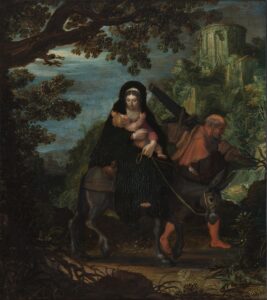
The flight into Egypt, a sketch

  • French title:
    Fuite en Egypt, griffonnée
  • German title:
    Die Flucht nach Ägypten, Skizze
  • Dutch title:
    De vlucht naar Egypte (schets)
  • New Hollstein:
    4
  • Rembrandt in Black & White:
    37

Etching. Ca. 1628.
Size: 146 x 122 mm in the 1st state only, then 79 x 51 mm. Surface: 178 resp. 40 cm2.
Not signed, not dated. Estimates of dates range from 1627 (White-Boon), 1628 (New Hollstein) and 1629 (Münz and Biörklund) to 1630 (Middleton and Hind).

NH 4 – 8th and final state

Copper Plate

The plate was not part of the collections of De Jonghe, De Haan (1767) or Humber (1993) and is probably not in existence.


Rarity of impressions

  • In auctions (2000-2025): extremely rare                                              Late: 2                                             ⦿⦿⦿⦿⦿⦿

  • In collections (New Holllstein 2013): rare                                             Early: 16     Late: 32                   ⦿⦿⦿⦿⊙⊙

  • Nowell-Usticke (1967): RRRR+, a great rarity, even the small cut down pieces are excessively rare     ⦿⦿⦿⦿⦿⦿


Story

Matthew 2:14-15
The flight into Egypt was one of Rembrandts favourite subjects of which he made a series of etchings over a rather long period, from 1629 till 1655 (Bartsch numbers 52 to 59). Most of these have a similar size.


Picture

In the very rare 1st state, the back of Joseph is visible walking to the left, pulling the donkey with Mary and the Child. The plate then measured about 146 x 122 mm. but it was later cut by Rembrandt himself, leaving only the figure of Joseph.
The upper right part of the original plate is later used by Rembrandt for his Self-portrait leaning forward (B 5), in which the head of Mary is still visible in a corner.
Gersaint, in his catalogue of 1751, listed this print under the beggars. Yves corrected him indicating that the print was known in Holland under the name Het Josephie onder het ronde poortje (The little Joseph under the curved gate) in the De Burgy sale in 1755.


Related

Pieter LastmanThe flight into Egypt – 1608 – Boymans van Beuningen


Rembrandt may have been inspired by the painting of this subject that his tutor Pieter Lastman made in 1608 (now in the Boymans van Beuningen).
There is a drawing in the same direction, dated 1629/1630, now in the Louvre (Benesch 14) which bears resemblance to the figure of Joseph.
According to Münz only the 1st state is by Rembrandt. He points at various examples, like a woodprint by Durer (B89) for the position of Mary and a woodprint by Altdorfer for the position of Joseph. For the composition as a whole he refers to the altarpiece in Champmol by Melchior Broederlam (now in Dijon) and a 16th century piece by the Master of 1518 (in the National Gallery, London).
Rubens and Jordaens have also painted Joseph in this position.


Copies

There are two copies in the same direction. Copy A is by William James Smith, arched (78 x 50 mm, WB 1). Copy B is by Leopold Flameng, in the catalogue of Blanc (1859-61, p. 121 II, 133 x 104 mm, WB 2).


Attributions and reviews

According to Coppier and Singer this etching is not by Rembrandt.


States

The New Hollstein lists eight states, of which the final four not by Rembrandt. His 2nd and 7th state are ‘new’. Most other authors list six states, Rovinsky seven.
The 1st state (NH, WB, R179) is the complete plate. Impressions are weak and dull. There are only three lines on the beard of Joseph.
In the 2nd state (NH only) the plate is cut to 79 x 51 mm and rounded at the top, before the hatching of the 3rd state.
In the 3rd state (NH/2nd state WB, R181) hatching is added to the left of the knife.
In the 4th state (NH/3rd state WB, R182) some thin lines are added to the beard.
In the 5th state (NH/4th state WB, R183) much shading is added as well as vertical shading on the lower part of the right leg, probably not by Rembrandt.
In the 6th state (NH/5th state WB, R184) there is crosshatching on the right leg of Joseph.
In the 7th state (NH only) the outlines of the right shoulder are more continuous.
In the 8th state (NH/6th state WB, R185) the hat is flattened.
Rovinsky recognizes a 7th state with acid spots on the beard.


Prints and collections

There are only two impressions of the 1st state known, in the Rijksmuseum and in the Bibliothèque Nationale.


Watermarks

In the 1st state: Basilisk (c. 1626); Arms (c. 1626).
In the 8th state: Foolscap with five-pointed collar (2 ed.).


Literature

H 17, BB 29-4, G 163, M 181, Mz 189, RA 179-186, Cl 58, W 59, Bl 27, Du 59, CD 12
Rembrandts passie, p. 75-79; The Printmaker (2000) p. 85-86; R. Van Straten, Rembrandts Leidse tijd, 1606-1632, 2005, p. 136-137 and 290-299; Verdi 2014, p. 38-61;


Rembrandt in Black & White: 37

New Hollstein: 8th and final state/White-Boon: 6th and final state
A good and even, probably somewhat later impression. Dark print, with burr in the neck and on the beard of Josef. The flattened hat of Josef indicates the 8th state.
Sheet 78 x 52 mm. Cut on or slightly within the platemark (+1%).
No watermark, only one vertical chain line visible, in the middle.


Exhibitions

Rembrandt in Zwart-Wit, Westfries Museum (Hoorn), Het Markiezenhof (Bergen op Zoom), Stedelijk Museum Zutphen, Het Hannemahuis (Harlingen), Museum Gouda, Jan ten Horne Museum (Weert), Stadsmuseum Harderwijk, March 2013-August 2015;
Rembrandt in Black & White, Schloß Britz (Berlin), Chateau des Penthes (Geneva), November 2015- October 2016;