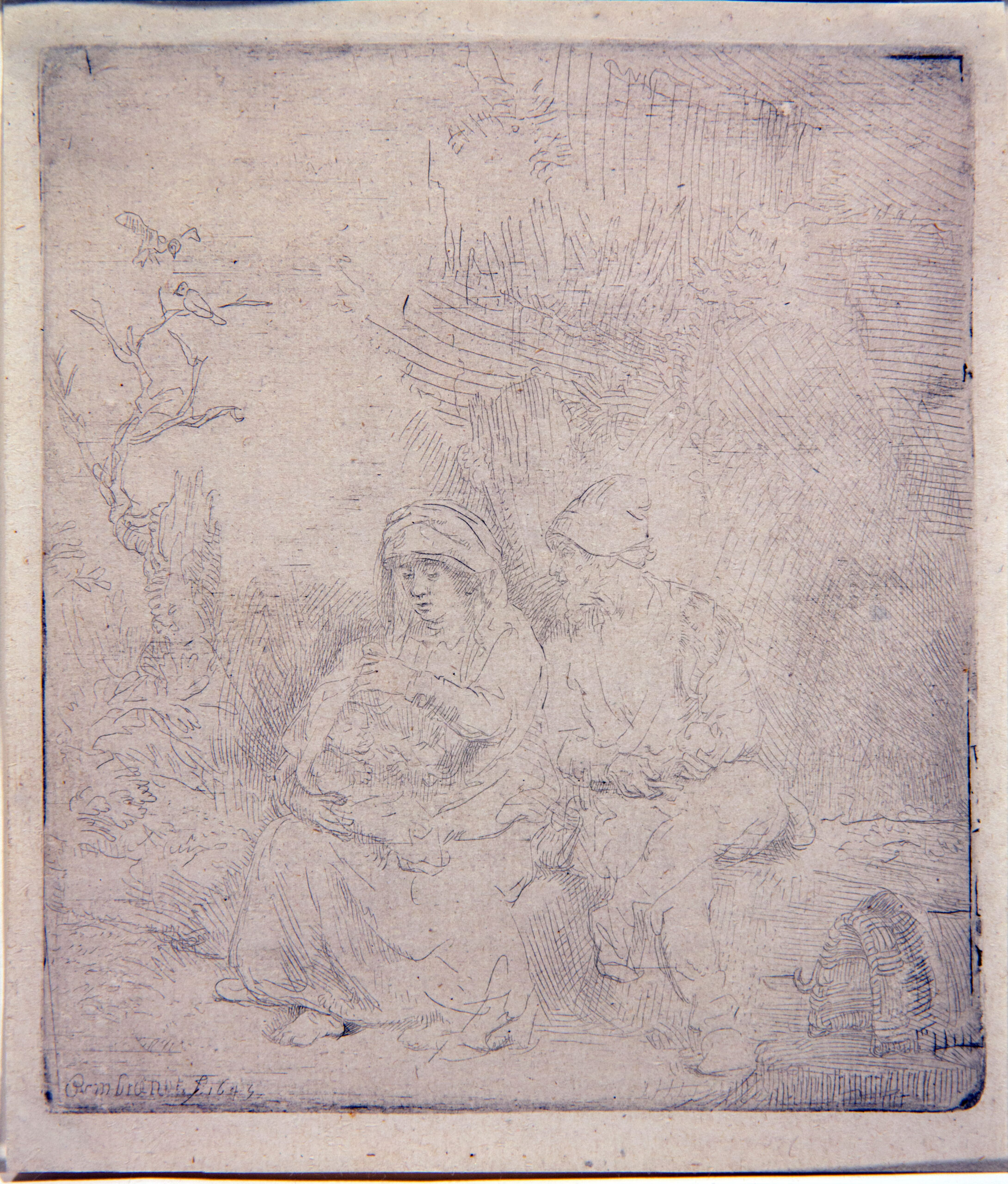
Repos pendant la fuite en Egypt, légèrement gravée
German title:
Die Ruhe auf der Flucht nach Ägypten, leicht geätzt
Dutch title:
De rust op de vlucht naar Egypte: licht geëtst
New Hollstein:
227
Rembrandt in Black & White:
44
Etching. Ca. 1645.
Size: 95 x 64 mm. Surface: 61 cm2.
Not signed, not dated. Date estimated to be ca. 1645. Hind and Biörklund stated 1648 and Münz 1646.
The copperplate was not part of any of the early auctions or collections and is probably not anymore in existence.
Rarity of impressions
In auctions (2000-2025): very rare Early: 10 ⦿⦿⦿⦿⊙⊙
In collections (New Hollstein 2013): very rare Early: 43 ⦿⦿⦿⦿⦿⊙
Catalogue Nowell-Usticke (1967): RRR-, a very rare, lightly etched plate ⦿⦿⦿⦿⦿⊙
Story
The flight into Egypt was one of Rembrandts favourite subjects of which he made a series of etchings over a rather long period, from 1629 till 1655 (Bartsch numbers 52 till 59). Most of these have a similar size. The story of the rest on the flight is not found in the Bible, but in the gospel of the pseudo-Matthew (chapters 20-21), which was later worked out in a 13th century book, The Legenda Aurea (the Golden Legends). It was a very popular subject of which many artists made paintings and/or engravings, including Rubens, Lucas Cranach, Maarten de Vos and Goltzius.
Picture
Rembrandt made three etchings of the ‘rest’ of which this light version is probably the most attractive. The knife that Josef is using can be seen hanging on his belt in the other versions. Just as in two other etchings dating from the same year (B 96 and B 147) the plate is very briefly bitten in the acid. The result is that the print shows the characteristics of a silverpoint drawing. Gary Schwarz (and many with him) considers it unlikely that this method is actually an error on the side of Rembrandt. He obviously intended to use a sophisticated technique to create a peaceful atmosphere in this picture. The donkey that carried Maria is not seen, but the saddle is, right under near Josef’s feet. Or is it another setting? Christopher White has noted that the scenery seems to be too peacefull for a family on the run. Could it be just a family outing in the garden? It would explain the absence of the donkey.
Inspiration
For this etching Rembrandt must have looked at an engraving by Lucas van Leyden (B 38, ca 1506) The difference is that van Leyden shows Joseph handing Mary a pear while Rembrandt makes Joseph peal one. Rembrandt may have copied this from another work by van Leyden, the Pilgrims (B 149).
Rembrandt may also have been inspired by a painting by Adam Elsheimer (1609, Alte Pinakothek in Munich), which in itself became well-known through an engraving by Hendrick Goudt (1613). A copy of the painting was in the collection of Herman de Neyt (Dordrecht 1642).
Related
In 1647 Rembrandt made a painting (Bredius 576, National Gallery in Dublin) showing the family resting near a lake, in a moonlit night, with shepherds tending a campfire.
Hind refers to a painting by Ferdinand Bol, signed and dated 1644 (now in Dresden?).
Copies
There is a copy in the same direction by Léopold Flameng, inscribed Rembrandt f. 1645 (in the catalogue of Blanc, 133 x 114 mm).
Attributions and reviews
According to Blanc this etching is not by Rembrandt.
States
The only state is already lightly bitten, later impressions quickly become even weaker. NH see a crack in the copperplate in the upper left corner. Early impressions may be with a greyish ink.
Watermarks
Basilisk (c. 1640-47); Foolscap with five-pointed collar (c. 1645); Strasbourg lily with WK’ (c. 1652); Double-headed eagle.
Literature
H 216, BB 45-E, G 58(1), M 218, Mz 219, RA 199, Cl 62, W 63, Bl 31, Du 63, CD 169, S 24. Rembrandt’s Women 2001, p. 186; Rembrandts Passie, p. 80; De grote Rembrandt p. 242; Hinterding 2008, p. 127-128; Verdi 2014, p. 38-61;
Rembrandt in Black & White: 44
New Hollstein/White-Boon: Only state
A very weak impression of the only state.
Sheet 143 x 122/ 123 mm, margins of 4 to 5 mm at three sides, 7 mm at the bottom (+16%).
Watermark: Foolscap with five-pointed collar, variant B.a.a or B.a.b, according to Hinterding dated 1645. Horizontal chain lines at approx. 21 mm.
Provenance
In the collection of Richard Dawnay, 10th Viscount of Downe (1903-1965, Wykeham Abbey, Scarborough, Lugt 719a), his collector’s mark vaguely visible in the lower left corner verso; His sale with Sotheby’s London 26 November 1970, lot 63 (£ 3.800) to C.G.Boerner.
In the collection of the Hungarian chemical engineer Lesley E. Lancy (Subotica 1911-1996 Pittsburgh, Lugt 4796), her collector’s mark in red ink in the lower right corner verso;
Exhibitions
Rembrandt in Zwart-Wit, Westfries Museum (Hoorn), Stedelijk Museum Zutphen, Het Hannemahuis (Harlingen), Jan ten Horne Museum (Weert), March 2013-March 2015;