B 61

The Virgin and Child in the clouds

  • French title:
    La Vierge and l’Enfant Jesus sur les nuages
  • German title:
    Maria mit dem Christkinde in Wolken
  • Dutch title:
    Maria met Kind in de wolken
  • New Hollstein:
    188
  • Rembrandt in Black & White:
    5

Etching. Ca. 1652.
Size: 112 x 68 mm. Surface: 76 cm2.
Not signed, not dated. Date estimated to be ca. 1652. There is no evidence for this date, but it fits the other prints from that period.

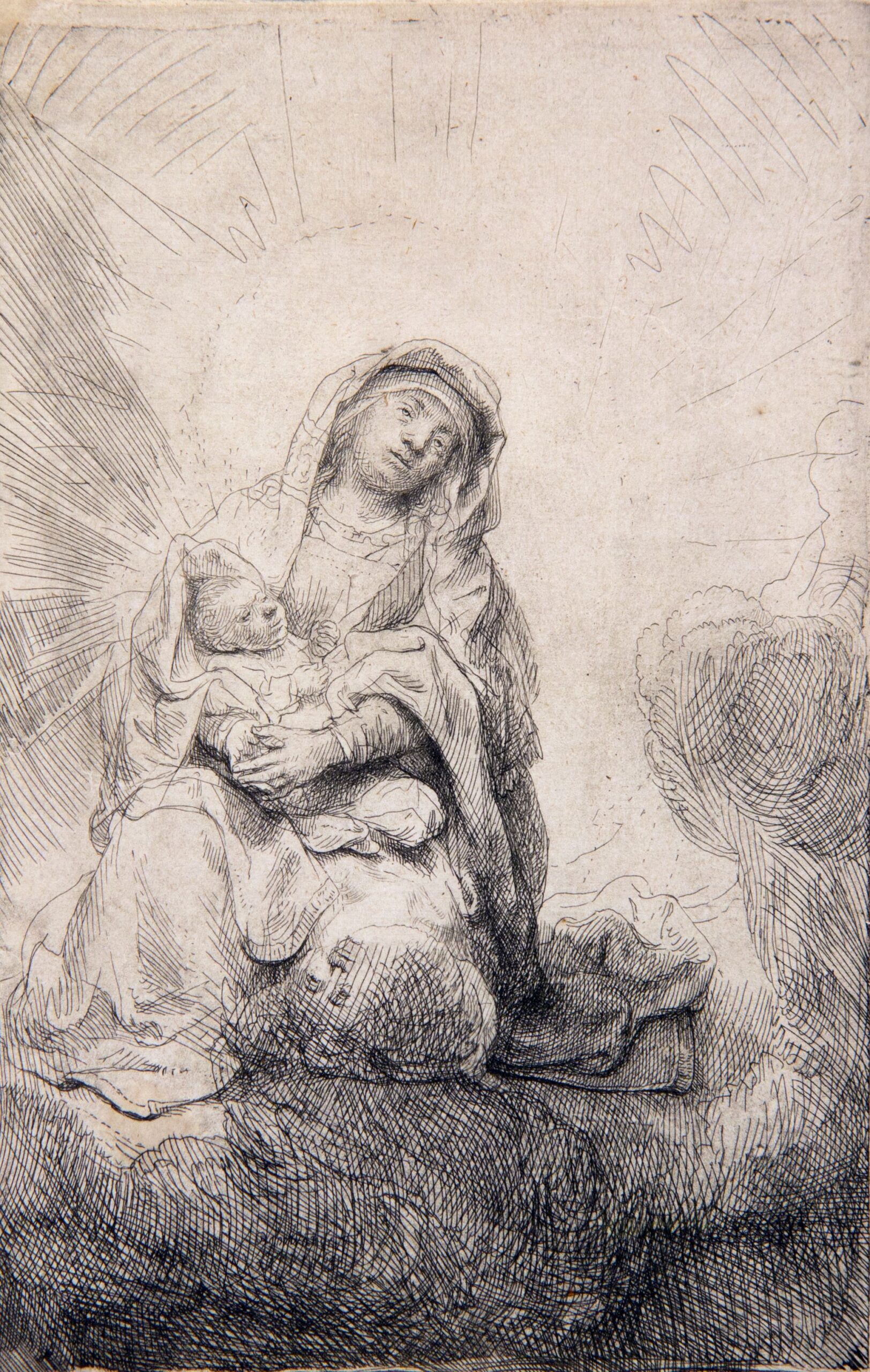
NH 188 – 1st state of II

Copper Plate

The copperplate was not part of any of the early auctions or collections and is probably not anymore in existence.


Rarity of impressions

  • In auctions (2000-2025): common                                          Early: 11     Late: 7                        ⦿⦿⦿⊙⊙⊙

  • In collections (New Hollstein 2013): common                       Early: 45     Late: 22                     ⦿⦿⦿⊙⊙⊙

  • Catalogue Nowell-Usticke (1967): C1+, a rather uncommon print                                          ⦿⦿⊙⊙⊙⊙


Subject/Sitter

The Virgin with her Child seem to be sitting on a cloud. Is it a referral to the Heaven or just another way of picturing her? There is no clear link to any text in the Bible, so we are unaware of the reason for this setting.  In itself it is remarkable that Rembrandt is picturing Maria here (and in many other works) because it is a typical roman-catholic subject, rarely seen in the Dutch reformist art of the 17th century.


Picture

Mary seems to be in a pensive mood, looking away from the Child. Her long mantle dropped on the floor (clouds?) on her left side. As if already aware of the problems her baby will be faced with in the future. The Child is resting in Her arms, His eyes halfway open, His hands fumbling.

Near the left knee of the Virgin a head (upside down) is clearly visible. It could be the remains of an earlier use of the same plate or, as van Regteren Altena suggested , the reflection of the face of Mary in the clouds. The most likely explanation, by Erik Hinterding, is based on the angle of the face: the artist was simply not happy with his first attempt. He turned the plate and started all over.


Inspiration

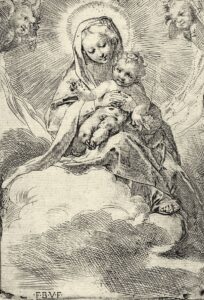
B&W 311Federico BarocciThe Virgin with the Child in the clouds – 1581

It is generally assumed that an etching made around 1581 by Federico Barocci (ca. 1528-1612) served as an example for this composition. Rembrandt was a great admirer of Barocci of whom he owned a book with prints, listed in his inventory in 1656. Not only the picture itself, also the execution shows similarities, like the folded hands of Mary and the cross-hatching in the clouds. The differences are as striking. Jesus is not an adolescent boy but a real baby. Mary is not looking downwards, admiring her Son, but upwards and away. An impression of this etching is included in the collection “Rembrandt in Black and White”, nr 311.
It may be that Rembrandt was also inspired by two more prints, one by Albrecht Durer, Madonna on the crescent moon, the title print of Life of the Virgin (Bartsch 76) and a print (H13) by Jan van de Velde II after Willem Buytenwech (Hinterding).


Attributions and reviews

The plate was made by a pupil according to Coppier.
The plate is not by Rembrandt according to Singer.


States

The New Hollstein lists two states, the second one not by Rembrandt and ‘new’ (two dots). Most other authors list one state. Nowell-Usticke lists two states, both contemporary.
In the 1st state (NH, WB, R203, NU) the intermediate prints show scratches upper left and on both sides of the face. There is burr on the sleeve of the right arm of the Child. In later impressions these scratches are very vague.
In the 2nd state (NH only) two dots are added in the upper right corner, not by Rembrandt.
In the 2nd state (NU only) the scratches are corrected. The impressions are weak.
The 2nd state of Hind, showing a second head upside down, is probably a fake.


Prints and collections

There is a counterproof in the British Museum. Another one was first in the Josefowitz Collection (Lausanne), sold in December 2025 at Christie’s London (lot 55, £ 26.000).


Watermarks

1st state: Arms of Amsterdam; Basilisk (c. 1640-47); Strasbourg lily with WK’ (c. 1652);
2nd state: Pro Patria; Seven Provinces.


Literature

H 186, BB 41-H, G 60, M 211, Mz 212, RA 203, Cl 65, W 65, Bl 32, Du 64, CD 142, S26/27.
Schmidt-Degener (1928) p. 12; Broos 1985, p. 70; Rembrandts etsen, p. 21-22; Rembrandt’s Women 2001, p. 173; De grote Rembrandt (2006), p. 31; Hinterding 2008, p. 130-131; Dat kan beter! 2013, p. 56-57;


Rembrandt in Black & White: 5

New Hollstein: 1st state of II/White-Boon: only state.
A very good, contemporary impression. The two dots in the upper right corner missing, confirming the 1st state.
Sheet 169/171 x 112 mm, margins of 2 mm at both sides, 1 mm at the bottom, cut at the platemark at the top (+7%).
Watermark: Crowned Strasbourg Lily with the letters ‘PR’ (Ash/Fletcher e.a.). Probably c. 1652. Vertical chain lines.


Provenance

In the collection of Charles Delanglade (b 1870, Marseille, Lugt 660), his name stamp in purple ink verso;


Exhibitions

The Rotunda at Exchange Square, Hong Kong, January 2008;
Rembrandt in Zwart-Wit, Westfries Museum (Hoorn), Het Markiezenhof (Bergen op Zoom), Stedelijk Museum Zutphen, Het Hannemahuis (Harlingen), Museum Gouda, Jan ten Horne Museum (Weert), Stadsmuseum Harderwijk, March 2013-August 2015; Stedelijk Museum Vianen, October 2017 – January 2018;
Rembrandt in Black & White, Schloß Britz (Berlin), Bozar Expo (Brussels), Chateau des Penthes (Geneva), November 2015- October 2016;
Rembrandt, fotograaf avant-la-lettre, Museum De Reede (Antwerp), January – May 2023;
Rembrandt, 17th century photographer, Daegu Art Museum (Korea), November 2023 – March 2024;
Rembrandt, de fotograaf, Westfries Museum (Hoorn), June 2024 – January 2025;