The copperplate was in the collection of Clement de Jonghe (1679, as 60 ontfangigh van de verloren soon). It later appeared in the sale of Pieter de Haan (1767, lot 22) and was sold via Fouquet to Claude-Henri Watelet (1718-1786). It then became part of the set of plates subsequently owned and used for printing Recueils by Pierre-François Basan (1723-1797), Henri-Louis Basan (his nr 1392), Auguste Jean (ca 1809), Veuve Jean, Auguste and Michel Bernard (1846), Alvin-Beaumont (1906) and Robert Lee Hunter (1937). It was sold at the Artemis sale in London (1993) and is now in the Rembrandthuis in Amsterdam.
Before the plate was in the hands of Rembrandt, it was used (in 1598 in Antwerp!) for an engraving by Ferdinand van Aertsz for a publication by Juan Alfonso de Molina Cano, Descubrimientos geometricos, in which the Spanish mathematician tried to solve the problem of squaring the circle. The plate came to Amsterdam around 1630 via the publisher Joannes Janssonius. Rembrandt then acquired and re-used it.
Rarity of impressions
In auctions (2000-2025): very frequent Mixed: 44 Late: 17 Unknown: 9 ⦿⊙⊙⊙⊙⊙
In collections (New Hollstein 2013): frequent Early: 76 Late: 6 ⦿⦿⊙⊙⊙⊙
Catalogue Nowell-Usticke (1967): C2-, a common plate ⦿⊙⊙⊙⊙⊙
Story
Luke 15, verses 11-32
This etching shows the moving episode of the younger of the two sons returning home after spending every penny of the legacy he had asked from his father. Yet, he is welcomed back home by his father.
Picture
The father is situated on the steps of his house and not far from it, as described in the Bible. Servants hasten to bring the shoes and cloth the father has called for. The older son can be seen from a distance, returning home from the fields.
Animal Farm
A flock of sheep is vaguely visible at the left side of the house. Probably a reference to the activities of the son before he came back to his father.
Inspiration
Rembrandt owned the complete engraved work of Maerten van Heemskerk (1498-1574). A woodcut by his hand with the same name, made around 1547 (New Hollstein 359) may have served as an example for this etching, since many elements of the composition and style are copied.
Related
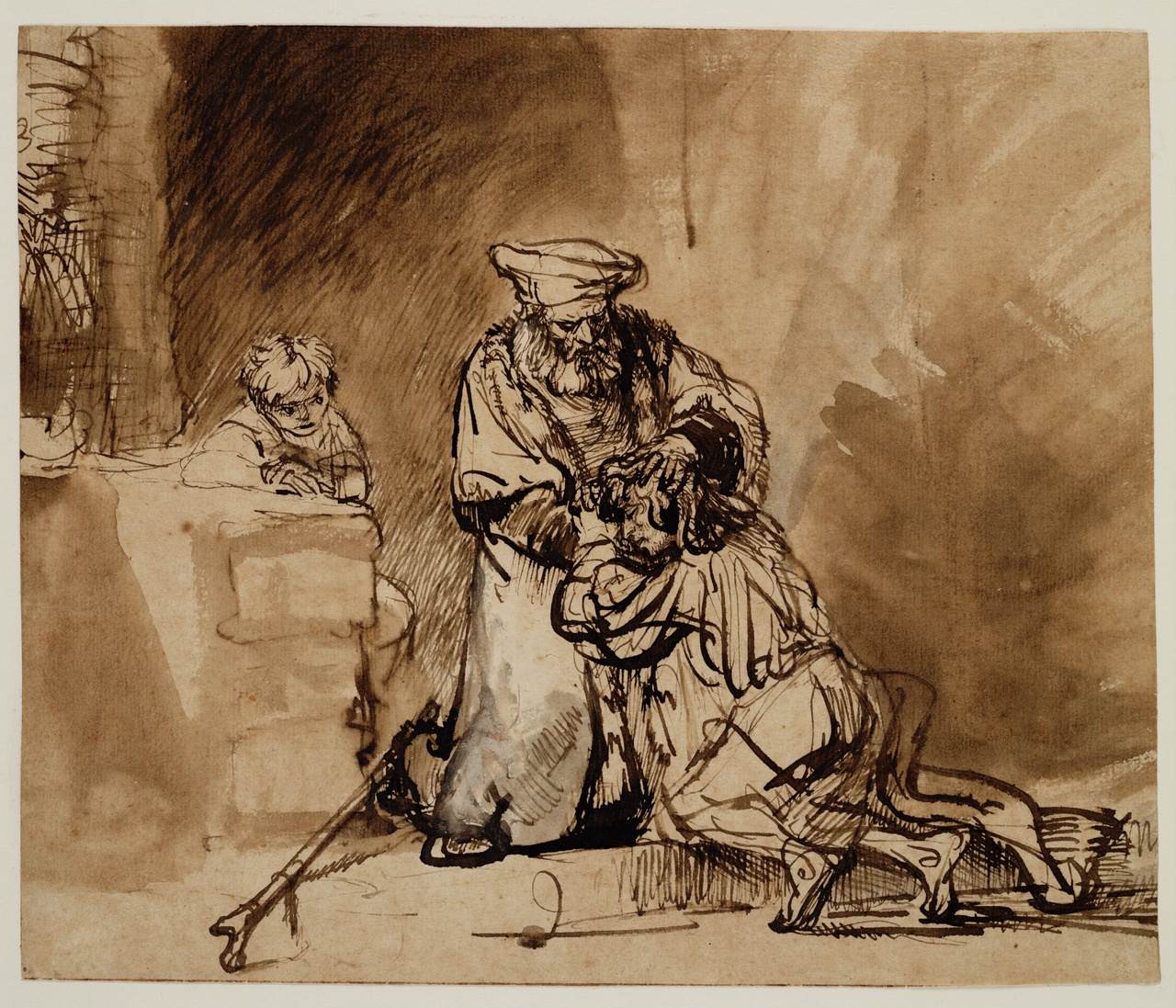
Rembrandt – Return of the prodigal son – ca 1642 – 190 x 227 mm – Teylers Museum – Benesch 519
Rembrandt – Samson threatens his father-in-law – 1635 – 159×131 cm – Gemäldegalerie Berlin – Corpus A109 -VI140 – Bredius 499
Rembrandt made a drawing of the same subject dated around 1641 (Benesch 519.
The concept of a figure looking out of a shuttered window can also be found in a painting of ca. 1635, Samsom threathening his father, now in the Gemäldegalerie in Berlin (Corpus A 109).
And finally, a year before his death, Rembrandt made a painting of this subject, now in the Hermitage (Bredius 598, Corpus VI 320).
Copies
New Hollstein lists three copies of which one anonymous copy (B) in the same direction (156 x 138 mm).
There are two copies in reverse. Copy A is published by Johann Georg Hertel and attributed by Middleton to Salomon Savery, signed Rembrandt f 1636 (the final 6 reversed, three states, 155 x 132 mm, WB 1). Copy C is anonymous, with mezzotint (162 x 138 mm, WB 2).
Attributions and reviews
The etching is considered as special by Coppier and Blanc.
The plate was made by a pupil according to Middleton and Seidlitz.
The plate is not by Rembrandt according to Singer.
States
The New Hollstein lists three states, only the 1st state by Rembrandt. Most other authors list one state only, Nowell-Usticke four states, from his 1st state there are later impressions by P.Basan, Basan, Jean, Bernard and Beaumont.
The 1st state (NH, WB final, R293, NU, P.Basan, Basan) is before the shading added in the 2nd state. In early impressions the lines in the triangular space below the prodigal’s shin are still well visible, in later impressions only faint traces are left.
In the 2nd state (NH, NU, Jean, Bernard) shading is added on the tile of the lower steps, far left. Many lines are added to the front of the steps. The toe of the boot at the extreme right is cut off.
In the 3rd state (NH, NU Bernard) a dark spot of retouching appears in the corner of the wall to the right of the father’s right hand. Similar smaller spots are elsewhere. The shading on the step at left is very weak.
In the 4th state (NU only, Beaumont) there is some retouching of the weak spots of shading on the arch at the top left. The horizontal lines of shading on the step at the left are sharp and clear.
Prints and collections
In good, early impressions of the 1st state the landscape at the left is clearly visible.
There are counterproofs in the Rijksmuseum, the Fitzwilliams Museum (Cambridge) and the British Museum.
Recueils
The etching appears in the Recueil de Basan, impressions fairly strong (NU). B&W 54 – Recueil de Basan – Page 8 NH: 1st state of III/WB: only state The landscape at left barely visible, some wear in the shadows to the right of the boy’s nose and right of the father’s sleeve.
B&W 206 – Recueil de Beaumont – Sheet 23 NH: 3rd and final state/WB: only state Still a pretty good impression.
Watermarks
In the 1st state: Basel crosier; Countermark B; Foolscap with seven-pointed collar (2 ed.); Paschal lamb (1651); Strasbourg lily and various late ones.
Literature
H 147, BB 36-D, G 70, M 201, Mz 207, RA 293, Cl 95, W 96, Bl 43, Du 76, CD 105 Van Gelder 1947, p.25; Broos 1985, p. 40; Tümpel 2006, p. 68; Hinterding 2008, p. 201-202; Rohde 2006, p. 27; Dat kan beter! 2013, p. 46-47; Verdi 2014, p. 204-207;
Rembrandt in Black & White: 105
New Hollstein: 1st state of III/White-Boon: only state
A good impression, with the outlines of the landscape at left well visible, indicating an early impression. The steps are without the additional lines of the 2nd state (NH).
Residue of glue is visible along the top and the right side recto. A residue of gold paint in the right margin approx. 20 mm from the bottom. Several fox marks.
Sheet 159 x 127/128 mm, thread margins of 1 to 2 mm at top and bottom, at the platemark at right and approx. 8 mm within the platemark at the left side (-4%). Remargined.
No watermark, vertical chain lines at approx. 22 mm.
Provenance
In the collection of Ch.Jacquin (1817-1854, Paris, Lugt 1397a) his name stamped in black ink in the lower right corner verso.
It was probably sold at the posthumous sale of the collection with Rousseau and Diflée in Paris in June 1939.
Exhibitions
Rembrandt in Zwart-Wit, Westfries Museum (Hoorn), Het Markiezenhof (Bergen op Zoom), Stedelijk Museum Zutphen, Het Hannemahuis (Harlingen), Museum Gouda, Jan ten Horne Museum (Weert), March 2013-March 2015; Rembrandt, fotograaf avant-la-lettre, Museum De Reede (Antwerp), January – May 2023; Rembrandt, 17th century photographer, Daegu Art Museum (Korea), November 2023 – March 2024; Rembrandt, de fotograaf, Westfries Museum (Hoorn), June 2024 – January 2025; Thuis, Rembrandthuis (Amsterdam), September 2025-January 2026;