B 99

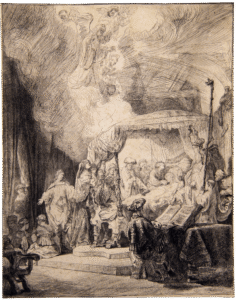
The death of the Virgin

  • French title:
    La mort de la Vierge
  • German title:
    Der Tod der Jungfrau
  • Dutch title:
    Het sterfbed van Maria
  • New Hollstein:
    173
  • Rembrandt in Black & White:
    13

Etching and drypoint. 1639.
Size: 409 x 315 mm. Surface: 1288 cm2.
Signed and dated, in the lower left corner: Rembrandt f. 1639

NH 173 – 2nd state of V

Copper Plate

The copperplate was in the sale by Pieter de Haan (1767, lot 34) and was sold via Fouquet to Claude-Henri Watelet (1718-1786). It then became part of the set of plates subsequently owned and used for printing Recueils by Pierre-François Basan (1723-1797), Henri-Louis Basan (his nr 1403), Auguste Jean (ca 1809), Veuve Jean and Auguste Bernard (1846). There are impressions in the first versions of Bernard’s publications, but it is replaced in later versions by a copy (in reverse). So, the plate was probably lost around that time and is not in existence anymore.


Rarity of impressions

  • In auctions (2000-2025): very frequent                                                 Early: 1      Mixed: 16      Late: 70            ⦿⊙⊙⊙⊙⊙

  • In collections (New Hollstein 2013): very frequent                             Early: 11     Mixed: 44     Late: 48                ⦿⊙⊙⊙⊙⊙

  • Catalogue Nowell-Usticke (1967): C2-, a common large plate, fine early impressions rare                      ⦿⊙⊙⊙⊙⊙


Description

NH 173 – B 99 – The Death of the Virgin – in reverse


This is one of the largest etchings and also one of the first in which Rembrandt makes extensive use of the drypoint. As a consequence, later impressions rapidly deteriorate in quality.
In itself it is surprising that Rembrandt made such a large print of a typical Catholic subject given the fact that Protestantism was the dominating religion in Amsterdam at the time.
Because of the complexity of the composition, the print is better ‘readable’ if seen in reverse, the way Rembrandt made the original etching on the plate. This is due to the fact that western people are normally ‘reading’ from left to right


Subject/Sitter

The death of Maria is not described in the New Testament. As in many other works, Rembrandt is inspired by the apocryphal books, as they are reflected later in the 13th century Legenda Aurea. It states how an angel announced to Mary that her death was near, upon which the disciples were called to Mount Sion to be present in her final hours. They are all displayed by Rembrandt in this print.


Picture

The lower part of the scene is clearly an ‘earthly’ part, with a sick woman, surrounded by friends and a priest. The upper part is the ‘heavenly’ one. With angels floating in the clouds, waiting for Mary to join them. A theme often seen in Italian and Flemish altarpieces.


Inspiration

B&W 393 – Albrecht DürerThe death of the Virgin

Rembrandt was probably inspired by two woodcuts by Albrecht Dürer (1471-1528) published in 1511, The Birth of the Virgin (B 80) and The Death of the Virgin (B 81, Meder 205). The latter print is included in the collection ‘Rembrandt in B&W’, number 393. A year before he made his own version, Rembrandt had acquired a set of the Dürer prints
According to Tümpel the doctor feeling Maria’s pulse is based on examples of ‘regular’ deathbeds.
Brom pointed at the relation to a painted window in the Oude Kerk in Amsterdam and a preliminary drawing for it, attributed to Dirck Crabeth, in which the man sitting at the desk is visible.


Related
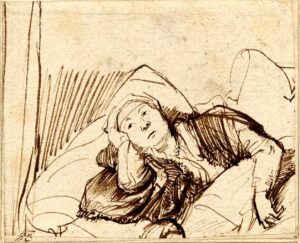
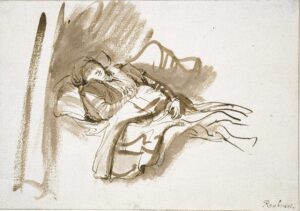
RembrandtStudy of Saskia, ill in Bed – 1635 – British Museum – Benesch 286
Rembrandt – Saskia asleep in bed – ca. 1635 – Ashmolean Museum – Benesch 281a

Rembrandt made several drawings in this period showing sick women in bed, possibly inspired by the sickness of Saskia, who gave birth to a daughter in 1638 (Benesch 404 in the Rijksmuseum, Benesch 281a in the Ashmolean in Oxford and Benesch 286 in the British Museum).
The composition also shows similarities with a later (1640-41) drawing The Death of Jacob, now in the Museum of Fine Arts in Montreal (Benesch 493).


Copies

The New Hollstein lists ten copies, all in reverse. Copy A is by Willem Drost, the physician only (70 x 54 mm). Copy B is by Melchior Küsel, numbered 39 and titled The Death of Jacob (94 x 41 mm). Copy C is by Thomas Worlidge, inscribed Rembrandt 1639. It is erroneously listed as ‘in the same direction’ in NH (392 x 312 mm, WB 1). Copy D, of the bed only, is by Richard Byron signed R.Byron 1777 (185 x 235 mm, WB 3). Copy E is by Dominique Vivant Denon inscribed Rembrandt f. 1639, included in his album in 1873 (450 x 343 mm, WB 2). Copy F is signed by Franz Anton Maulpertsch (423 x 327 mm, WB 4). Copy G is an anonymous copy of the bed and bystanders only (84 x 127 mm). Copy H is signed by John Burnett (113 x 121 mm). Copy I is an anonymous copy of the bed only (142 x 112 mm, not traced by NH, WB 5). Copy J is a wood engraving of bed only, by Bouquet, published by Rittner and Groupil (149 x 161 mm).


Attributions and reviews

This etching is considered as special by Bartsch, Seidlitz, Coppier, Wilson, Blanc and Singer.


States

The New Hollstein lists five states, the first two by Rembrandt. Most other authors list three states, Hind and Biörklund four. Nowell-Usticke lists five states, from his 4th state there are later impressions by Watelet, P.Basan, H.Basan, Jean and Bernard.
In the 1st state (NH, WB, R309-311, NU) the arm of the chair on the right side is lightly shaded and there are scratches in the margin lower right. Early impressions are clear, later ones somewhat light.
In the 2nd state (ND, WB, R310, NU) the arm of the chair is heavily shaded.
In the 3rd state (NH, WB final, R312, NU) the scratches are gone. Light vertical shading is added to the left round knob of the foremost bedpost (WB). The shading above the table on the left is strengthened with left-right diagonals (NU). Since a rocker was used for these ‘repairs’ Hinterding is convinced that this state is not by Rembrandt anymore.
The 4th state (NH, NU Watelet, P.Basan, H.Basan) is a retouch by Watelet. New, fine shading makes the composition stronger. Vertical shading is added to the pillars of the bed (foremost bedpost near the right of the man leaning on the bed) and elsewhere. Later impressions are by P. and H. Basan.
In the 5th state (NH, NU Jean, Bernard) the plate is reworked completely. There are heavy horizontal and diagonal lines of shading above the table left.
There are variations in the timing of the shading to the bedpost.
According to NU (4th state) this was part of the rework by Watelet, WB (3rd state) considers it contemporary work.


Prints and collections

Of the 1st state twelve impressions are known.
Of the 2nd state there are counterproofs in the British Museum and in the Bibliothèque Nationale.
Of the 4th state there are impressions on Japanese Paper (Rijksmuseum and the British Museum) and in red ink (Albertina).
At least eight editions of the 3rd state are known, probably all posthumous, some printed around 1700, some around 1777.


Recueils

The etching appears in the earlier editions of the Recueil de Basan, impressions fairly good (NU).

B&W 54 – Recueil de Basan – Page 40                   NH: 4th state of V/WB: 2nd and final state.
A good impression, printed on two pages.

B&W 206 – Recueil de Beaumont –  Not included


Watermarks

In the 1st state: Strasbourg lily (1639).
In the 2nd state: Strasbourg lily (4 ed. 1633-41); Strasbourg bend (2 ed. 1646 and 1653); Crown with a cross.
In the 3rd state: HIS. In the 4th state: Fleur-de-Lys; Grapes (5 ed.); Strasbourg bend (3 ed.); Strasbourg lily; Words (2 ed.).


Literature

H 161, BB 39-A, G 97, M 207, Mz 208, RA 309-312, Cl 102, W 104, Bl 70, Du 102, CD 121, S 51
Fuchs 1968, p. 55; Tümpel 1970, p. 127; G.Brom, De traditie in Rembrandt’s Dood van Maria, (Oud-Holland, 1926); Broos 1985, p. 48; Rembrandt’s Women 2001, p. 165; Hinterding 2006, p. 101-102; Hinterding 2008, p. 214ff; Dat kan beter! 2013, p. 36-37; Verdi 2014, p. 177-180;


Rembrandt in Black & White: 13

New Hollstein: 2nd state of V/White-Boon: 2nd state of III
A very good, contemporary impression, with burr. A repaired tear of approx. 4 cm in the upper left corner, slight discolorations and some dirt on the sides.
Sheet: broad margins on all sides (5 to 8 mm).


Provenance

In the collection of the English lawyer Arthur Melville Champernowne (1871-1946, Dartington Hall, Lugt 153). It was sold at Sotheby’s London on 1 February 1911, lot 89.


Exhibitions

The Rotunda at Exchange Square, Hong Kong, January 2008;
Rembrandt in Zwart-Wit, Westfries Museum (Hoorn), Het Markiezenhof (Bergen op Zoom), Stedelijk Museum Zutphen, Het Hannemahuis (Harlingen), Jan ten Horne Museum (Weert), Stadsmuseum Harderwijk, March 2013-August 2015; Stedelijk Museum Vianen, October 2017 – January 2018;
Rembrandt in Black & White, Schloß Britz (Berlin), Bozar Expo (Brussels), Chateau des Penthes (Geneva), November 2015- October 2016;
Rembrandt, fotograaf avant-la-lettre, Museum De Reede (Antwerp), January – May 2023;
Rembrandt, 17th century photographer, Daegu Art Museum (Korea), November 2023 – March 2024;
Rembrandt, de fotograaf, Westfries Museum (Hoorn), June 2024 – January 2025;