B 110

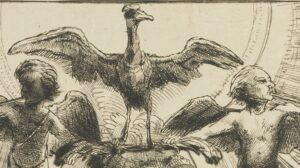
The Phoenix or The statue overthrown

  • French title:
    Le tombeau allegorique
  • German title:
    Allegorie, der Phoenix genannt
  • Dutch title:
    De Phoenix of Het omvergeworpen standbeeld
  • New Hollstein:
    303
  • Rembrandt in Black & White:
    Not included

Etching and drypoint. 1658.
Size: 179 x 183 mm. Surface: 328 cm2.
Signed and dated, in the lower right corner: Rembrandt. f. 1658

NH 303 – Only state

Copper Plate

The plate was not part of any of the major collections and is probably not in existence.


Rarity of impressions

  • In auctions (2000-2025): not seen in auctions

  • In collections (New Hollstein-  2013): extremely rare         Early: 22                                       ⦿⦿⦿⦿⦿⦿

  • Catalogue Nowell-Usticke (1967): RRRR+, one of the greatest and most sought after rarities.   ⦿⦿⦿⦿⦿⦿


Description

There are many explanations of the meaning of this work, ranging from a referral to Rembrandt’s resurgence from his bankruptcy to Hind’s suggestion that it represents the victory of the Staten Generaal of the Unites Provinces over Spain.
The overthrown statue represents ‘envy’.


Animal Farm


In Greek mythology the Phoenix was a bird, a heron, that was able to be reborn out of his own ashes, again and again. It would build a nest in a tree full of herbs and then burn in it.  The scent of the herbs would cause the bird to be reborn. In the Chinese culture the bird is a symbol of the female gender.


Inspiration

According to Veth, a painting by Tommaso Lauretti Triumph of Faith on the ceiling of the Sala di Constantion in the Vatican has inspired Rembrandt for the composition of this etching.
Münz thinks that the man lying on his back is copied from The miracle of St.Ignatius of Loyola, an engraving by Marinus van der Goes after a design by Rubens (1577-1640).


States

All authors list one state only.


Prints and collections

Seven of the twenty-two known impressions (NH) are on Japanese paper.


Watermarks

Strasbourg lily (2 ed.); IHS.


Literature

H 295, BB 58-A, G 111, M 296, Mz 279, RA 333, Cl 112, W 114, Bl 80, Du 111, CD 252
De ‘joodse’ Rembrandt 2006, p. 18-19; Hinterding 2008, p. 233-234;


Rembrandt in Black & White: Not included