B 111

The Ship of Fortune

  • French title:
    La Fortune contraire
  • German title:
    Das Lob der Schiffahrt
  • Dutch title:
    Het scheepje van fortuin
  • New Hollstein:
    123
  • Rembrandt in Black & White:
    8

Etching. 1633.
Size: 113 x 184, in the 2nd state 166 mm. Surface: 208 cm2, in the 2nd state 188 cm2.
Signed and dated, on the bow of the boat just under Minerva: Rembrandt. f. 1633

NH 123 – 2nd state of II

Copper Plate

The plate was not part of any of the early sales or collections and is almost certainly not in existence.


Rarity of impressions

  • In auctions (2000-2025): common                                                  Early: 16                                        ⦿⦿⦿⊙⊙⊙

  • In collections (New Hollstein – 2013): frequent                    Early: 69                                       ⦿⦿⊙⊙⊙⊙

  • Catalogue Nowell-Usticke (1967): R, scarce. Usually a book illustration                               ⦿⦿⦿⊙⊙⊙


Description

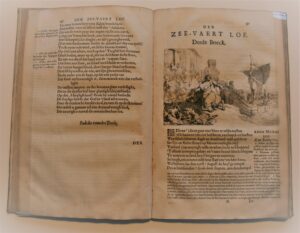
This etching is used as illustration in a book by Elias Herckmans (1596-1644), Der Zee-vaert Lof, published by Jacob Pieterszn. Wachter in Amsterdam in 1634. This book is included in the collection Rembrandt in Black & White (number 58).


Subject/Sitter

Many scholars have expressed their opinion on what is represented in the picture. Even more difficult to determine is the meaning of it.
Chapter III of the book, of which this plate is the prefix, deals with the Roman Empire, starting in 27 BC with the reign of August and ending with the conquest of Constantinople in 1453. It could be, as often suggested, that the horseman is Mark Anthony defeated in the battle of Actium (31 BC) by August. It could also be an allegory of the Roman Empire. In that case both beginning and end of the Empire is shown, in line with the book. The prominent presence of a statute of Janus and the closing of the doors of his Temple, is a sign of peace being restored. The naked woman is probably Fortuna, the goddess of fortune and misfortune. She is often shown nude, in the presence of boats, full blown sails and a globe. The man on the wheel is probably Neptune.

It is possible that Rembrandt referred to both the historical context as well as to the contemporary peace-negotiations between the Spanish and Dutch. They were resumed after the battle near Slaak on 13 September 1631. If successful, it would certainly help the traders in the Dutch Republic.
Another interpretation is that the horsemen is in fact St.Paul, in his military costume. Although Paul is mentioned in the book, there are many reasons to reject this hypothesis. Like the fact that the same chapter contains an engraving by Willem Base of the shipwreck in which Paul is involved.


Title

The present title was introduced by Amadé de Burgy in 1755. Earlier titles were d’Eneas (by Valerie Röver 1735) and La Fortune Contraire (by Gersaint 1751).


Related

Van de Grind points at the figure of Bellona (left of the Janus-statue, in harness), also represented in the painting Bellona, now in the Metropolitan Museum in New York, made in the same period.


Copies

There are two copies in reverse. Copy A is anonymous, signed Rembrandt f (100 x 151 mm, WB 2). Copy B is  inscribed F. Novelli inc, Rembrandt inv (his nr 15, two states, 134 x 186 mm, WB 1).


Attributions and reviews

The etching is considered as special by Blanc.
The plate was made by a pupil according to Middleton.
The plate is not by Rembrandt according to Singer.


States

The New Hollstein, as most other authors, lists two states, both contemporary. Nowell-Usticke lists one state and considers the only impression known of the 1st state to be a trial print.
In the 1st state (NH, WB, R334/Trial proof A NU), a thin horizontal line runs from the right side of the building over the top of the statue of Janus, through the mast and flag.
In the 2nd state (NH, WB, R335/1st state NU) the plate is cut on both sides, about 12 mm on the left and 6 mm on the right side. There are several changes (NH) of which the added vertical shading on the back of Fortuna is best visible. In early impressions, like those in the books, the thin line is well visible, it later faints away. According to Nowell-Usticke the line can easily be erased by gentle rubbing. The signature becomes faint, the date remains well visible. In early impressions some sulphur tint is still visible, but the horizontal stripes are almost invisible. On the backside of early and intermediate impressions there is text from the book.


Prints and collections

B 111 – NH 123  The Ship of Fortune – CounterproofCollection Black&White – nr 226

Of the 1st state only one impression is known, in the Bibliothèque Nationale.
Of the 2nd state there is one impression on vellum and one on Japanese paper in the Rijksmuseum.
There are counterproofs in the Bibliothèque Nationale and in this collection ‘Rembrandt in Black & White”, number 226.


Watermarks

Many single impressions are on paper with the Cross of Lorraine watermark, which is not used by Rembrandt. These may have been printed by the publisher of the book. The impressions in the books are on the same paper as the book.
In the 1st state: Double-headed eagle (1632-34);
In the 2nd state: Cross of Lorraine (c 1633, not used by Rembrandt); Foolscap with five-pointed collar with cm PD (c. 1648), Foolscap; Strasbourg lily; Countermark;


Literature

H 106, BB 33-E, G 123, M 262, Mz 256, RA 334-335, Cl 113, W 115, Bl 81, Du 112, CD 71
I.D.M.Cornelissen, ‘Two allegorical etchings by Rembrandt: ‘The ship of Fortune’ in Oud-Holland LVIII, 1941, p. 111; Hinterding 2008, p. 235ff; A.vd Grind in Kroniek 2016, p. 40-49; Rutgers/Standring 2018, p. 46;


Rembrandt in Black & White: 8

New Hollstein, White-Boon: 2nd and final state
A very good, early impression. The thin line running through mast and flag is still visible. A small tear in the middle of the right margin, a small hole in the sky left of Fortuna, adhesive residue in the corners.
Sheet 119/120 x 175 mm, narrow margins of 4 mm all around (+12%).
No watermark, horizontal chain lines.


Exhibitions

The Rotunda at Exchange Square, Hong Kong, January 2008
Rembrandt in Zwart-Wit, Westfries Museum (Hoorn), Het Markiezenhof (Bergen op Zoom), Stedelijk Museum Zutphen, Het Hannemahuis (Harlingen), Museum Gouda, Jan ten Horne Museum (Weert), Stadsmuseum Harderwijk, March 2013-August 2015; Stedelijk Museum Vianen, October 2017 – January 2018;
Rembrandt in Black & White, Schloß Britz (Berlin), Bozar Expo (Brussels), Chateau des Penthes (Geneva), November 2015-September 2016;