
B 114

The large lion hunt

  • French title:
    Grande chasse aux lions
  • German title:
    Die grosse Löwen Jagd
  • Dutch title:
    De grote leeuwenjacht
  • New Hollstein:
    187
  • Rembrandt in Black & White:
    34

Etching and drypoint. 1641.
Size: 224 x 300 mm. Surface: 672 cm2.
Signed (in drypoint) and dated in the upper right corner: Rembrandt f. 1641.

NH 187 – 2nd state of II

Copper Plate

The plate was not part of any of the major collections and is probably not anymore in existence.


Rarity of impressions

  • In auctions (2000-2025): very rare                                         Early: 5                                         ⦿⦿⦿⦿⦿⊙

  • In collections (New Hollstein – 2013): very rare                  Early: 42                                        ⦿⦿⦿⦿⦿⊙

  • Catalogue Nowell-Usticke (1967): RRR-, a very rare sketch print                                           ⦿⦿⦿⦿⦿⊙


Subject/Sitter

Hunting scenes were very popular in the 16th century, well-known through the prints by Philips Galle and Adriaan Collaert.


Picture

This etching seems to be unfinished. Some sort of a sketch. However, the fact that Rembrandt put his signature and date on it indicates that he considered the work as finished. He may have assumed that there was a market for these infinito’s.


Animal Farm

RembrandtYoung lion resting – ca 1642 – 1024 x 781 mm

Rembrandt made the three lion-hunt etchings (B114-B115 and B116) when still in Leyden. He had probably not seen any real lions at that time. After moving to Amsterdam he made at least seven drawings of lions in 1642 and in 1648-50. Compared with the etchings, the drawings are more natural and authentic. Not surprisingly. By that time Rembrandt must have been able to see them alive. Several of these wild animals were imported by VOC-ships and shown to the public.

One of the drawings was in the Leyden collection of Thomas Kaplan. It was auctioned at Sotheby’s New York on 4 February 2026 and sold for ca. $ 18 mill.

Lions are also visible in five etchings, in combination with Saint Jerome. With the same ‘steps in maturity’. In three early works (B100, B101 and B102, 1632-1635) they are hardly recognizable as lions, in the two later ones (B 103 and 104, 1648 and 1653) they resemble the lions in the drawings.


Inspiration
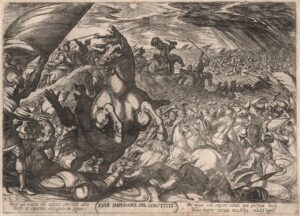
B&W 344 – Antonio TempestaHorse battle scene


As is the case for two other etchings of this subject (B 115 and 116) the composition is almost certainly based on a series of engravings by Antonio Tempesta (1555-1630). The inventory-list of 1656, drawn up as part of the bankrptcy proceeding, proves that Rembrandt had four albums with works by Tempesta in his possession.


Related

The inventory list of 1656 includes a painting by Rembrandt of a lion hunt. Unfortunately, this painting is now lost.
According to Ger Luijten, Rembrandt’s loose style was inspired by sketches in oil made by Peter Paul Rubens, like one in the Alte Pinakothek.


States

All authors list two states, both contemporary.
In the 1st state (R342) there is not yet any shading on the head of the horse upper right. In early impressions sulphur tint is still visible. The corners are square.
In the 2nd state (R344) the shading is present. There are later impressions on ‘modern’ paper.


Prints and collections

Of the 1st state only four impressions are known: in the Fitzwilliam Museum (Cambridge, Boon 104), the Bibliothèque Nationale, the Dutuit Collection (Paris, R342) and in the Biblioteca Nacional in Madrid.
There are impressions of the 2nd state on Japanese paper. Hinterding identified at least four editions of the 2nd state (1641, 1647, 1652 and 1665).


Watermarks

In the 1st and 2nd state: Basilisk (ca 1640-47).
In the 2nd state: Cross of Lorraine (1647); Strasbourg lily (1652); Arms of Amsterdam.


Literature

H 181, BB 41-D, G 113, M 272, Mz 262, RA 342-344, Cl 116, W 118, Bl 86, Du 115, CD 147
N.Beets, ‘Herscheppingen’ in the Feestbundel Bredius, 1915, p. 1-7; Broos 1985, p. 68; Hinterding 2008, p. 242-243; Dat kan beter! 2013, p. 54-55;


Rembrandt in Black & White: 34

New Hollstein/White-Boon: 2nd and final state.
A very good, early impression with burr near the fallen horseman, on the hat of the riding bowman and elsewhere.
Sheet 224/227 x 300/299 mm, thread margins of 1 to 2 mm, cut at the platemark at some places (+1%).
Watermark: Part of a Cross of Lorraine (cf A&F p. 83), dated 1647 (Hinterding 2006, II p. 282). Vertical chain lines at approx. 25 mm.


Provenance

In the collection of G.A.H. Buisman Jzn.


Exhibitions

The Rotunda at Exchange Square, Hong Kong, January 2008;
Rembrandt in Zwart-Wit, Het Markiezenhof (Bergen op Zoom), Stedelijk Museum Zutphen, Het Hannemahuis (Harlingen), Museum Gouda, Jan ten Horne Museum (Weert), Stadsmuseum Harderwijk, August 2013-August 2015; Stedelijk Museum Vianen, October 2017 – January 2018;
Rembrandt in Black & White, Chateau des Penthes (Geneva), June – October 2016