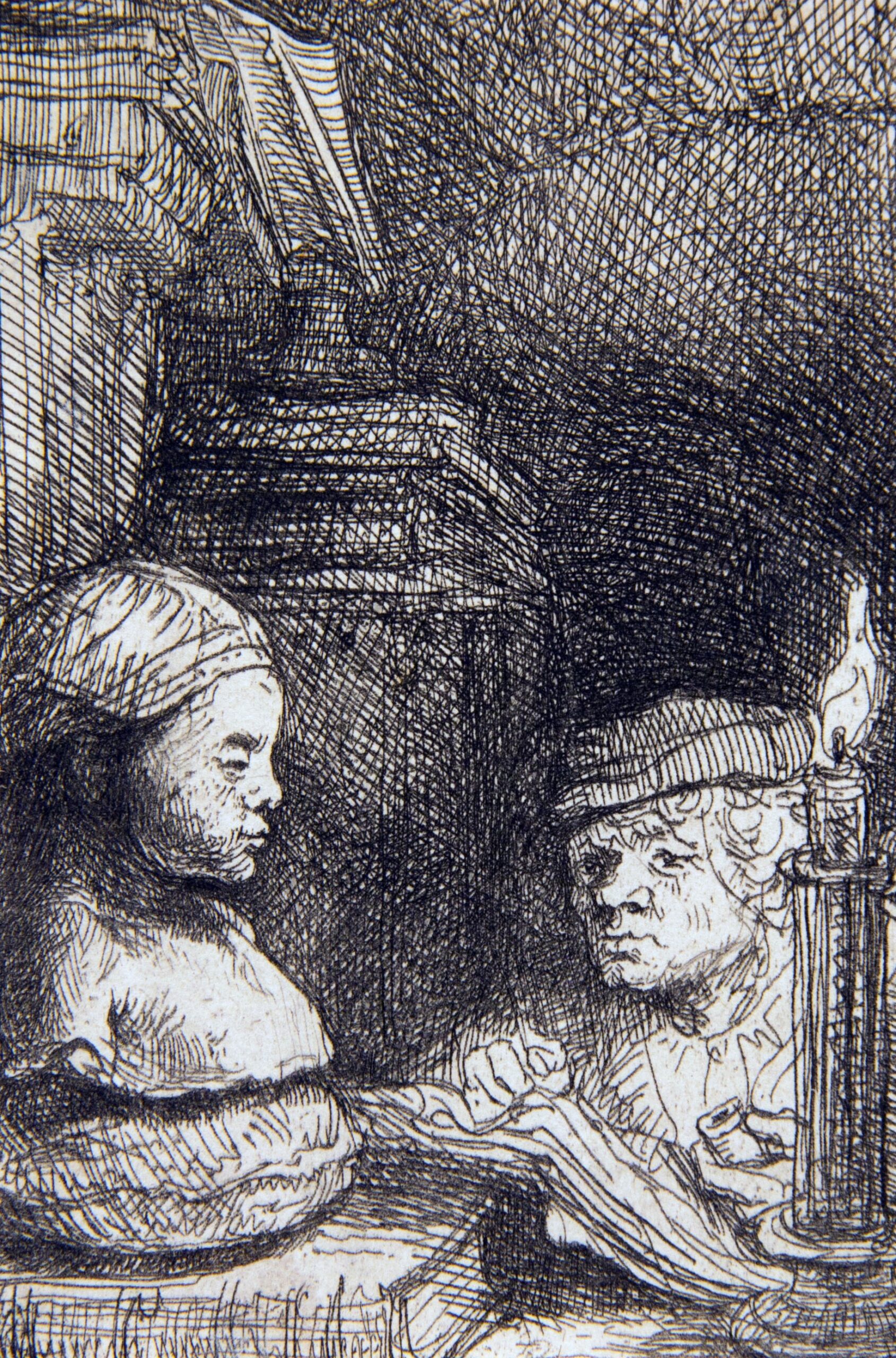
The copperplate was in the sale by Clement de Jonghe (1679,as 11 pleysterhooft met een jongetjen). It later appeared in the sale by Pieter de Haan (1767, lot 41 together with B133) and was sold via Fouquet to Claude-Henri Watelet (1718-1786). It then became part of the set of plates subsequently owned and used for printing Recueils by Pierre-François Basan (1723-1797), Henri-Louis Basan (his nr 1415), Auguste Jean (ca 1809), Veuve Jean, Auguste and Michel Bernard (1846), Alvin-Beaumont (1906) and Robert Lee Humber (1937). It was sold at the Artemis sale in London (1993) and is now in the George and Ilona Kremer Collection (Wassenaar, the Netherlands).
Rarity of impressions
In auctions (2000-2025): very frequent Early: 15 Late: 22 Unknown: 14 ⦿⊙⊙⊙⊙⊙
In collections (New Hollstein – 2013): frequent Early: 43 Late: 32 ⦿⦿⊙⊙⊙⊙
Catalogue Nowell-Usticke (1967): C1: Fairly common ⦿⦿⊙⊙⊙⊙
Subject/Sitter
The scene pictured here is an important moment in the training of artists, when they switch from copying two-dimensional examples to three-dimensional ones. First using fixed objects like this bust, then life models. This, combined with the darkness suggesting evening or night, may be the reason that some authors think that Rembrandt expresses his admiration for students, constantly practising their art, even late at night or in the early morning (hence the candlelight).
Related
This scene of an apprentice, seated at a table, drawing a bust is also visible in B 192. Several other Dutch artists have painted a similar scene (Jan Steen, Vaillant).
Münz thinks the same model is used in B 136 (The Cardplayer) and in B 261 (Man at desk) and the same bust in an etching by a pupil of Rembrandt (his nr 339).
Copies
New Hollstein lists three copies in reverse. Copy A is by Claude-Henri Watelet (85 x 80 mm, WB 3); Copy B is by James Hazard (nose up-turned, 95 x 84 mm, WB 1); Copy C is anonymous (76 x 62 mm, WB 2).
States
The New Hollstein lists six states, only the first by Rembrandt. Most other authors list three states, Hind two, Nowell-Usticke five, from his 2nd state there are later impressions by Watelet, P.Basan, Basan, Jean, Bernard and Beaumont.The 1st state (NH, WB, R376) is before the drypoint work. The dark area behind the cast can be clearly distinguished from the shadow at the back of the head. In later impressions a white area appears at this place (WB).
In the 2nd state (NH, WB, R377) the shadowed area behind the head of the cast is reworked; it appears now darker than the shadow on the side of the head.
In the 3rd state (NH, R378, BB, H/2nd state NU) the plate is heavily reworked by Watelet, adding the signature (between book and candlestick) Restaure + Watelet.
In the 4th state (NH/3rd state WB final, NU P. and H.L. Basan) the inscription is burned out, but sometimes the remains are visible.
In the 5th state (NH/4th state NU, Jean) the plate is coarsely re-etched. Thick outline to the artist’s hat and a worn space to the left of the hat. Impressions are greyish.
In the 6th state (NH/5th state NU, Bernard) there is new work, including new vertical lines and crosshatching in the worn space to the left of the hat. The fine lines of shading on the artist’s right brow are fading.
Prints and collections
Of the 1st state there are some impressions on Japanese paper.
Recueils
The etching appears in the Recueil de Basan, impressions very good (NU). Recueil de H.L. Basan – Page 13 NH: 3rd or 4th state of VI/WB: 3rd and final state.
A very good impression. In comparison to the B&W 80 impression there is additional shadow on the chin of the artist and the forehead of the model.
Recueil de A. Beaumont – Sheet 46 NH: 6th and final state/WB: 3rd and final state.
A good impression.
Watermarks
In the 1st state: Paschal lamb (1651); Foolscap (2 ed.).
Literature
H 191, BB 41-4 G 128, M 270, Mz 62, RA 376-380, Cl 131, W 133, Bl 100, Du 130, CD 137 Hinterding 2008, p. 268-269;
Rembrandt in Black & White: 80
New Hollstein: 1st state of VI/White-Boon: 1st state of III.
A very good impression, on laid paper. The dark area behind the cast’s head not yet reworked, indicating a 1st state.
A soft vertical crease in the middle, mainly visible verso.
Sheet 94 x 64 mm, almost no margin, partially trimmed on the platemark (= 0%).
No watermark, no chain lines visible.
Exhibitions
Rembrandt, de fotograaf, Westfries Museum (Hoorn), June 2024 – January 2025; Etsen van Rembrandt, Museum Den Briel, May-September 2026;