B 131

Peasant family on the tramp

  • French title:
    La paysan avec femme et enfant
  • German title:
    Der Bauer mit Weib und Kind
  • Dutch title:
    Rondtrekkende boerenfamilie
  • New Hollstein:
    266
  • Rembrandt in Black & White:
    91

Etching. Ca. 1652.
Size 113 x 93 mm. Surface: 105 cm2.
Not signed, not dated. Date estimates reach from 1643 (Middleton) to 1654 (Rembrandthuis). Most authors (Hind, Münz, White-Boon, Barnard-Biörklund, Hinterding) date this print to 1652.

NH 266 – 1st state of III

Copper Plate

The copperplate was first in the sale by Clement De Jonghe (1679, as 28 wandelende bommeler en kint) and then in the sale by Jean de Bary (1759, lot 54), where sold to Busserus. It appeared in the collection of Claude-Henri Watelet (1718-1786) and became part of the set of plates subsequently owned and used for printing Recueils by Pierre-François Basan (1723-1797) , Henri-Louis Basan (his nr 1416), Auguste Jean (ca 1809), Veuve Jean, Auguste and Michel Bernard (1846), Alvin-Beaumont (1906) and Robert Lee Humber (1937). It was sold at the Artemis sale in London (1993) and is now in the Fitzwilliam Museum in Cambridge (UK).


Rarity of impressions

  • In auctions (2000-2025): frequent                     Early: 18     Late: 34                                         ⦿⦿⊙⊙⊙⊙

  • In collections (New Hollstein – 2013): frequent                     Early: 27     Late: 51                   ⦿⦿⊙⊙⊙⊙

  • Catalogue Nowell-Usticke (1967): C2, a common print                                                               ⦿⊙⊙⊙⊙⊙


Picture

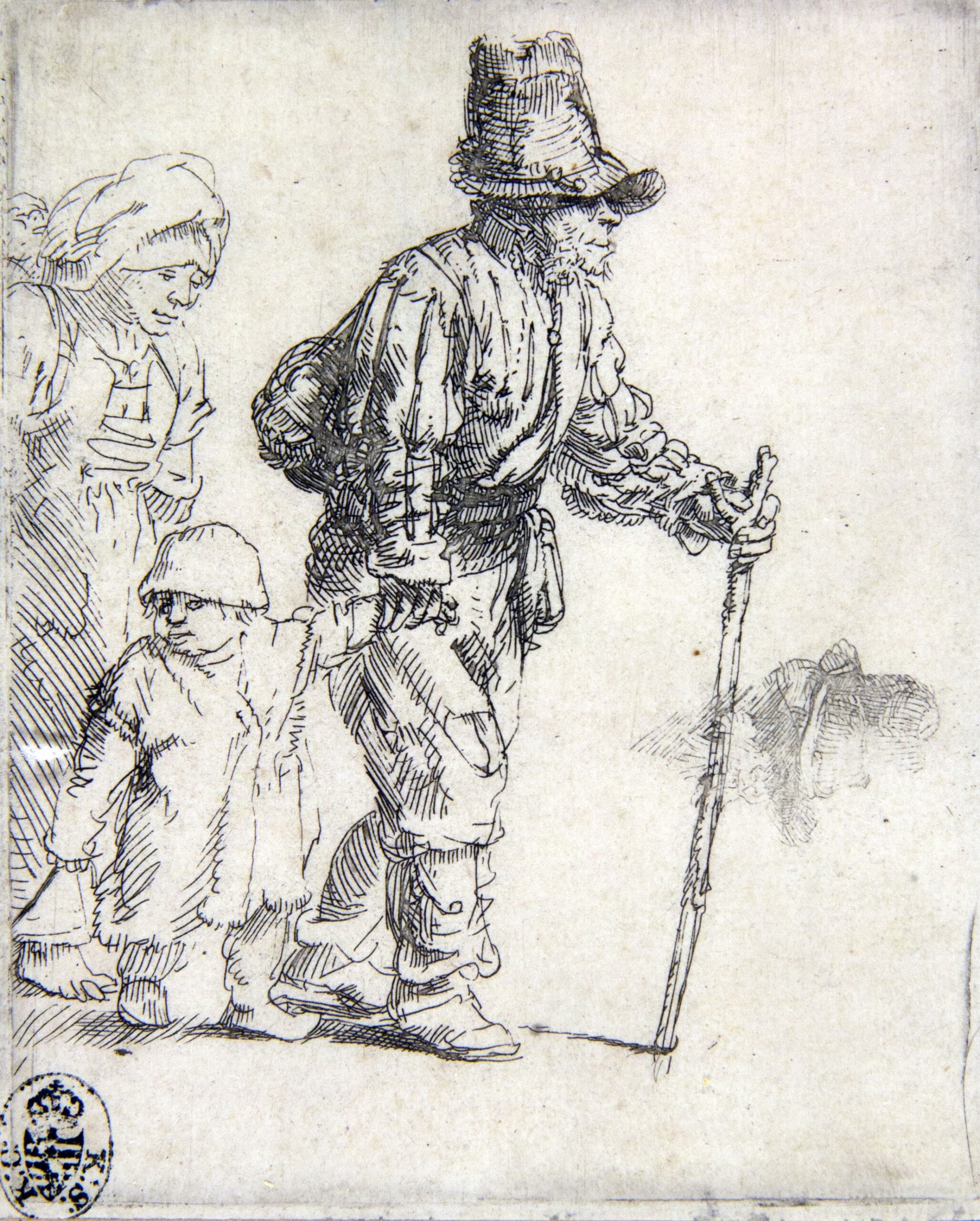
We see a travelling family, with the man in front holding a small child. A woman, probably the mother, follows. In the corner below right the faint outlines of the head of a man are visible. It seems that Rembrandt has left these traces of an earlier picture on purpose, as part of the environment.
According to Schwarz the open technique used here reminds of the Kolfplayer (B 125).


Inspiration

Rembrandt may have been inspired by an etching by Lucas van Leyden of 1520, The Owlglas, which shows a similar scene of a traveling family. Rembrandt was a great admirer of the famous master from his native town of Leiden and owned a large collection of his prints and drawings.


Copies

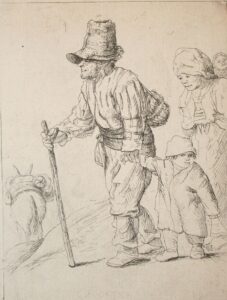
B&W 357 – David Deuchar – Copy of NH 266 / B 131 – Peasant family on the tramp – in reverse


NewHollstein lists four copies of which an anonymous one (copy C) in the same direction (122 x 77 mm).
There are three copies in reverse. Copy A is by Johannes van Vliet (117 x 88 mm, WB 2).
Copy B is by David Deuchar, with a donkey added (117 x 88 mm, WB 10). It is included in the collection ‘Rembrandt in Black & White’, nr 357.
Copy D is anonymous, inscribed P.I (95 x 65 mm).


Attributions and reviews

According to Michel this etching is not by Rembrandt.


States

New Hollstein lists three states, only the first by Rembrandt. Most other authors list two states, Nowell-Usticke four, from his 2nd state there are later impressions by P.F. and H.L. Basan, Jean, Bernard, Beaumont and possibly by Watelet.
In the 1st state (NH, WB, R381, NU) false stains are visible on the backpack, the belt and the hat of the man. The shading of the stick starts directly beneath it.  The head below right is clearly visible.
In the 2nd state (NH, WB final, R382, NU) the false stains are gone. Three small vertical lines are added on the backpack. The shading of the stick is connected with the stick. There are later impressions by P.F. and H.L. Basan where the shading of the stick is at least 2 mm separated from the stick. There is no ‘V’ between the two lines under the stick.
The 3rd state (NH/4th state NU) is heavily reworked by Bernard. The upper line of the hat of the woman, first very weak, now is a clearly uninterrupted line. The hat below left is only just visible. In later impressions it is not.
In the 3rd state (NU) the lower part of the stick is completely retouched (by Jean?) and again connected to the stick.


Prints and collections

Some early prints of the 1st state are on Japanese and Chinese paper. There are counterproofs of the 1st state in the Rijksmuseum, the Bibliothèque Nationale and the Albertina (also of the 2nd state).


Recueils

Nowell-Usticke considers the impressions in the Recueil de Basan as reasonably good.
Recueil de H.L. Basan – Page 3                  NH: 2nd state of III/WB: x state of II.
A fairly good impression.

Recueil de A. Beaumont –  Sheet 47        NH: 3rd and final state/WB: 2nd and final state.
A good impression, the hat at right no longer visible


Watermarks

In the 1st state: Foolscap with five- and seven-pointed collar (2 ed., 1648-52), Strasbourg lily (c. 1652).
In the 2nd state: Arms of Amsterdam.


Literature

H 259, BB 52-3, G 129, M 153, Mz 131, RA 381-382, Cl 132, W 134, Bl 120, Du 131, CD 213
Hinterding 2008, p. 270-271; Verdi 2014, p 14-15;


Rembrandt in Black & White: 91

New Hollstein: 1st state of III/White-Boon: 1st state of II
A good and clear impression, before the correction of the foul biting to the man’s knapsack.
Two vertical graphite stripes. Glued to a thick paper support sheet.
Sheet 116/115 x 95 mm, narrow margins of 1 to 2 mm all around (+5%).
No watermark, horizontal chain lines at approx. 23 mm.


Provenance

Kupferstichkabinett Dresden (L 1647), their duplicate mark visible recto.


Exhibitions

Rembrandt in Zwart-Wit, Westfries Museum (Hoorn), Museum Gouda, Jan ten Horne Museum (Weert), Stadsmuseum Harderwijk, March 2013-August 2015; Stedelijk Museum Vianen, October 2017 – January 2018;
Rembrandt in Black & White, Chateau des Penthes (Geneva), June – October 2016
Rembrandt, fotograaf avant-la-lettre, Museum De Reede (Antwerp), January – May 2023;
Rembrandt, 17th century photographer, Daegu Art Museum (Korea), November 2023 – March 2024;
Rembrandt, de fotograaf, Westfries Museum (Hoorn), June 2024 – January 2025;