
B 173

Beggar seated warming his hands at a chafing dish

  • French title:
    Gueux assis au bas d’un mur se chauffant les mains
  • German title:
    Der Bettler mit der Glutpfanne
  • Dutch title:
    Zittende bedelaar, de handen warmend bij een komfoor
  • New Hollstein:
    44
  • Rembrandt in Black & White:
    115

Etching with some drypoint. Ca. 1630.
Size: In the 1st state 93 x 78, in the 2nd state 92 x 74, in the 5th state 92 x 67 mm.
Surface: in the 1st state 73, in the 2nd state 68, in the 5th state 62 cm2.
Not signed, not dated. Most authors assume 1630, Middleton states 1635.

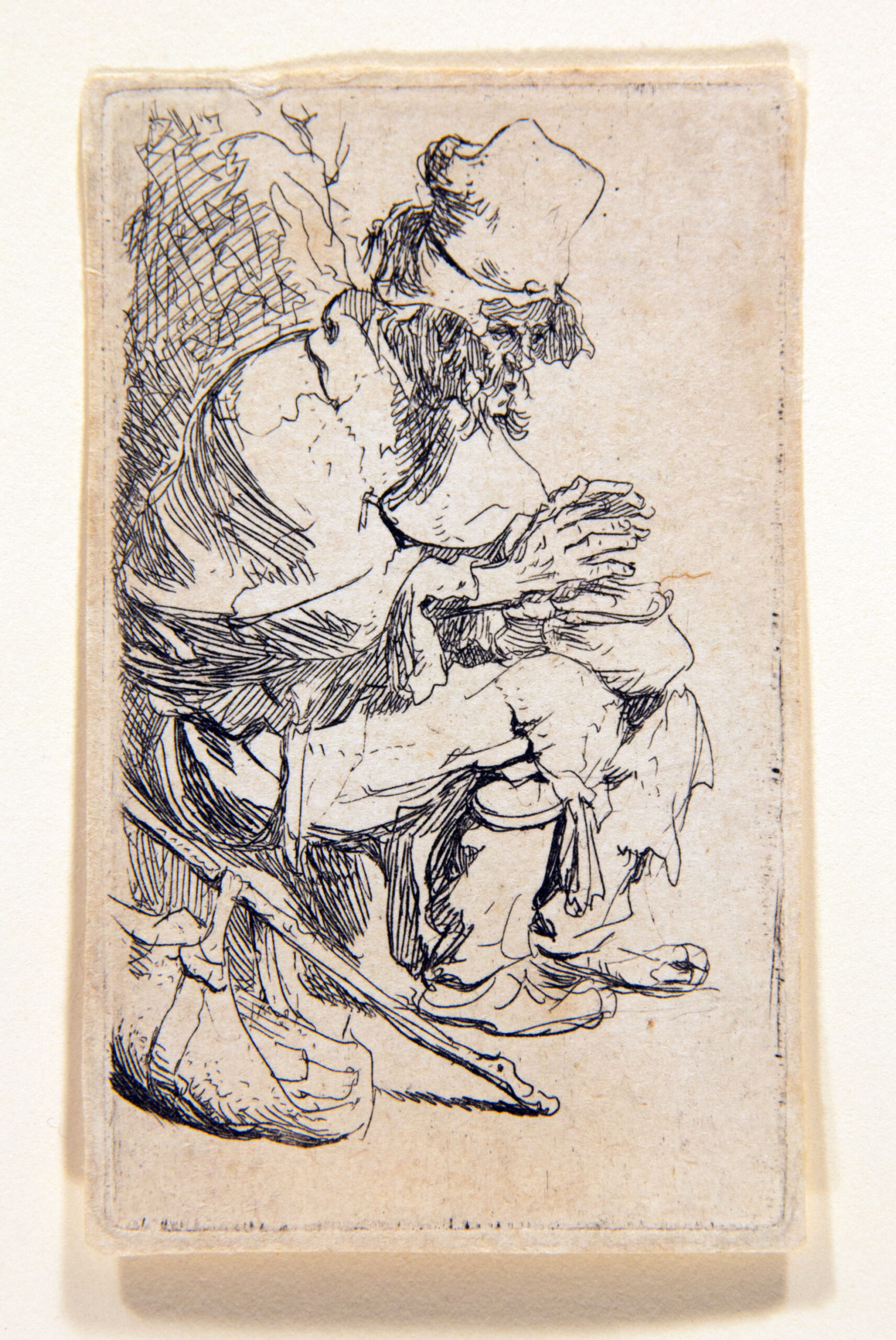
NH 44 – 2nd state of II

Copper Plate

Rembrandt used the plate of St.Jerome kneeling: the large plate (B 106, NHD 3) for this etching and for B135, Peasant with his hands behind his back. In both ‘new’ pictures remnants of the earlier picture are clearly visible. In this case some knuckle of the fingers, in the lower left corner (see New Hollstein, part I, page lv).
The plate was not part of any of the early sales or collections and is almost certainly not anymore in existence.


Rarity of impressions

  • In auctions (2000-2025): rare                                                   Early: 20                                      ⦿⦿⦿⊙⊙⊙

  • In collections (New Hollstein – 2013): rare                            Early: 53                                       ⦿⦿⦿⦿⊙⊙

  • Catalogue Nowell-Usticke (1967): R+, a scarce little print                                                         ⦿⦿⦿⊙⊙⊙


Description

Around 1630 Rembrandt etched a series of beggars. It is generally assumed that he was inspired by a series of beggars made by Callot in 1622. He copied the long parallel lines Callot used to indicate shadows.


Title

In the De Burgy sale (1755) this plate was referred to as Een oud Man, zittende zig te warmen over een Tesje met Vuur en een Knapzak byzich (An old man sitting and warming himself over a fire pan with fire and a knapsack with him).


Related

The idea of picturing a fire pan may come from a print by Callot (Lieure 484) or from a work by Abraham Bloemaert, of which Rembrandt owned some prints.


Copies

NH lists eight copies, of which three in the same direction, all anonymous.
There are five copies in reverse. Copy A is signed H.Suhrland 1766 (90 x 52 mm, WB 5). Copy B is by François Vivares, included in the 200 Etchings (79 x 53 mm, WB 2)/ Also included in ‘Rembrandt in B&W’ as nr 377. Copy H is signed by Francesco Novelli, inscribed Rembrandt (his nr 14, 89 x 61 mm, WB 3). There two more anonymous copies.


States

All authors list two states. Nowell-Usticke lists two trial proofs and one state, all contemporary.
In the 1st state (NH, WB, R498/NU trial proof A) the lower left side of the bundle is not shaded, nor completed. Hinterding thinks that this is due to varnish that Rembrandt applied before putting the plate in the acid. It also explains why the plate edges are irregular and inky.
In trial proof B (NU) the bundle is completed but not yet shaded. The plate edges remain irregular and inky.
In the 2nd state (NH, WB, R499/1st state NU) the bundle is shaded. The corners are rounded. In later impressions the edges remain inky, but gradually they become more regular.


Prints and collections

Of the 1st state (NU trial proof A) only two impressions are known, in the Rijksmuseum and in the Kunsthalle in Hamburg.
Early impressions of the 2nd state show somewhat rough plate edges (HD), in later ones these are less prominent.


Watermarks

In the 2nd state: Man.


Literature

H 8, BB 30-1, G 167, M 14, Mz 112, RA , Cl 170, W 170, Bl 135, Du 169, CD 8
Rohde 2005, p. 129; Hinterding 2008, p. 321-322;


Rembrandt in Black & White: 115

NH/WB: 2nd and final state
A delicate 17th century impression with narrow margins, pale staining in places, a thin spot on the reverse at the left edge.
Sheet 81 x 49 mm, margins of 1 to 2 mm all around (+ 12%).
No watermark, one vertical chain line.


Provenance

In the collection of Salomon Solomonovitch Scheikevitch, a Russian lawyer (1842-1908, Moscow – Paris, Lugt 2367). His stamp in blue ink (very thin) in the lower right corner, verso; Probably in his sale in Paris, May 1910. With Christie’s London, December 2009 (lot 75).


Exhibitions

Rembrandt in Zwart-Wit, Westfries Museum (Hoorn), Museum Gouda, Jan ten Horne Museum (Weert), Stadsmuseum Harderwijk, March 2013-August 2015;
Rembrandt in Black & White: Chateau de Penthes (Geneva), June – October 2016;
Rembrandt, de fotograaf, Westfries Museum (Hoorn), June 2024 – January 2025;