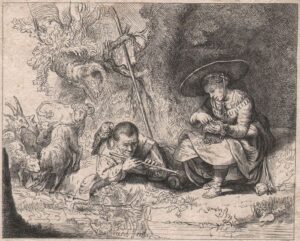
Etching and drypoint. 1642. Size: 116 x 143 mm. Surface: 166 cm2.
Signed and dated from the 2nd state, in the lower centre: Rembrandt. f. 1642 (the ‘2’ reversed)
The copperplate was not part of one of the early sales or the collections and is probably not in existence.
Rarity of impressions
In auctions (2000-2025): common Early: 22 ⦿⦿⦿⊙⊙⊙
In collections (New Hollstein – 2013): frequent Early: 74 ⦿⦿⊙⊙⊙⊙
Catalogue Nowell-Usticke (1967): R+: a scarce plate ⦿⦿⦿⊙⊙⊙
Picture
This seemingly idyllic and ‘harmless’ picture is in fact part of the frivolous section of Rembrandt’s work, together with the Monk in the cornfield (B187) and the Lit a la Francaise (B186). It is full with sexual references and symbols. The flute is pointing at the slightly lifted skirt, which obviously offers the player an interesting view. The owl, considered to be a symbol of loose morals. The wreath, a symbol of virginity. And the bag, of which the Dutch name, Tas or Tasch, is also used to describe a frivolous woman or even the female genitals. The sheep and goats in the background are considered to be animals with a strong sexual appetite
Title
The plate was in earlier years referred to as Uylenspiegel.
This does neither refer to the owl (Uyl) visible on the players shoulder, nor to Tijl Uilenspiegel, a famous person in a Flemish folktale. Since the 16th century, as Hinterding pointed out, the name Uilenspiegel was used for a non-valeur, a joker. There even existed an expression ‘op Uilenspiegels fluit spelen’ (to play on Uilenspiegels flute), which meant to ‘talk nonsense’. So, Adam Bartsch was right when he named the print L’Espiègle (the rascal) in 1797. Moreover, Rembrandt bought a print ‘Eulenspiegel’ by Lucas van Leyden for the staggering price of 179 guilders.
Copies
B&W 345 – Anonymous – Copy B in reverse of the 1st state of NH 211 / B 188 – The flute player
NH lists seven copies, of which an anonymous copy (C) of the 4th state in the same direction, signed Rembrandt 1640 (129 x 150 mm, WB 1).
There are six copies in reverse. Copy A of the 3rd state was formerly attributed to Gerard Dou, inscribed Rembrandt I, de Ram exc. and the number 3 (115 x 144 mm, WB 3).
Copy B of the 4th state is anonymous and signed Rembrand fecit. It is published by Johann Georg Hertel and included in the collection “Rembrandt in Black & White” as nr 345 (114 x 141 mm, WB 4,).
Copy D is an anonymous copy of the 1st state, inscribed Rembrand f. (115 x 146 mm, WB 6).
Copy E, of the boy with flute only, is by John Holland, signed J H.
Attributions and reviews
The etching is considered as special by Coppier and Wilson.
The plate was made by a pupil according to Middleton and Seidlitz.
The plate is not by Rembrandt according to Singer.
States
NH, as most authors, lists four states. Biörklund and Nowell-Usticke list five states. All states are contemporary.
In the 1st state (NH, WB, R526-27) the signature is still missing. There is dark shadow above the woman’s hat and diagonal left-to-right shading to the left of the girl.
In the 2nd state (NH, WB, R528-29) the signature is added. The shadow above the hat is much lighter, replaced by a few leaves. There is a clear face in the bushes below the upper margin. Lines were added to the skirt, following similar adaptations in grey ink on impression of the 1st state.
In the 3rd state (NH, WB, R530) the shadow above the hat is back and now very dark. The face below the upper margin is clear. This state is very similar to the 1st state.
In the 4th state (NH, WB, R531-532) the face in the bushes below the upper margin, to the right of the player is gone. Many small changes are made. The margin on the left behind the girl is shaded with crosshatching. In the 5th state (BB/NU) the eyes of the player are made softer by some vertical strokes.
Prints and collections
Only six impressions of the 1st state are known, most showing retouches in grey ink that may well be the work of the artist himself.
The 5th state (NU/BB) is a unique impression in the Albertina, by most authors considered as a special version of the 4th state.
Watermarks
In the 1st, 2nd and 3rd state: Basel crosier (1640-41), which indicates that they were all printed within a short period.
In the 4th state: Foolscap with five-pointed collar (4 ed. 1643 and 1648); Strasbourg bend (1646); Foolscap with seven-pointed collar.
Literature
H 200, BB 42-D, G 180, M 268, Mz 264, RA 526-532, Cl 185, W 185, Bl 153, Du 185, CD 157 Rembrandt’s Women 2001, p. 178; Hinterding 2008, p. 335;
Rembrandt in Black & White: 90
NH/WB: 4th and final state
A very good, well-inked, contemporary impression. A collector’s mark verso, slightly visible in the lower left corner recto.
Sheet 115/114 x 144/142 mm, no margins, trimmed on the platemark (-1%).
Watermark: Foolscap with five-pointed collar, to be dated between 1643 and 1648 (NH), horizontal chain lines at approx. 24 mm.
Provenance
An unknown collector’s stamp (SZ?, not in Lugt) recto.
Exhibitions
Rembrandt in Zwart-Wit, Westfries Museum (Hoorn), Het Markiezenhof (Bergen op Zoom), Stedelijk Museum Zutphen, Het Hannemahuis (Harlingen), Museum Gouda, Jan ten Horne Museum (Weert), Stadsmuseum Harderwijk, March 2013-August 2015; Stedelijk Museum Vianen, October 2017 – January 2018; Rembrandt in Black & White, Schloß Britz (Berlin), Bozar Expo (Brussels), Chateau des Penthes (Geneva), November 2015- October 2016; Rembrandt, fotograaf avant-la-lettre, Museum De Reede (Antwerp), January – May 2023; Rembrandt, 17th century photographer, Daegu Art Museum (Korea), November 2023 – March 2024; Rembrandt, de fotograaf, Westfries Museum (Hoorn), June 2024 – January 2025;