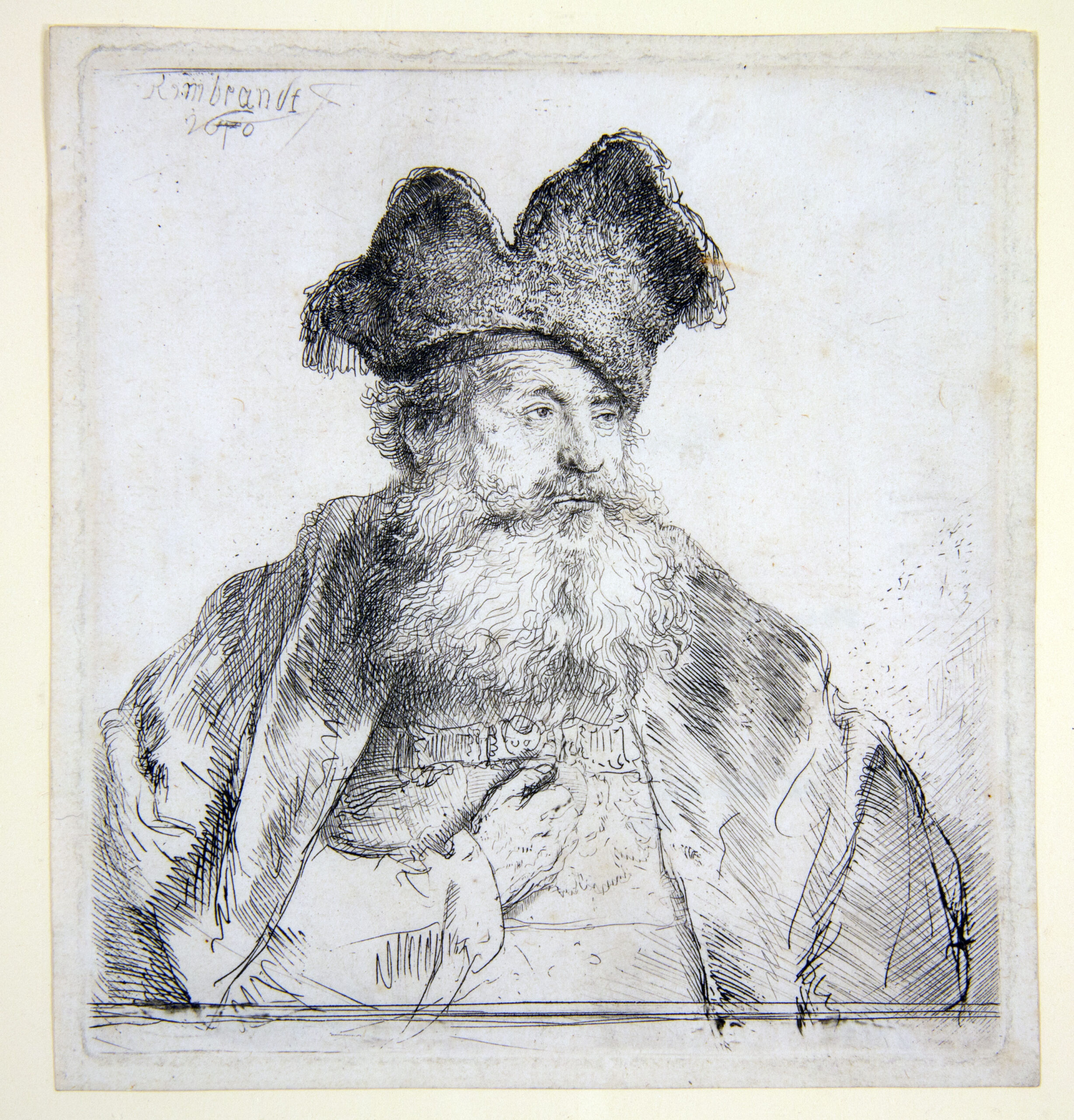
Etching with some drypoint. 1640.
Size: 150 x 147 mm. Surface: 221 cm2.
Signed and dated, in the upper left corner (the e reversed): Rembrandt. f. 1640
The copperplate was sold in the De Bary sale in 1759 (nr 59) to the Dutch dealer Busserus (together with plates B 65 and B 269). It was then reworked in mezzotint, according to Hinterding probably by Pieter Louw (1725-1800) or by Capt. Baillie, as other authors suggested.
The plate was not seen since and is probably not in existence anymore.
Rarity of impressions
In auctions (2000-2025): frequent Early: 43 ⦿⦿⊙⊙⊙⊙
In collections (New Hollstein – 2013): very frequent Early: 88 ⦿⊙⊙⊙⊙⊙
Catalogue Nowell-Usticke (1967): C1, not very uncommon ⦿⦿⊙⊙⊙⊙
Subject/Sitter
The hat of the sitter is a Polish kutchma, which may indicate that the sitter is related to Poland. Michiel Roscam Abbing suggested it is Nicolaes de Bye, who was the son of Dutch parents and served as Councillor to Wladislaw IV Wasa, King of Poland, from 1639.
Picture
This etching shows two sides of Rembrandt’s craftsmanship. His strength: the head is drawn in great detail. His weakness: the hand is drawn quite clumsily.
Related
Wurzbach, Münz and Hinterding see the same model in a small red chalk drawing (Benesch 346, now in the Amsterdamsch Historisch Museum).
The kutchma hat is used by Rembrandt in other drawings.
Copies
NH lists four copies in reverse. Copy A is by G.L.Hertel (his nr 183, two states, 157 x 138 mm, WB 2). Copy B is by Honoré Coussin, signed rembran H.Coussin sculp. (two states, 187 x 152 mm, WB 3). Copy C is by Costantino Cumano (162 x 130 mm, WB 1). Copy D is by Mattheus Ignatius van Bree, numbered and signed No 1|MB (109 x 102 mm).
Attributions and reviews
The etching is considered as special by Bartsch, Rovinsky, De Claussin, Wilson and Blanc.
States
NH and White-Boon list two states, most other authors three states. In later impressions of the 1st state (2nd state WB) a short (slipped?) stroke runs from the cap at the level of the left eyebrow, through the hairs, to the left cheek. About 5 mm right of the left eye. Sometimes the scratch is difficult to find. NH do not consider this to be a separate state.
The 2nd state (NH) is the posthumous mezzotint version. WB do not list the mezzotint state.
Prints and collections
Bartsch 265 – New Hollstein 182 Old Man with a divided fur cap – Counterproof
The 1st state was printed as late as 1651, so the 2nd state must be dated even later.
An impression of the 1st state (with stroke) in the Rijksmuseum is on Japanese paper.
There are impressions of the reworked 2nd state in the Rijksmuseum, the Hermitage (R690 bis) and the British Museum.
There are counterproofs of the 1st state (with stroke) in the Rijksmuseum, the Albertina, the British Museum and in the collection ‘Rembrandt in Black & White’, nr 247.
Watermarks
In the 1st state (without stroke): Countermark AD; Double-headed eagle; Foolscap with five-pointed collar; Foolscap; Strasbourg lily.
In the 1st state (with stroke): Arms of Amsterdam (5 ed.); Pro Patria; Seven Provinces (2 ed., > 1749).
In the 2nd state: Various (> 1742).
Literature
H 170, BB 40-A, G 245, M 145, Mz 59, RA 689-690bis, Cl 262, W 267, Bl 271, Du 280, CD 132 Hinterding (2008), p. 466-468; Kroniek 2016, p. 62-64;
Rembrandt in Black & White: 141
NH: 1st state of II/WB: 2nd and final state.
A very good impression with burr showing on the left shoulder and on the horizontal lines at the lower left and right edges of the plate. The accidental scratch is well visible, indicating a somewhat later print of the 1st state (NHD/2nd state WB).
Sheet: 162/160 x 150/149 mm, margins of 4 to 5 mm all around (+10%).
No watermark. Horizontal chain lines at 25 mm,
Exhibitions
Rembrandt in Zwart-Wit, Het Hannemahuis in Harlingen, March – June 2014; Stedelijk Museum Vianen, October 2017 – January 2018; Rembrandt in Black & White: Chateau de Penthes (Geneva), June – October 2016; Rembrandt, 17th century photographer, Daegu Art Museum (Korea), November 2023 – March 2024; Rembrandt, de fotograaf, Westfries Museum (Hoorn), June 2024 – January 2025;