B 266

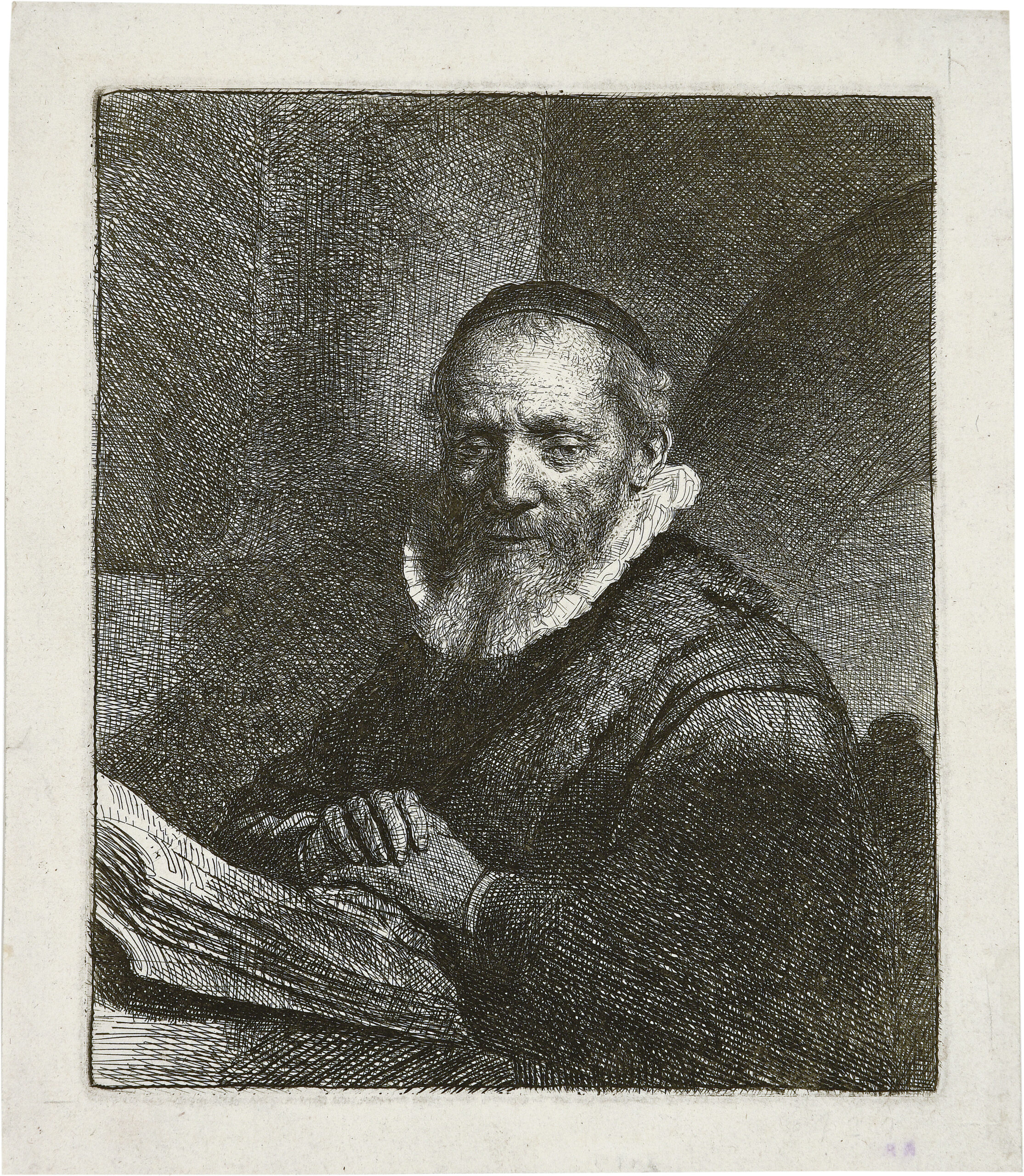
Jan Cornelis Sylvius

  • French title:
    Janus Sylvius
  • German title:
    Janus Sylvius
  • Dutch title:
    Johannes Cornelisz. Sylvius
  • New Hollstein:
    124
  • Rembrandt in Black & White:
    161

Etching, with burin in the 2nd state. 1633.
Size: 166 x 141 mm. Surface: 234 cm2.
Signed and dated, in the left centre Rembrandt. f. 1633

NH 124 – 1st state of III

Copper Plate

The copperplate may have been with the Sylvius family for a long period. It first showed up in 1767 at the sale by Pieter de Haan (nr 61) and was sold to J. Sluyter. It then was in the possession of John McCreery, W. Lewis and J. Kay and used for (re)prints in the 200 Etchings. It has not been seen since and is probably not in existence anymore.


Rarity of impressions

  • In auctions (2000-2025): frequent                                           Early: 21    Late: 28                    ⦿⦿⊙⊙⊙⊙

  • In collections (New Hollstein – 2013): frequent                     Early: 49    Late: 27                    ⦿⦿⊙⊙⊙⊙

  • Catalogue Nowell-Usticke (1967): C1, not uncommon                                                                 ⦿⦿⊙⊙⊙⊙


Subject/Sitter

Johannes Sylvius (1564-1638) was a preacher, first in Sloten (1604) and since 1621 in the Oude Kerk in Amsterdam. He was friend and family of Rembrandt by his marriage to a niece of Saskia, Aeltje Uylenburgh. In 1632 Rembrandt made a painting of Aeltje at the age of 62 (Bredius 333, collection Rose-Marie and Eijk de Mol van Otterloo, Boston). At a pre-wedding ceremony, on 10 June 1634 in the Oude Kerk in Amsterdam, it was Sylvius who represented the bride. He also baptized the first two of Rembrandt’s children, Rombartus in 1635 and Cornelia in 1638.


Picture

This print is Rembrandt’s first formal portrait of a third person. Thirteen years after he made this portrait, Rembrandt made a posthumous one of the same person (B 280). He also made an etched portrait of Jan’s son Petrus (B268).


Related

Stephanie Dickey suggests that the setting of a formal figure in an articulated space could be inspired by engravings by Jacques de Gheyn.


Copies

NH lists four copies in reverse. Copy A is a contemporary copy, attributed to Salomon Savry, published by Cornelis Danckerts, inscribed with a Latin text including Silvius en Ianus (209 x 143 mm, WB 1). Copy B is an oval copy by Johann Colizzi (44 x 34 mm, WB 3). Copy C is anonymous, numbered 23 (161 x 132 mm). Copy D is by Bland inscribed Thou are the man and signed E.B.1834 (WB 2).


Attributions and reviews

The etching is considered as special by Coppier.
Hamerton considers this plate one of the worst made by Rembrandt.
Münz thinks that the plate was made with the assistance of pupils.
The plate is not by Rembrandt according to Campbell Dodgson and Singer.


States

NH lists three states, only the first by Rembrandt. Most other authors list two states, Nowell-Usticke three states, from the 2nd state there seem to be impressions by Watelet (NU, not in NH).
In the 2nd state (NH, WB final, R691-693, NU) fine parallel horizontal shading is added to the upper lip, just below the right nostril. Extensive shading is added to the cap, the collar and the background, making these areas much darker. According to NHD the mezzotint rocker was already used in this state, like in the left margin , just above the book. Not by Rembrandt.
In the 3rd state (NH/NU, included in the 200 Etchings) the general appearance is coarse, the background is darkened by sulphur tinting, especially on the left shoulder (NU). The shadows on the right side of the face are darkened with crosshatching. The shadow below the nose is strengthened by heavy diagonal lines. The corner of the right eye is connected to the nose by additional shading.
The three different states identified by Rovinsky are in fact all impressions of the 1st state.


Prints and collections

An impression of the 1st state in the Fitzwilliam Museum in Cambridge (UK) has a handwritten Dutch poem signed W.D, possibly William Dilburgh. From this poem the identification of the sitter could be established.
Another impression, in the National Gallery, has an inscription recto in a 17th century hand Janus Siluius Amstelrodamensis Minister.
A counterproof of the 1st state in the British Museum is worked out in chalk. Another counterproof of the 1st state is in the Fitzwilliam Museum.
A now lost impression had a text verso, supposedly by Rembrandt, stating that the artist gave four copies to Sylvius himself, “Aan Jan Cornelius Sylvius dese vier printen”.
An impression of the 2nd state in the Scottish National Gallery in Edinburgh is printed in red ink.
There are no impressions in the Recueils, but there is one in the 200 Etchings by Lewis/Kay (1826).


Watermarks

In the 1st state: Arms of Wurttemberg (c. 1634-35); Double-headed eagle (c. 1637); Foolscap with five-pointed collar (2 ed., c. 1648); Strasbourg lily (4 ed. 1638 and c. 1648); Basel crosier; Countermark RP; Cross of Lorraine; Foolscap with seven-pointed collar; Strasbourg bend. A total of 14 editions.


Literature

H 124, BB 33-B, G 246, M 112, Mz 47, RA 694-696, Cl 263, W 268, Bl 263, Du 281, CD 69
Hinterding 2008, p. 468-470;


Rembrandt in Black & White: 161

NH: 1st state of III/WB: 1st state of II
A good, well-inked impression.The thin horizontal lines on the upper lip of the 2nd state and the thicker lines of the 3rd state are not visible, nor are the rocker lines in the left margin, just above the book. Indicating a 1st state impression.
Sheet 170/168 x 147/148 mm, margins of 3 to 4 mm on three sides, trimmed on the platemark at the top (+7%).
No watermark (?). Vertical chain lines at approx. 25 mm.


Exhibitions

Rembrandt in Zwart-Wit, Het Hannemahuis – Harlingen, Museum Gouda, March 2014 – September 2014;
Rembrandt in Black & White: Schloβ Britz (Berlin), Chateau de Penthes (Geneva), November 2015-October 2016;
Rembrandt, de fotograaf, Westfries Museum (Hoorn), June 2024 – January 2025;