B 279

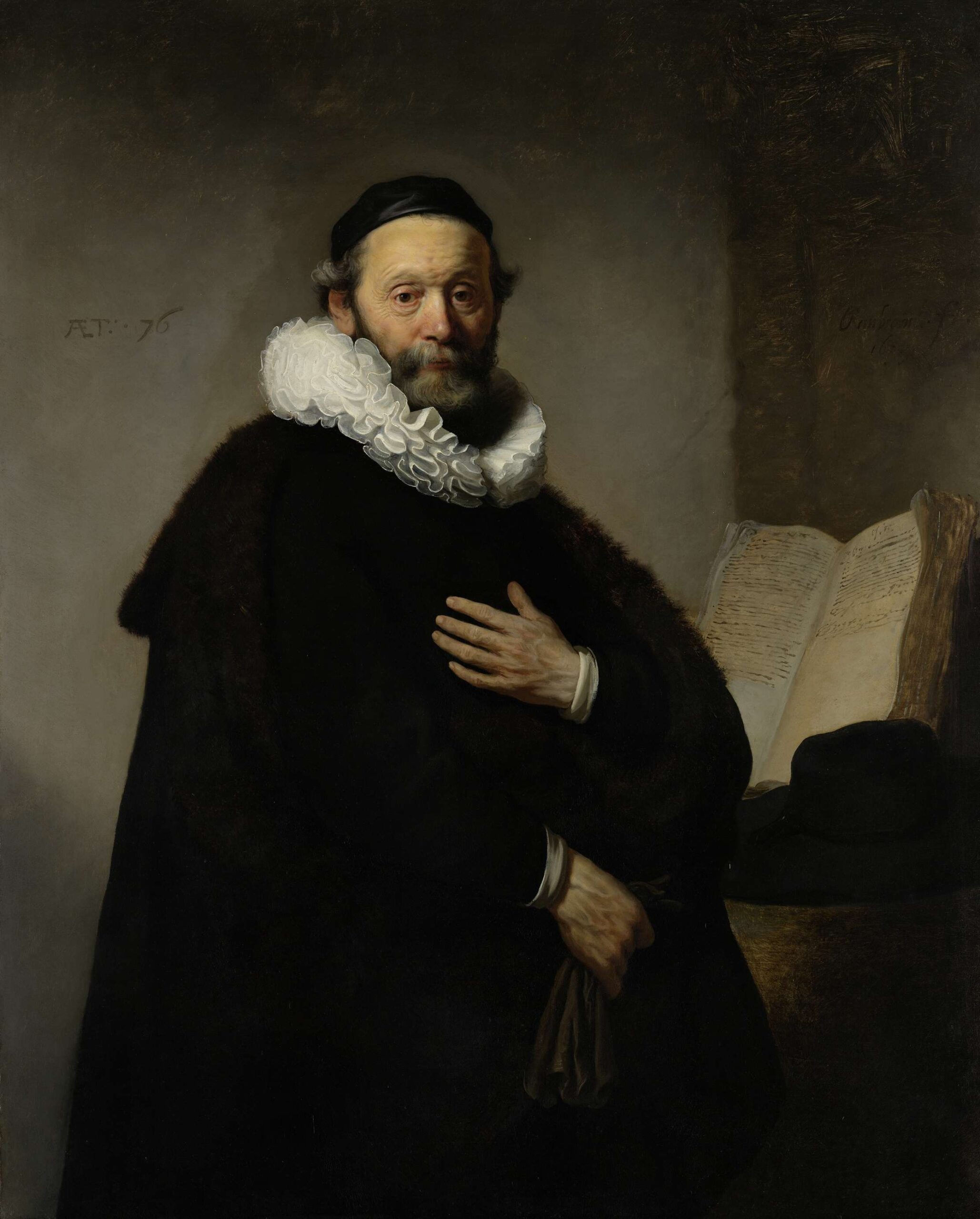
Jan Uytenbogaert, preacher of the Remonstrants

  • French title:
    Jan Uytenbogaert, Armenian preacher
  • German title:
    Johannes Wytenbogardus
  • Dutch title:
    Johannes Wtenbogaert
  • New Hollstein:
    153
  • Rembrandt in Black & White:
    1

Etching, drypoint and burin (from the 2nd state). 1635.
Octagonal, 224 x 187 mm. Surface: 419 cm2.
Signed in the upper left corner and dated in the upper right corner (from the 3rd state): Rembrandt ft 1635

NH 153 – 5th state of IX

Copper Plate

The copperplate may originally have been in the hands of the sitter or his family. It is mentioned for the first time in the description of the estate of Clement de Jonghe (1679) and later acquired by an anonymous owner, who added two dots in the upper right and a cross in the lower left corner. In the sale by Pieter de Haan (1767, lot 67) the plate was sold for Fl 20,00 via Fouquet to Claude-Henri Watelet (1786). It then became part of the set of plates subsequently owned and used for printing Recueils by Pierre-François Basan, Henri-Louis Basan (his nr 1439), Auguste Jean (ca 1809), Veuve Jean, Auguste and Michel Bernard (1846) and Robert Lee Humber (1937). It was sold at the Artemis sale in London (1993) and is now in the collection ‘Rembrandt in Black & White’.


Rarity of impressions

  • In auctions (2000-2025): very frequent  Early: 4    Mixed: 26    Late: 20    Unknown: 17  ⦿⊙⊙⊙⊙⊙

  • In collections (New Hollstein – 2013): very frequent            Early: 45    Late: 52                    ⦿⊙⊙⊙⊙⊙

  • Catalogue Nowell-Usticke (1967): C1-, fairly common in the later states                               ⦿⦿⊙⊙⊙⊙


Description

This portrait was the first Rembrandt made on commission. Before this he had only made portraits of family members, such as Jan Cornelisz. Sylvius, Saskia’s mentor. Schwarz thinks that Rembrandt used all techniques available to him in order to make the resemblance as well as possible, portraying the clothing as rich as possible.
The Latin inscription under the drawing was probably meant to give the plate a formal character. It is rarely seen in Rembrandt’s work, but it is in most other portraits of preachers. The text itself is by Hugo Grotius and reads:  “Quem pia mirari plebes, quem castra solebant, / damnare et mores aula coacta suos, /Iactatus multum, nec tantum fractus ab annis/VVTENBOGARDUS sic tuus, Haya, redit”. Or, “He who was honoured by the pious and the army was condemned by the preachers. Treated worse by fate than by time, he, Uytenbogaert, now returns to you, The Hague”.


Subject/Sitter

Uytenbogaert (1577-1644 The Hague) studied with Arminius in Geneva and became a preacher in Utrecht in 1584. He was one of the most important leaders of the Remonstrants, not least because he was first army chaplain to Prince Maurits and later tutor to the young Frederick Henry, the Prince of Orange. He payed an important role in writing and presenting the Remonstratie to the States-General in 1610 (in the collection ‘Rembrandt in B&W’, number 524). This document started a long-lasting dispute in the Lutheran church. During the Synod of Dordrecht in 1618-19 the orthodox Contra-Remonstrants (also called preciezen or Gomaristen after their leader Franciscus Gomarus) won a long-lasting dispute over the Remonstrants (also called rekkelijken or Arminianen, after their leader Jacobus Arminius). Gomarus and Arminius were both living in Leyden. On 24 May 1619, eleven days after the execution of the Arminian Johan van Oldenbarnevelt, Uytenbogaert was banned. He fled to Antwerp and then to Rouen, where he stayed in exile. After the death of the Gomarist Prince Maurits in 1625, he returned to Holland. First in hiding in Rotterdam and then to The Hague. He regularly visited Amsterdam where he was a preacher at the Remonstrant Church. But he never regained his former influence.


Related


Two years earlier Rembrandt made a painting of Uytenbogaert, then 76 years old, on a commission from the merchant and candle maker Abraham Anthonissen for his mansion in the Watergraafsmeer (Corpus A80, Bredius 173). Uytenbogaert recorded in his journals that he took a whole day of to sit for the painter, on the 13th of April 1633. The painting was in the possession of the family of Lord Roseberry for more than 130 years and was acquired by the Rijksmuseum in 1992 for € 6,5 mill. Stephanie Dickey points at the similarity between the setting in this print with that of contemporary engravings of other preachers, like a portrait of Carolus Niellius by Chrispijn de Passe (made after a painting by Thomas de Keyser) and a portrait of Johannes Acronius by Jan van de Velde.


Copies

NH lists eight copies of which two in the same direction. Copy E is anonymous, possibly by Baillie, inscribed on the book Rembrandt f. (222 x 183 mm, WB 1). Copy H is by John Frederick Lewis signed copied by J F Lewis (253 x 200 mm).
There are six copies in reverse. Copy A is by Thomas Worlidge (1757, WB 3). Copy C is by Johann Friedrich Bause zu Halle (1765, 275 x 208 mm, WB 2) Copy D is by Honoré Coussin, signed and inscribed rembran in which the sitter resembles Jan Sylvius, (two states). Copy F is by Dirk Jan Singendonck inscribed Wtenbogardus (two states, 111 x 85 mm). Copies B and G are anonymous (resp. 95 x 70 mm and 250 x 184 mm).


Attributions and reviews

The etching is considered as special by Wilson.
The plate was made by a pupil according to Coppier.
Schwartz rejects the suggestion by Münz that a pupil (van Vliet?) worked on the background of this etching.


States

NH lists nine states, of which the first five by Rembrandt. The 6th (two dots and cross) and 7th state are ‘new’. Most other authors list six states, Nowell-Usticke two trial prints and six states.
In the 1st state (NH, WB, R743/NU trial print A) the plate is still square and has square corners (250 x 187 mm). The picture itself is almost oval. The collar is almost white. The background is a curtain to the left only.
In the 2nd state (NH, WB, R744-745/NU trial print B) the shading on the collar is completed. Shading is also added to the cap and to the face (the eyes), hair and beard.
In the 3rd state (NH, WB, R746/1st state NU) the plate is cut to an octagon and heavily reworked. The dark background is added. The signature, date and inscription are added. A smaller book is placed on top of the first. The oval form is very weak at the right side, but this is due to cutting the print incorrectly (HD).
In the 4th state (NH, WB, R747/2nd state NU) the oval shape is strengthened. In the curtains, especially the right one, close horizontal lines are added. The right and left lower corners are irregular.
In the 5th state (NH, WB, R748/3rd state NU) the corners are corrected.
In the 6th state (NH only) an anonymous owner added a cross in the lower left corner and two dots behind the date in the upper right corner (one dot already present, JM).
In the 7th state (NH only) the plate is extensively reworked. The darker folds of the curtain, the cap of the sitter, the shadows behind him and on his arm and in many more places. Some lines now cross the oval contours, like under the signature, under the table and under the books. Many lines on the ruffed collar are redrawn, as are the signature and the date. In the 8th state (NH/6th state WB (final), R749/4th state NU, Watelet, P.Basan) the plate is lightly and expertly retouched (possibly by Watelet) with many very thin lines of shadow. Such as horizontal lines on the bust directly under the collar. There are parallel lines under and on the nose and vertical shading near the top right of the column. Later impressions still show some burr. In the 5th state (NU H.Basan, Jean) thick shading is added to the background. There is much new work on the curtains on the right.
In the 9th state (NH/6th state NU, Bernard, Beaumont) the entire plate is rebitten. The vertical shading on the nose is relatively heavy. The hat is strongly reworked, visible in the highlight on the right side of the band.


Prints and collections

Of the 1st state only three impressions are known: at the Rijksmuseum, the British Museum and in the Bibliothèque Nationale (Rothschild Collection).
Of the 2nd state there are two impressions at the British Museum, one of which has additional work in black chalk, probably in preparation of further states. The other has the word ‘Wtenboga..’ inscribed recto.
Of the 3rd state only one impression is known, in the Hermitage.
The 4th state is the first to be printed in large numbers, in four editions, three in 1635 and one in 1637.
The 5th state is probably made soon after that (HD). Both states have the Double-headed eagle (C.a.) watermark.
Nowell-Usticke considers the impressions in the Recueil de Basan, to be good.


Watermarks

In the 1st state: Double-headed eagle (1635).
In the 4th state: Arms of Kyburg (c. 1635-37); Arms of Württemberg (c. 1634); Double headed eagle C.a (2 ed. c. 1634 and c. 1637); Single headed eagle (c. 1635-37).
In the 5th state: Foolscap with seven-pointed collar; Idem with cm DS; Strasbourg bend (1646); Strasbourg lily with WR with cm HIS.
In the 6th state: Seven Provinces (> 1665).
In the 8th state: Foolscap; Strasbourg bend; Strasbourg lily (2 ed.); Grapes; Words and various others.


Literature

H 128, BB 35-D, G 259, M 114, Mz 50, RA 743-749, Cl 276, W 281, Bl 190, Du 272, CD 100
Victoria Charles p. 53; Dickey 2004, p. 35ff; Rohde 2005, p. 99; Hinterding 2006, II, p, 319-320; De grote Rembrandt (2006), p. 186-187; Hinterding 2008, p. 501-504; Bikker 2019, p. 62-63;


Rembrandt in Black & White: 1

NH: 5th state of IX/WB: 5th state of VI
A good early impression. The two dots and cross are not visible, indicating a 5th state (NH/WB).
Thread margins.
Watermark: Strasbourg Lily WR (Heywood 141), also indicating a 5th state.


Provenance

According to a sticker at the back: Herbert Palmer Gallery, 9001 Melrose Avenue, Los Angeles. It is unclear whether this refers to the plate or to the print or both.


Exhibitions

North Carolina Museum of Arts, Raleigh (USA) 1956-1993;
Rembrandthuis, Amsterdam, May-June 1993;
The Rotunda at Exchange Square, Hong Kong, January 2008;
Uit de Kunst, Museum Paleis ‘t Loo, November 2011 – January 2012;
Rembrandt in Zwart-Wit, Westfries Museum (Hoorn), Het Markiezenhof (Bergen op Zoom), Stedelijk Museum Zutphen, Het Hannemahuis (Harlingen), Museum Gouda, Jan ten Horne Museum (Weert), Stadsmuseum Harderwijk, March 2013-August 2015; Stedelijk Museum Vianen, October 2017 – January 2018;
Rembrandt in Black & White: Schloβ Britz (Berlin); Bozar (Brussels), Chateau de Penthes (Geneva), November 2015-September 2016.
Rembrandt, fotograaf avant-la-lettre, Museum De Reede (Antwerp), January – May 2023;
Rembrandt, 17th century photographer, Daegu Art Museum (Korea), November 2023 – March 2024;
Rembrandt, de fotograaf, Westfries Museum (Hoorn), June 2024 – January 2025;