The plate was supposedly in the hands of the sitter’s grandson Jan van Gheel, according to his estate drawn up in 1760. It was acquired by Capt. Baillie who made various impressions between 1760 and 1778. The plate was acquired by John Boydell (stocklists of 1792 and 1803) and sold at Christie’s London in 1929 to Charles Roosembloom (Pittsburg). After his sale with Park-Bennet Galleries (New York) in 1946, it is now in the Israel Museum in Jerusalem.
Rarity of impressions
In auctions (2000-2025): frequent Early: 9 Late: 35 ⦿⦿⊙⊙⊙⊙
In collections (New Hollstein – 2013): very frequent Early: 44 Late: 42 ⦿⊙⊙⊙⊙⊙
Catalogue Nowell-Usticke (1967): C1, fairly common in later states ⦿⦿⊙⊙⊙⊙
Subject/Sitter
At the time this etching was made Uytenbogaert had just become the Ontvanger der Gemeenelandsmiddelen over de stad en ‘t kwartier Amsterdam (Receiver of Amsterdam and surrounding area), a position he would hold for 42 years. He was a cousin and godson of the Remonstrant preacher Johannes Uytenbogaert of which Rembrandt made both a painting (in the Rijksmuseum) and an etching (B 279). It is unknown whether Rembrandt made this etching on commission or as a token of friendship and appreciation for the sitter. The latter is more likely since Rembrandt must have known Jan Uytenbogaert from his period in Leiden. They could have been befriended, since Rembrandt mentions Uytenbogaert several times in his letters to the Stadhouder, asking for payment for the two paintings he made in the same year.
Picture
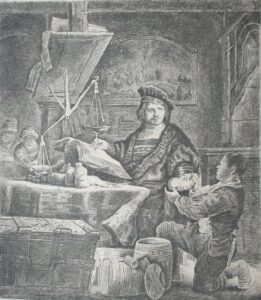
This is the first portrait by Rembrandt is which the sitter is placed in an associative environment, probably his own office (comptoir). The various objects surrounding the sitter are supposed to give some insight in his preferences and virtues, in this case the love of art. Uytenbogaert possessed a large art-collection. The painting shows the Biblical story about a copper snake that would protect the Israelites. It was used as a metaphor for the battle against the Spanish rulers over the Northern Provinces. This war required a steady stream of tax income. Note the two people at left, awaiting their turn to pay their duties. The barrels were used for all sorts of transport, including money.
Related
Paintings of goldweighers were made in the 16th century by Quinten Massijs and Marinus van Reymerswael, among others. This may have inspired Rembrandt to portray his subject with a 16th century garb. For his working method, initially leaving the face almost blank and then, partially helped by a chalked counterproof, completing the face, Rembrandt may have been inspired by Theodor Mathan’s engraved portrait of Reinier Pauw (after Jan Mytens).
Copies
B&W 356 – Captain Baillie – Copy D of NH 172 / B 281 – Jan Uytenbogaert, ‘The goldweigher’ – 3rd state
NH lists nine copies of which six in the same direction. Copy C is by James Hazard (two states, 250 x 201 mm, WB 2). Copy E is attributed to Geiling (250 x 201 mm, WB 3).
Copy D is a very deceptive copy by Capt. Baillie, in which the head is more upright (three states, 249 x 202 mm, WB 1). An impression of the 3rd state is included in the collection “Rembrandt in Black & White”, number 356.
Copy G is anonymous, signed Rembrandt f. 1639 (253 x 205 mm). It is also included in the collection “Rembrandt in Black & White”, number 320.
Copy H is a large one, published by Landry (700 x478 mm). Copy I is a mezzotint version by Henry Dave (196 x 148 mm).
There are three copies in reverse. Copy A is a mezzotint by Jan van der Bruggen (294 x 220 mm, WB 4). Copy B is by Jean Philippe Le Bas (two states, 276 x 208 mm, WB 5). Copy F is by Edmund Girling (234 x 198 mm).
B&W 320 – Anonymous – Copy G of NH 172 / B 281 – Jan Uytenbogaert, ‘The goldweigher’.
Attributions and reviews
The etching is considered as special by Bartsch, De Claussin and Wilson. It was considered one of the best etchings by all early authors like Gersaint and Daulby.
Later, Seymour Haden suggested the hand of pupils like Flinck in the surrounding area.
The plate was made by a pupil according to Seidlitz and Michel.
It has now been generally accepted as mainly by Rembrandt.
States
NH lists three states, the final one reworked by Capt. Baillie. Most other authors list two states, Biörklund four. Nowell-Usticke lists one trial proof and three states, from his 2nd state there are later impressions by Capt. Bailly and others.
In the 1st state (NH, WB, R751/NU trial proof A) the face is only lightly sketched, almost blank. The left part of the barrel is only slightly shaded.
In the 2nd state (NH, WB final, R753/1st state NU) the face and hair are completed. The left part of the barrel is darkened, obscuring some of the coins.
In the 3rd state (NH, BB/2nd state NU) the plate is completely reworked by Capt. Baillie. Vertical lines are added to the light space between the boy’s legs. The lower part of the side of the desk is shaded with open lines in various directions.
In the 4th state (BB/3rd state NU) more verticals have been added, at irregular spaces.
Prints and collections
Of the 1st state at least twelve impressions are known, suggesting that Rembrandt intentionally left the face rather blank.
An impression and a counterproof of the 1st state in the British Museum have the face filled in with black chalk.
The 2nd state was reprinted in 1646, but probably also reprinted by Capt. Baillie before he made the alterations of the next state (NU 2nd state).
There is a counterproof on oriental paper in the Louvre.
There are impressions of both the 2nd and 3rd state on fake oriental paper, probably all by Capt. Baillie.
Watermarks
In the 1st state: Strasbourg lily (2 ed. 1639).
In the 2nd state: Strasbourg lily (2 ed., 1633-41 and 1639); Strasbourg lily with HP; Strasbourg bend (2 ed. c. 1646); Foolscap with five-pointed collar.
In the 3rd state: miscellaneous later ones (> 1742).
Literature
H 167, BB 39-D, G 261, M 138, Mz 259, RA 751-754, Cl 278, W 283, Bl 189, Du 271, CD 126, S 127 White 1999, p. 62; Dickey 2004, p. 66 (a very detailed description); Hinterding 2008, p. 508;
Rembrandt in Black & White: 204
NH: 2nd state of III/WB: 2nd state of II.
A good 18th century impression, before the rework by Capt. Baillie. The white space between the legs of the boy is still without the additional shading, confirming a 2nd state (NHD). Sheet: 253 x 207/209 mm, thread margins of 1 to 2 mm all around (+3%).
An proprietary, unidentified watermark, vertical chain lines at approx. 30 mm.
Provenance
With Colnaghi, London, there bought by an English collector on 28 February 1962;
Sold at Christie’s London, Fifty prints by Rembrandt van Rijn, A private English collection on 5 July 2016 (lot 17), hammer price £ 12.500;
Exhibitions
Rembrandt, 17th century photographer, Daegu Art Museum (Korea), November 2023 – March 2024; Rembrandt, de fotograaf, Westfries Museum (Hoorn), June 2024 – January 2025;