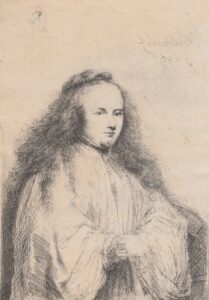
Etching and touches of drypoint. 1638.
Size: 110 x 78 mm. Surface: 9 cm2.
Signed and dated, in the upper right corner: Rembrandt. f. 1638
Copper Plate
The plate was not part of any of the major, early collections and is probably not in existence.
Rarity of impressions
In auctions (2000-2025): very rare Early: 5 ⦿⦿⦿⦿⦿⊙
In collections (New Hollstein – 2013): rare Early: 47 ⦿⦿⦿⦿⊙⊙
Catalogue Nowell-Usticke (1967): R-, a very uncommon, delicate print ⦿⦿⦿⊙⊙⊙
Description
Valerius Röver, in his catalogue in 1731, was the first to introduce the title, in 1751 supported by Gersaint. Later authors have suggested that the subject may be Saint Catharine of Alexandria, based on the wheel in the background. She was a popular early Christian martyr, since she protested against the persecution of Christians by emperor Maxentius. She was sentenced to be killed by being bound to a spiked wheel.
It has been suggested that Saskia acted as a model for this print, both for this print and for the larger version (B 340 – NHD 154). There is indeed a strong resemblance to the face of Saskia in the studies (Bartsch 365 and 367).
Copies
B&W 374 – Copy B of NH 169 – B 342
There are five copies in the same direction. Copy A is probably published by Hertel (two states, 98 x 91 mm).
Copy B is attributed to Ignace Joseph De Claussin, included in the 200 Etchings and in the collection ‘Rembrandt in Black & White’ nr 374(125 x 88 mm, WB 1).
Copy C is by Dominique Vivier Denon, included in his album (1873, 112 x 77 mm, WB 2). Copy E is anonymous (115 x 80 mm). Copy F is by Julius Kronberg, showing two heads (100 x 97 mm, in NH erroneously listed as ‘in reverse’).
There is one copy in reverse (D), signed by Francesco Novelli, inscribed Rembrandt inv. (his number 31, two states, 112 x 92 mm, WB 3)
Attributions and reviews
The etching is considered as special by Middleton, De Claussin and Wilson .
The plate was made by a pupil according to Coppier.
The plate is not by Rembrandt according to Singer.
States
All authors list one state only. Early impressions are strong, but delicate, with light burr on the left sleeve.
Prints and collections
In later impressions accidental marks appear in the background above the wheel, forming a rectangular shape.
Watermarks
Basilisk A’.a (c. 1640-47); Strasbourg lily E’.a with cm WK’ A.a (c. 1652); Strasbourg lily C.y and ZZ.zz;
Literature
H 154, BB 38-A, G 312, M 135, Mz 94, RA 901, Cl 332, W 338, Bl 200, Du 331, CD 116 Rembrandt’s Women 2001, p. 156; De ‘joodse’ Rembrandt 2006, p. 59-60;