B 30

Abraham casting out Hagar and Ishmael

  • French title:
    Agar renvoyée par Abraham
  • German title:
    Hagars Verstossung
  • Dutch title:
    Abraham verstoot Hagar en Ismaël
  • New Hollstein:
    166
  • Rembrandt in Black & White:
    216

Etching with touches of drypoint. 1637.
Size: 125 x 95 mm. Surface 119 cm2.
Signed and dated in the upper right corner: Rembrandt. f. 1637.

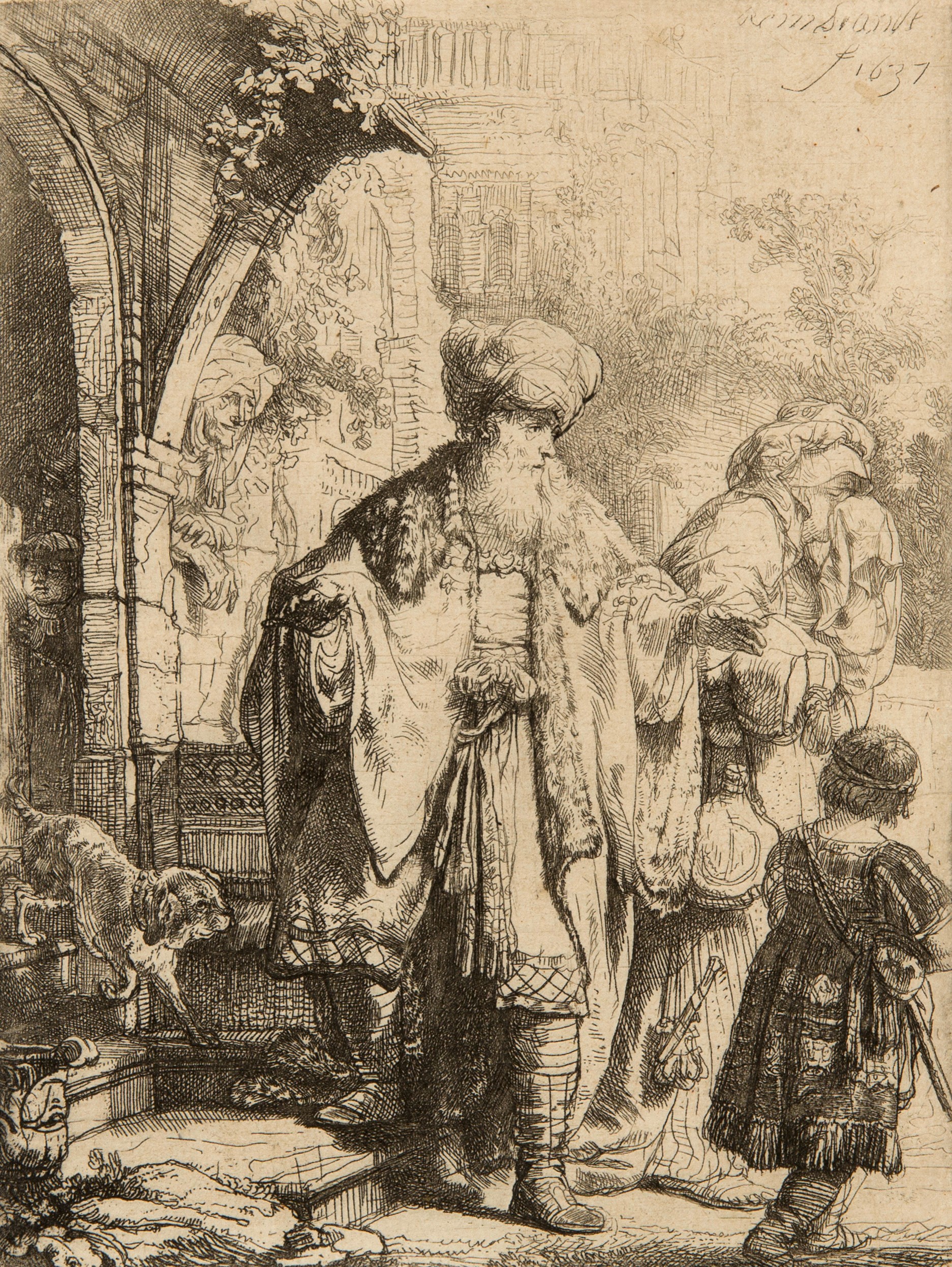
NH 166 – Only state

Copper Plate

In the year of its creation the copperplate was sold by Rembrandt to the Portuguese painter Samuel D’Orta. Both the transaction itself (on 16 December 1637) and a subsequent dispute are recorded in notarial deeds (now in the Gemeentearchief in Amsterdam). In the dispute D’Orta claimed that Rembrandt made additional impressions before handing the plate over to him. The claim did not hold in court. In later years the plate may have been in the collection of Clement de Jonghe (1679 as 43 wandelende vaeder Abraham). It has almost certainly not survived.


Rarity of impressions

  • In auctions (2000-2025): common                                          Early: 19                                        ⦿⦿⦿⊙⊙⊙

  • In collections (New Hollstein 2013): common                        Early: 57                                       ⦿⦿⦿⊙⊙⊙

  • Nowell-Usticke (1967): C1+, fairly common, but fine proofs are very rare                           ⦿⦿⊙⊙⊙⊙


Story

Genesis 21, verses 1-20
Hagar was an Egyptian slave, belonging to Sarah. When Abraham and Sarah remained without offspring Sarah sent Hagar to Abraham to sleep with him. As a result a son was born, Ishmael. When Sarah gave birth to Isaac, ten years later, she asked Abraham to send Hagar and Ishmael away. Abraham obeys and sends them away with his and God’s blessing. The story of Hagar’s dismissal was a very popular subject in the 17th century, which is reflected in the large number of copies made of this etching (New Hollstein lists fourteen).


Picture

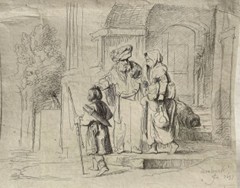
Rembrandt shows the moment that the weeping Hagar is already on her way and Abraham is ready to step back into the house. The turned right foot gives the picture a lot of movement. His face shows his dislike of Sarah’s request. Ishmael is already looking away, into the future. Even the dog seems to regret the departure. But who is the boy in the doorway? It is probably Isaac, although he was supposed to still be a baby when this awkward moment occurred.


Animal Farm

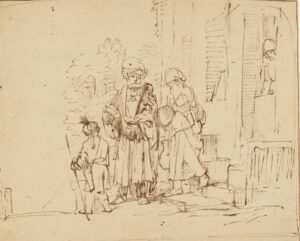
The dog is shown in the etching and in two drawings, each time in the same way, following the departing group. It is very likely the dog of Ishmael. But the only drawing of the mother and son after their dismissal (Benesch ca. 1655) does not show a dog. So, it is quite likely that the dog stayed with Abraham, Sarah and Isaac.


Inspiration

Rembrandt may have been inspired by two engravings made by Lucas van Leyden in 1506 and 1516. He used the same format and even copied the dog in the lower left corner.
Münz refers to a little etching by Tempesta in his Old Testament series in which a similar pose is shown.
Van der Coelen mentions illustrations of this subject by George Pencz and Abraham Bloemaert.


Related

B&W 338 – Anonymous – Copy of Benesch 962
RembrandtThe dismissal of Hagar – ca 1655 – British Museum – Benesch 962

Apart from this etching, Rembrandt made four drawings of this subject. The first is made after a painting made by his teacher Pieter Lastman in 1612 (Benesch 447, now in the Albertina).
One drawing, made c. 1650 shows a somewhat different setting. It is in the Rijksmuseum (Benesch 916).
Two other drawings are in the British Museum. (Benesch 524 and 962), although the former one is assumed to be of a much later date and by some attributed to Aert de Gelder.


Two anonymous etched copies of Benesch 962 are included in the collection Rembrandt in B&W’, numbers 338 and 371.


Copies
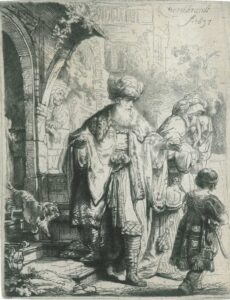
B&W 378 – Copy H of NH 166 – B 30


The popularity of this print shows in the fourteen copies listed by NH, of which seven in the same direction.
Copy G is by Thomas Worlidge (his nr 29, five states, 126 x 98 mm, WB 8).
Copy H is by Leopold Flameng, inscribed Rembrandt | f 1637. It is included in the Blanc catalogue and in the collection “Rembrandt in B&W”, number 378 (125 x 95 mm, WB 1).
Copy M is by Martin Wegenaer, inscribed Rembrandt | f 1637 (129 x 98 mm, WB 9). There are four anonymous copies (D, I, J and N).
There are seven copies in reverse. Copy A was formerly attributed to Gerard Dou (two states, 126 x 97 mm, WB 3). Copy B is by Maria Boortens, signed MB (130 x 97 mm, WB 10). Copy C is by Melchior Küsel (his nr. 16, 94 x 141 mm). Copy E is attributed to Frans van Mieris, dated 1706 (123 x 95 mm, WB 5). Copy F is by James Bretherton (125 x 96 mm, WB 6 or 7). Copy K is signed Francesco Novelli (his nr 40, later 19, three states, 134 x 105 mm, WB 4).


Attributions and reviews

The etching is considered as special by De Claussin and Wilson.


States

All authors list one state only.


Prints and collections

In the early impressions of the only state there is burr on the right side of Abraham’s turban. Later impressions are getting greyish. There is a counterproof in the British Museum.


Watermarks

Double-headed eagle (2 ed. c. 1637); Single-headed eagle with Basel crosier (2 ed., c. 1637); Arms of Württemberg; Foolscap; Strasbourg lily;


Literature

H 149, BB 37-A, G 31, M 204, Mz 174, RA 109, Cl 37, W 37, Bl 3, Du 37, CD 110.
Hamann, Marburger Jahrbuch für Kunstwissenschaft, VIII, IX; Tümpel 2006, p. 35; Spijkerboer 2006, p. 24; Ger Luijten, Rembrandts etsen, p. 19; De ‘joodse’ Rembrandt 2006, p. 13; Hinterding 2008, p. 73-74; Verdi 2014, p. 184-186; Rosenberg 2017, p. 68.


Rembrandt in Black & White: 216

New Hollstein/White-Boon: Only state
A good impression with delicate tones.
Sheet 126 x 96 mm, very thin margins (+2 %).
No watermark, horizontal chain lines at approx. 21 mm.


Provenance

Probably in the collection of G. Siciolante da Sermoneta.


Exhibitions

Rembrandt, de fotograaf, Westfries Museum (Hoorn), June 2024 – January 2025;