The plate was part of the inventory of Clement de Jonghe’s (1679, nr 17 Adam en Eva). It was not part of any of the later sales or collections and is probably not anymore in existence.
Rarity of impressions
In auctions (2000-2025): rare Early: 13 ⦿⦿⦿⦿⊙⊙
In collections (New Hollstein 2013): rare Early: 45 ⦿⦿⦿⦿⊙⊙
Nowell-Usticke (1967): RR+, a rare plate ⦿⦿⦿⦿⊙⊙
Story
Genesis 3, verses 1-6
This etching depicts the well-known story of the forbidden fruit offered by Eve to Adam, leading to their exile from paradise.
Picture
Rembrandt chooses the moment that Adam cannot resist the temptation any longer as he reaches out for the apple. Or is he not? The position of Adam’s hand seems to warn Eve, who is on the edge of taking a bite. Is Adam trying to stop her, as Wilson and others have suggested?
Satan is shown in the form of a monster entangled in the tree, a second apple in his mouth. In line with the bible text stating that only after the fall the serpent (Satan) was forced to crawl. Adam and Eve are pictured as ordinary people and not as the almost perfect nudes they so often are in other paintings. They are even a bit aged and wrinkled. As if they are at the verge of losing their youth. Although it is very much in line with the way Rembrandt pictured nudes, it was widely criticized by many authors, starting with Houbraken and Gersaint early in the 18th century (see Reviews). Wilson even called it a miserable interpretation of our first parents.
Note that the light is coming from the back.
Animal Farm
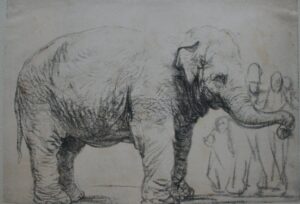
Rembrandt – An Elephant (Hansken) – ca 1637 – 178 x 256 mm – British Museum – Benesch 459
About a year earlier Rembrandt made four drawings of an elephant (Benesch 457-460). It is generally accepted that his source of inspiration was an elephant, called Hansken. She arrived in Amsterdam in 1633 and her appearance in the city has been well documented. Rembrandt may also have looked at elephants that were regularly visiting Amsterdam as part of fairs. Since elephants were considered to be devious and intelligent and thus a good example for married couples, it was not unusual to include them in scenes of the paradise.
Related
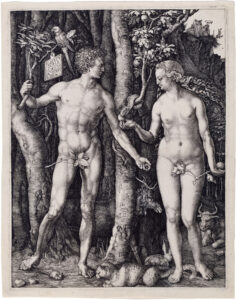
Albrecht Dürer – Adam and Eve – 1504
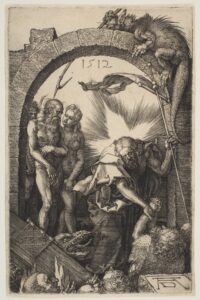
Albrecht Dürer – Christ in Limbo – 1512
There is no doubt that Rembrandt was inspired by Dürer, when he made this print. Not only by Dürer’s famous print of Adam and Eve of 1504, but certainly as much by another print Dürer made, Christ in Limbo (in 1512, B 16). Rembrandt owned a copy of this print. The composition with the arched foliage and the devious looking serpent is clearly made after this print.
Albrecht Altdorfer’s woodcut Fall and Redemption of Man (B1) may have served as an example for Eve.
Another example may have been a print made by Marcantonio Raimondi ca. 1510. Rembrandt made a preparatory drawing of the same subject (Benesch 164, now in the Leidse Universiteit). A second drawing (Benesch 163, now in the Felix Collection in Philadelphia), seems to be related as well, but the attribution to Rembrandt is not certain.
For the similarity with the light and shade on Eve’s body, Hinterding points at the drawing A Nude woman with a snake in the J.Paul Getty Museum (Benesch 137).
Copies
The New Hollstein lists two copies in the same direction. Copy A is by P.Basan (included in his Recueil), which is so deceptive it was taken for the original by Blanc (174 x 134 mm, two states, WB 1). The elephant’s eye is a black spot instead of an uncoloured circle. Copy B was earlier attributed to Gerard Dou (164 x 114, WB 2).
Attributions and reviews
The etching is considered as special by Blanc.
Arnold Houbraken criticized the way Rembrandt pictured the two figures, especially in comparison with the print by Dürer. Gersaint supported that view, stating “since Rembrandt was not very skilful in drawing nude people, this piece is inaccurate and the faces are quite unpleasant”.
The most appropriate description is probably made by Christopher White in his book Rembrandt by himself (London 1999). It reads as follows: “Eve, with the experienced calculating look of someone who is aware that the prey is at her command, holds up the apple with both hands (….) Adam stretches forth to take the apple while his other arm is raised (…) This becomes not so much a gesture of horror but one of awareness. His forefinger is raised as if he were spelling out the consequences to himself and warning Eve”.
The plate was made by a pupil according to Coppier.
States
All authors list two states, both contemporary. Nowell-Usticke lists one trial proof and one state.
In the 1st state (NH, WB, R106/trial proof A NU) the top line of the bank at left is light and interrupted.
In the 2nd state (NH, WB, R107/1st state NU) the top line is heavy. The corners are rounded. In early impressions there is a dark patch on Adam’s groin. Later impressions are dull.
Prints and collections
Of the 1st state only two impressions are known, one in the Albertina (R 106) and one in the British Museum in which a tree trunk is added in black chalk, probably by Rembrandt.
Watermarks
In the 1st and 2nd state: Strasbourg lily (1638); In the 2nd state: Foolscap; Strasbourg lily (2 ed., one c. 1648).
Literature
H 159, BB 38-D, G 29, M 206, Mz 177, RA 106-107, Cl 34, W 35, Bl 1, Du 35, CD 115, S 4. Rembrandt by himself 1999, p. 41; Lloyd Williams 2001, p. 155; Rohde 2005, p. 141; Tümpel 2006, p. 33; Hinterding 2008, p. 69; Rosenberg 2017, p. 54-61; Rutgers/Standring 2018, p. 66;
Rembrandt in Black & White: 78
New Hollstein/White-Boon: 2nd state of II.
A good, contemporary impression. A few small repairs at the left sheet edge, a horizontal crease through Adam’s head and adhesive remains at the sheet edges, verso.
Sheet 163 x 116 mm, no margins, trimmed on the plate mark (+1%).
Watermark: Foolscap, listed but not dated in Hinterding 2006 and NH. Horizontal chain lines at approx. 25 mm.
Provenance
In the collection of John MacGowan (d. 1803, Edinburgh, Lugt 1496), his collector’s mark in black ink verso;
In the collection of William Sharp (19th century, Manchester, Lugt 2650), his collector’s mark verso.
In the London Regional Art and Historical Museum 94 A 13, according to a sticker on the original
backside, with the additional notes 94 A 13 and 030.SB8;
Exhibitions
Rembrandt in Zwart-Wit, Westfries Museum (Hoorn), Het Markiezenhof (Bergen op Zoom), Stedelijk Museum Zutphen, Het Hannemahuis (Harlingen), Museum Gouda, Jan ten Horne Museum (Weert), Stadsmuseum Harderwijk, March 2013-August 2015;Stedelijk Museum Vianen, October 2017- January 2018; Rembrandt in Black & White, Schloß Britz (Berlin), Bozar Expo (Brussels), Chateau des Penthes (Geneva), November 2015 – October 2016; Rembrandt, fotograaf avant-la-lettre, Museum De Reede (Antwerp), January – May 2023; Rembrandt, 17th century photographer, Daegu Art Museum (Korea), November 2023 – March 2024; Rembrandt, de fotograaf, Westfries Museum (Hoorn), June 2024 – January 2025;