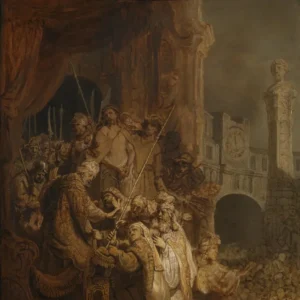
Etching and burin. 1635.
Size: 549 x 447 mm. Surface: 2454 cm2.
Signed and dated below the clock: Rembrandt f. 1635 in the 1st state. In the following states signed and dated in the bottom margin: Rembrandt f. 1636 cum privile.
According to an inscription on the 5th state the copperplate was in the possession of (and used by) Claude Malbouré (1645-1706) and/or his son Antoine (1679-1761), who were active as print dealers in Paris in the first half of the 18th century. It was not in any of major auctions or collections and is almost certainly not anymore in existence.
Rarity of impressions
In auctions (2000-2025): common Early: 21 Late: 1 ⦿⦿⦿⊙⊙⊙
In collections (New Hollstein 2013): frequent Early: 68 Late: 1 ⦿⦿⊙⊙⊙⊙
Catalogue Nowell-Usticke (1967): C1+, rather uncommon. A large plate; the central figures by Rembrandt, the balance probably school work. ⦿⦿⊙⊙⊙⊙
Story
John 19; verses 5-6
This largest of all etchings by Rembrandt is the earlier of two prints he made about the trial of Jesus in the court of Pilatus. Jesus, shown here in a serene, almost untouchable posture, is the subject of heavy debate between the Jewish Elders and the Roman Governor. Jesus has a crown of thorns on his head and is wearing a purple coat, ridiculing Him as the King of the Jews. Yet, Pilatus does not find Him guilty. Is that why the Jewish priests are furious and Pilatus has to hold them of, as Rembrandt seems to tell us?
Picture
Several authors have suggested that in this picture not Jesus, but Pilatus is the central figure. More precisely, the dilemma he is faced with.
On the left side a column is visible with the head of the Roman Emperor on top of it, as if looking at this scene from a distance.
Title
According to a document of 1711, this etching was also referred to as the ‘Thirty Guilder Print’ in the same way as B74 is (still) called the ‘Hundred Guilder Print’. It may be based on the price paid for the print in contemporary auctions.
Inspiration
The composition may be based on an engraving of 1581 by J. Sadeler, after Martin de Vos (Münz).
Related
Rembrandt – Christ before Pilate – 1634 – 55 x 45 cm – National Gallery London – Corpus A89 – Bredius 546
Rembrandt made a preparatory grisaille in 1634, now in the National Gallery in London (Corpus A89) and a drawing for one of the Jews, now in the Bibliothèque Nationale (HdG 715) and a second one (HdG 1363, formerly in the Texeira de Mattos collection).
Copies
The New Hollstein lists thirteen copies of which six in the same direction. Copy C is signed Savry (three states, 517 x 422 mm, WB 2 or 5).
Copy D is anonymous, inscribed Rembrandt (‘a’ and ‘d’ reversed, 565 x 453 mm, WB 3). Copy E is anonymous, inscribed Rimbrandt inuenter (527 x 440 mm). Copy F is by Georges Malbeste, signed Malbeste Sc. (two states, 301 x 219 mm, WB 1). Copy L is anonymous, inscribed Rembrandt f. 1636 cum priv. (the ‘d’ reversed, 554 x 438 mm, WB 4).
Copy M is by Edward John Poynter (1865, 213 x 165).
There are seven copies in reverse. Copy A is published by Cornelis Danckerts, inscribed Rembrandt van Rijn Inventor and C.Danckerts excud. (415 x 510 mm).
Copy B is anonymous (438 x 324 mm). Copy G is also anonymous (223 x229 mm, WB 6). Copy H is a small, anonymous copy, inscribed Rimbrandt inuenter (140 x 97 mm).
Copy I is a study of three heads by Dominique Vivant Denon, inscribed Rembrandt (52 x 119 mm). Copy J is by Ignace Joseph De Claussin (205 x 278, WB 7).
Copy K is by Auguste de Lamare, inscribed Lit de Calvados (1838, 257 x 203 mm).
Attributions and reviews
It is generally assumed that Rembrandt etched the central group and that others were responsible for the other parts. Suggestions range from Ferdinand Bol (Middleton) to Jan Lievens (Seymour Haden) to Salomon Koninck (de Vries) and Johannes van Vliet (Rovinsky, Seidlitz, Hind, Münz and Hinterding).
Tümpel and Royalton-Kisch, supported by watermark research by Hinterding, think that Rembrandt commissioned Johannes van Vliet to etch the 1st state on the basis of a grisaille made by Rembrandt. Watermark research has confirmed that the 1st state is printed on the same paper that Van Vliet used in that period. However, later editions are not, which means that the plate must have returned to Rembrandt, by then in Amsterdam.
The etching is considered as special by De Claussin and Blanc.
The plate was made by a pupil according to Middleton, Seidlitz, Coppier, Rovinsky, Singer and Michel.
States
As most authors New Hollstein lists five states, the final one not by Rembrandt but probably by Malbouré. Nowell-Usticke lists one trial proof and four states.
The 1st state (NH, WB, R252/NU trial proof A) is the unfinished version. Pilate and the group of Jews are left white. The plate is signed and dated below the tower clock at left.
In the 2nd state (NH, WB, R253/NU 1st state) the centre is completed. The signature is worked over and replaced by a new one, Rembrandt f. 1636 cum privile.
In the 3rd state (NH, WB, R254/NU 2nd state) the right shoulder of the man in front of Pilate is burnished out and Christ’s right leg is lengthened.
In the 4th state (NH, WB, R255/NU 3rd state) shading is added with the burin to the face of the man leaning forward left of Pilate.
In the 5th state (NH, WB/NU 4th state) an inscription is added Rembrandt pinxit. Malboure excud. Rue St. Jacques au dessus de St. Benoit a l’Imprimerie de taille douce. This is certainly a posthumous state.
Prints and collections
Of the 1st state only three impressions are known, one in the Rijksmuseum and two in the British Museum (R252). One of these shows many corrections in brown oil paint. These corrections were later included in the 2nd state.
Watermarks
In the 1st state: IHP with cm R (1633-1635). In the 2nd state: Strasbourg lily (2 ed., 1633-41).
In the 3rd state: Strasbourg lily.
In the 4th state: Arms of Bern; Grapes; HIS; Strasbourg lily (1639) and with 4WR (1655).
Literature
H 143, BB 35-K, G 83, M 200, Mz 204, RA 252-255, Cl 82, W 82, Bl 52, Du 84, CD 104, S 38Rembrandt & Van Vliet,1996, p. 69-72; Tümpel 2006, p. 76-77; Hinterding 2006, p. 88-91; Hinterding 2008, p. 167ff;
Rembrandt in Black & White: 201
New Hollstein/White-Boon: 4th state of V
A very strong impression with traces of burr in the curtain upper right. The 4th state confirmed by the shadow on the face of the leaning man (present) and the absence of the address of Malbouré in the lower margin.
Sheet 557/554 x 450/448 mm, no margins, cut at the platemark (+2%). Very thick laid paper.
Watermark: Strasbourg lily (Ash & Fletcher 36 C), horizontal chain lines at approx. 30 mm.
Provenance
In the collection of Charles M. Lea (1853-1927, Philadelphia, Lugt 1662a), his collection mark weakly visible verso.
In 1928 this collection of 4500 prints was donated by will to the Art Museum of Philadelphia.
Then via Christopher-Clark Fine Art (San Francisco) sold to Mr. Michael Chapman (Wenham, Maryland).
Exhibitions
Rembrandt in Zwart-Wit, Stedelijk Museum Vianen, October 2017 – January 2018; Rembrandt, fotograaf avant-la-lettre, Museum De Reede (Antwerp), January – May 2023; Rembrandt, de fotograaf, Westfries Museum (Hoorn), June 2024 – January 2025;