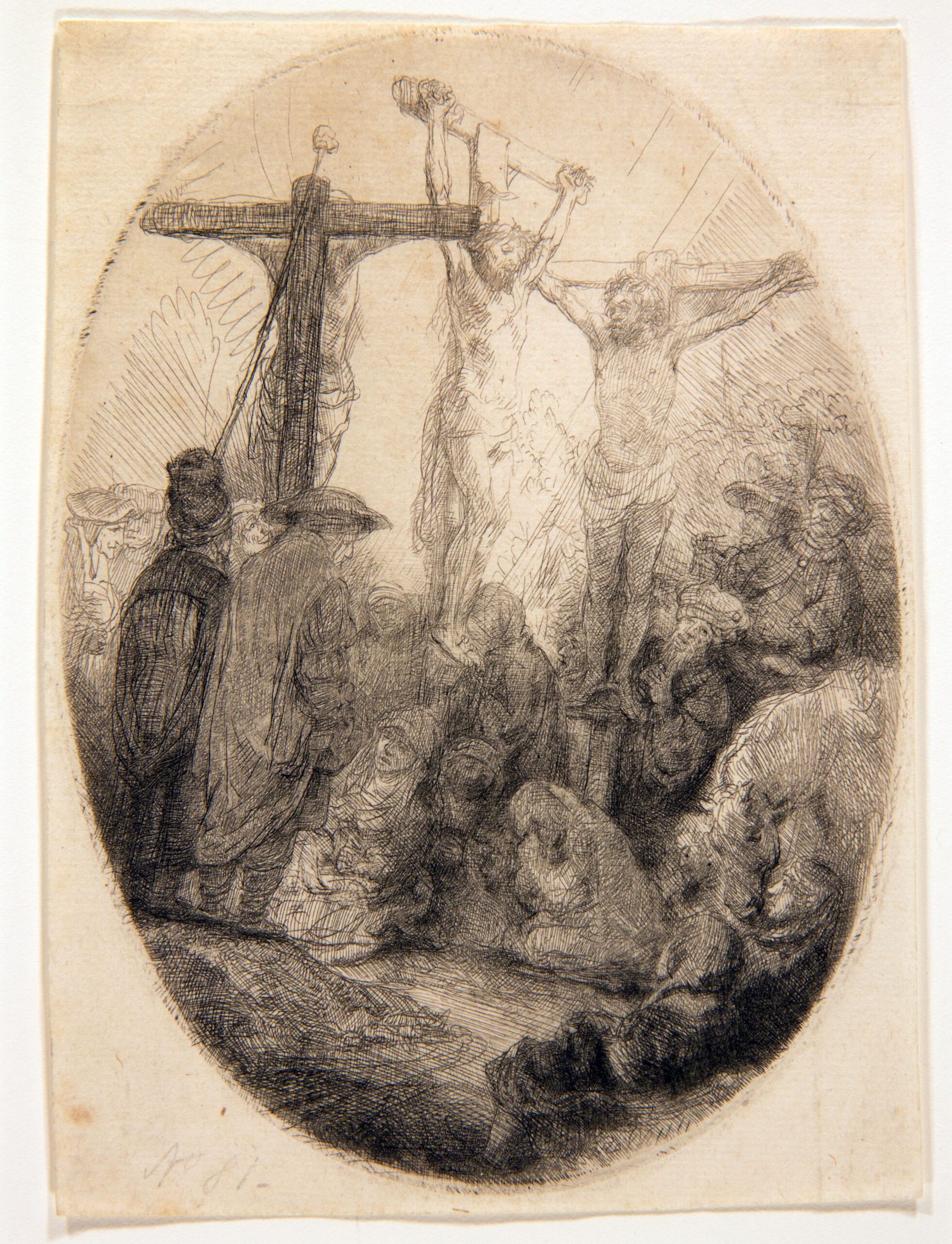
Christ crucified between the two thieves: an oval plate
French title:
Jesus Christ en croix entre deux larrons
German title:
Christus am Kreuze zwischen den Schachern
Dutch title:
Christus aan het kruis
New Hollstein:
196
Rembrandt in Black & White:
64
Etching and drypoint. Ca. 1641.
Size: an oval of 131 x 100 mm. Surface: 131 cm2.
Not signed, not dated. Dating is about 1641, although Münz states 1643 or 1644 (on the basis of similarity to the Three Crosses and the Hundred Guilder print) and Middleton even 1648.
The copperplate was in the sale by Clement de Jonghe (1679, as 36 oovaal cruysingh). An unknown owner added two dots around 1700. It was then in the sale by Pieter de Haan (1767, lot 27), where sold to J.Sluyter. It was used by Mc’Creery in the 200 etchings and later used for reprints by W.Lewis (1819 and 1822) and J.Kay (1826). The plate is probably not anymore in existence.
Rarity of impressions
In auctions (2000-2025): common Early: 2 Late: 24 ⦿⦿⦿⊙⊙⊙
In collections (New Hollstein 2013): common Early: 35 Late: 22 ⦿⦿⦿⊙⊙⊙
Catalogue Nowell-Usticke (1967): An uncommon print.
Picture
For the second of three prints dedicated to the crucifixion, as described in John (19, verses 17-36), Matthew (27, verses 33-56) and Mark (15, verses 21-41), it is difficult to define the precise moment of the picture, as Münz has pointed out. On one hand Christ seems to be talking to one of the thieves, while on the other hand the praying man on the left suggests that the central piece is the conversion of the centurion. The three Maria’s are drawn sitting with their back to the cross, comforting each other. They are mentioned by John, not by Luke. Notice that the light from above shines at Jesus and the ‘good’ thief on the right, but not on the ‘bad’ one on the left. As in the later print, the ‘good’ thief is shown on the wrong side of Jesus, due to the reversal effect of the etching.
Inspiration
According to Münz the group with the Virgin under the cross may be inspired by an engraving by Mantegna (B2), The Entombment with the three birds.
Related
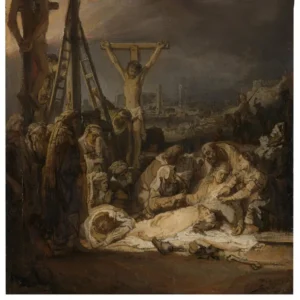
Rembrandt – The descent from the cross – ca 1635 – 32 x 27 cm – The Nationale Gallery London – Bredius 565
Around 1637 Rembrandt used the same composition in a grisaille The Descent of the Cross, now in the National Gallery in London (Bredius 565).
About ten years after this etching, Rembrandt made a drawing (Benesch 652, now in the Louvre) which also shows Christ’s last conversation with the thieves.
For some time the composition with the woman standing in front of the cross was compared with a drawing in Kupferstichkabinett in Berlin (Benesch 108), but that drawing is now attributed to Gerbrand van den Eeckhout (1621-1674).
Copies
The New Hollstein lists four copies of which an anonymous one (A), in the same direction, inscribed Rembrandt in (132 x 97 mm, WB 1).
There are three copies in reverse, B and C, both anonymous (resp. 132 x 100 mm and 141 x 96 mm). Copy D is signed by Francesco Novelli (three states, 142 x 108 mm, WB 2).
Attributions and reviews
The etching is considered as special by Coppier.
States
The New Hollstein lists three states, only the first by Rembrandt. The 2nd state, with the two dots, is ‘new’. Most other authors list two states, Nowell-Usticke three. From his 2nd state (NU) there are later impressions by Watelet.
In the 1st state (R260-261) the left arm of the cross has a square edge touching the border. The diagonals under the scroll are vertical and right-left only.
In the 2nd state (NH only) two dots are added in the upper centre, right above the right arm of Jesus.
In the 3rd state (NH/2nd state WB, H, NU, R262) some shadows are reworked with the rocker. Best visible in the left arm of the left cross, which is much darker. The end of the left arm is rounded and does not touch the border anymore. Diagonal lines left-right are added in the small area between Christ’s head and the scroll. Some outlines, like the right side of the body and waste, are strengthened with double lines.
In the 3rd state (NU, 200 etchings) the plate is coarsely rebitten and completely spoilt.
Prints and collections
There is a counterproof of the 1st state in the Teylers Museum in Haarlem.
Recueils
The etching is included in the 200 Etchings (1816) but not in the Recueil by Basan.
Watermarks
In the 1st state: Basilisk (ca. 1641); Foolscap with five-pointed collar (ca. 1651-52); Strasbourg lily.
Literature
H 173, BB 41-2, G 81, M 222, Mz 215, RA 260-262, Cl 84, W 85, Bl 54, Du 86, CD 130 Hinterding 2008, p. 174ff; Rutgers/Sandring 2018, p. 87;
Rembrandt in Black & White: 64
New Hollstein: 2nd state of III/White-Boon: 1st state of II
A very good posthumous impression. Residue of square adhesives verso. A very small stain spot in the lower left margin. On one hand the two dots are clearly visible, but all other changes of the 3rd state are not. The additional shading with the rocker on the left arm of left cross is not visible and the arm is still square and touching the edge. The right waist of Christ is only showing single lines. The very fine diagonal shading lines in the background are still visible, the plate edges are uncleaned. NH has not found a 2nd state, this may well be the only impression known.
Sheet 139/137 x 98/101 mm, cut at the plate line on top, margins of 1 mm at both sides and 2 mm at the bottom.
No watermark, vertical chain lines at approx. 20 mm.
Exhibitions
Rembrandt in Zwart-Wit, Stedelijk Museum Zutphen, November 2013-February 2014; Rembrandt, de fotograaf, Westfries Museum (Hoorn), June 2024 – January 2025;