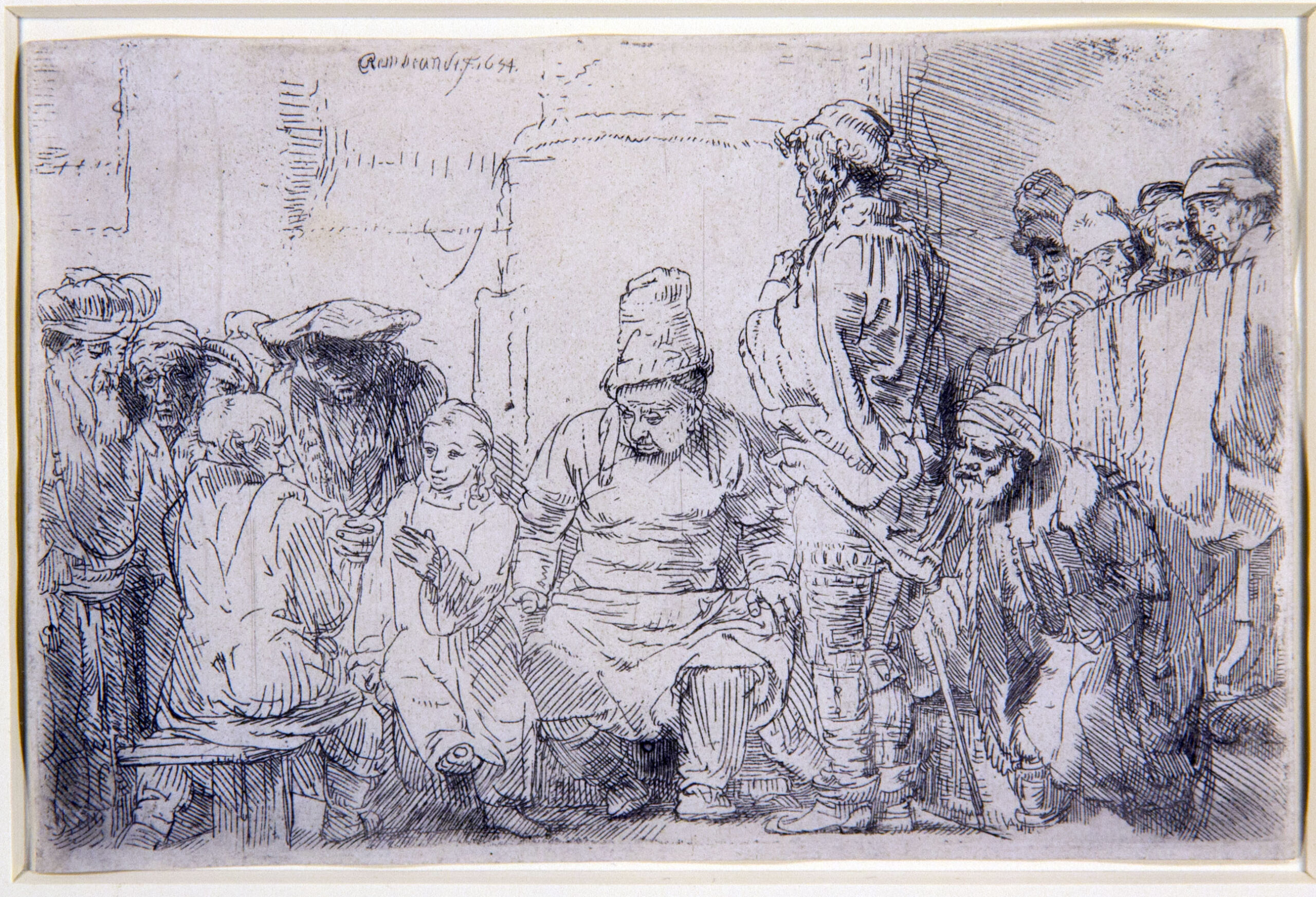
The plate was probably in the collection of Clement de Jonghe (1679, as 52 Christus disputerende met de Phariseen). It later appeared in the sale of Pieter de Haan (1767, lot 21) and was sold via Fouquet to Claude-Henri Watelet (1718-1786). It then became part of the set of plates subsequently owned and used for printing Recueils by Pierre-François Basan (1723-1797), Henri-Louis Basan (his nr 1388), Auguste Jean (ca 1809), Veuve Jean, Auguste and Michel Bernard (1846), Alvin-Beaumont (1906) and Robert Lee Humber (1937). It was sold at the Artemis sale in London (1993). It was first with Noortman Master Paintings (Maastricht 2007), then in the collection of Pieter Dreesmann (Brussels). In 2010 sold to a Dutch private collector.
Rarity of impressions
In auctions (2000-2025): very frequent Mixed: 76 ⦿⊙⊙⊙⊙⊙
In collections (New Hollstein 2013): frequent Mixed: 70 ⦿⦿⊙⊙⊙⊙
Catalogue Nowell-Usticke (1967): C2, a fairly common print ⦿⊙⊙⊙⊙⊙
Story
Luke 2: 41-52
Rembrandt must have been impressed by the verses in the Bible that describe that Christ, as a twelve-year old boy, accompanied his parents to Jerusalem for Passover and was left behind when they returned. He was found three days later in the temple, in discussion with the teachers. Rembrandt made the first etching of this story in 1630 (B66). In the early ’50s he returned to the subject with three more etchings (B60, B65 and this one).
Picture
At least nine men surround the young boy and four more are listening from some sort of balcony. One of those four seems to be dosing off. The man with the cane at right may have just arrived at the scene. At first glance the large man in the middle is attracting the attention, but it quickly becomes clear that the boy, the least shaded of all figures, is the main actor here.
Inspiration
The composition with the child was earlier used by Altdorfer and Gerard van Groeningen (1583).
Related
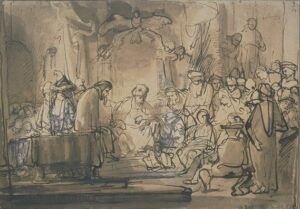
Rembrandt – Christ among the Doctors – ca 1652 – Louvre – Benesch 885
Rembrandt made drawings of the same subject probably about the same time that he made the three later etchings (Benesch 936, now at the Nationalmuseum in Stockholm and Benesch 885, now in the Louvre).
In 1654 Rembrandt made a series of six etchings about the childhood of Jesus, of which this is one. They all have a roughly similar size, are stylistically comparable and follow the scripture quite strictly, as Tümpel pointed out.
Rembrandt’s son Titus, who was twelve years old at that time, may have served as a model for Christ (Valentiner).
Copies
Middleton mentions two copies in reverse by Novelli and Denon, but Biörklund thinks that he may have seen a copy by Capt. Baillie. There are no copies listed in NH.
Attributions and reviews
The etching is considered as special by Singer.
States
The New Hollstein and most authors list one state only. Nowell-Usticke lists two states, from his 1st state there are later impressions by P.Basan, H.Basan, Jean, Bernard and Beaumont.
The 1st state (NU, R207) has square corners. Early impressions show burr on the legs of the man standing in the centre.
In the 2nd state (NU only) the corners are rounded. In later impressions (by Bernard and Beaumont) there is a diagonal left-right scratch of one inch to the left of the face of the tall man standing.
Prints and collections
There are several prints on Japanese paper.
Recueils
The etching appears in the Recueil de Basan, impressions fairly strong (NU).
B&W 54 – Recueil de Basan – Page 7 NH/WB: only state
A good impression of the only state (NH)
B&W 206 – Recueil de Beaumont – Sheet 20 NH/WB: only state
A good impression of the only state (NU), showing the scratch to the left of the man standing.
Watermarks
Countermark AD; Foolscap with five-pointed collar; Foolscap with seven-pointed collar; Seven Provinces; Strasbourg bend.
Literature
H 277, BB 54-E, G 63, M 245, Mz 230, RA 207, Cl 68, W 68, Bl 35, Du 67, CD 234, S28. Rembrandt’s passie, p. 84-85; Hinterding 2008, p. 135-136; Late Rembrandt p. 186;
Rembrandt in Black & White: 110
New Hollstein/White-Boon: Only state
A very good, somewhat later impression. There is a small paper flaw below the seated man at centre.
Sheet 96 x 145/146 mm, narrow margin of approx. 1 mm below, trimmed on the platemark elsewhere (+2%).
No watermark, chain lines horizontal.
Provenance
In the collection of the Swedish Rembrandt expert George Biörklund (b. 1887, Stockholm, Lugt 1138c), his collector’s stamp in purple ink (very faint) verso;
According to notes on the frame it was catalogue number 254A in an unknown auction.
Exhibitions
Rembrandt in Zwart-Wit, Stedelijk Museum Zutphen, Stadsmuseum Harderwijk, November 2013 – August 2015; Stedelijk Museum Vianen, October 2017 – January 2018; Rembrandt in Black & White, Schloß Britz (Berlin), Bozar Expo (Brussels), Chateau des Penthes (Geneva), November 2015 – October 2016; Rembrandt, de fotograaf, Westfries Museum (Hoorn), June 2024 – January 2025;