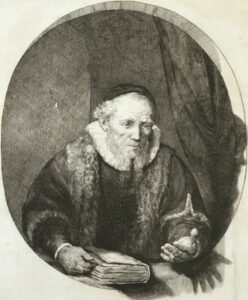
B 280

Jan Cornelis Sylvius, Preacher

  • French title:
    Jean Sylvius
  • German title:
    Jan Cornelis Sylvius
  • Dutch title:
    Jan Cornelis Sylvius
  • New Hollstein:
    235

Etching, drypoint and burin, 1646.
Size: 278 x 188 mm. Surface: 523 cm2.
Signed and dated, in the top of the oval: Rembrandt 1646

Copper Plate

The plate was not part of any of the major collections and is probably not in existence.


Rarity of impressions

  • In auctions (2000-2025): very rare                                         Early: 10                                        ⦿⦿⦿⦿⊙⊙

  • In collections (New Hollstein – 2013): rare                            Early: 54                                       ⦿⦿⦿⦿⊙⊙

  • Catalogue Nowell-Usticke (1967): RRR: A very rare posthumous portrait                            ⦿⦿⦿⦿⦿⊙


Subject/Sitter

Sylvius was a well-respected preacher in Amsterdam. He was a friend of Rembrandt and related by his marriage to Aeltje Uylenburgh, a niece of Saskia. When Rembrandt expressed his intention to marry with Saskia on 10 June 1636, it was Sylvius who represented the bride at the registrar. Rembrandt made various drawings and two etchings of Sylvius. This (second) portrait of Sylvius was made about eight years after his death in 1638. The text under the picture is by Caspar van Baerle (1584-1648), also known as Barlaeus. It is the only portrait which has both a description of the sitter surrounding the oval and a poem at the bottom. It was clearly meant as a tribute to this eminent person.
Thirteen years earlier Rembrandt made an etching of Sylvius from life (B266).


Related

As a study for this etching Rembrandt made several drawings (Benesch 763, now at the British Museum and Benesch 762a, Nationalmuseum in Stockholm). In these drawings he left a large blank piece of paper, probably anticipating the text of Barlaeus.
Royalton-Kisch pointed at a third drawing (Benesch 762 in the National Gallery in Washington).
Rembrandt made a painting of Aeltje Uylenburgh in 1632 (Bredius 333, private collection, on loan in the Mauritshuis).


Copies

B&W 389 – Copy C of NH 235 – B 280


NH lists three copies, all in reverse.
Copy A is  by Thomas Worlidge (four states, 161 x 105 mm, WB 2). Copy B is by Claude-Henri Watelet (bust only, 107 x 159 mm).
Copy C is by Francesco Novelli (his nr. 6, two states, 230 x 190 mm, WB 1), inscribed F.Novelli inc 1792. It is included in the collection “Rembrandt in Black & White”, number 389.


Attributions and reviews

The etching is considered as special by Bartsch, Hind, Seidlitz, Coppier, Rovinsky, Wilson and Blanc.
The plate is not by Rembrandt according to Singer.


States

NH, as most authors, lists two states, both contemporary. Nowell-Usticke lists one trial proof and two states.
In the 1st state (NHD, WB, R750) a small area between the corner of the right eye and the eyebrow only has diagonal shading, appearing lighter.
In the 2nd state this area is covered with cross hatching, appearing darker. A slipped stroke of about 40 mm in the upper right-hand corner is considered by NU as a trial proof . NH does not consider it a separate state.


Prints and collections

Of the 1st state only seven impressions are known. There are probably no posthumous impressions.


Watermarks

In the 1st state: Strasbourg bend (1646);
In the 2nd state: Countermark R (3 ed.); Countermark IR; Strasbourg bend ((3 ed., all 1646);


Literature

H 225, BB 46-E, G 260, M 225, Mz 68, RA 750, Cl 277, W 282, Bl 187, Du 269, CD 182, S 126.
Broos and Panhuysen in Kroniek van het Rembrandthuis, 2006/1-2, p. 42-68; Dickey 2004, pff; Hinterding 2006, p. 320-321; Hinterding 2008, p. 504-507; Broos 2012, p. 51; Rutgers/Sandring 2018, p. 103; Bikker 2019, p. 64;