B 17

Self-portrait in cap & scarf with the face dark: bust

  • French title:
    Rembrandt avec l’echarpe autour du cou
  • German title:
    Selbstbildnis mit der Scharpe um den Hals
  • Dutch title:
    Zelfportret met muts en sjaal
  • New Hollstein:
    120
  • Rembrandt in Black & White:
    157

Etching. 1633.
Size: in the 1st state 146 x 115/118 mm, from the 2nd state 132 x 103 mm.
Surface: in the 1st state 172 cm2, from the 2nd state 136 cm2.
Signed and dated from the 2nd state, in the margin below: Rembrandt. f. 1633.

Copper Plate

The copperplate was in the sale of Jean de Bary (1759, lot 55) and sold to Fokke (on behalf of Yver) and later Claude-Henri Watelet (1718-1786). It then became part of the set of plates subsequently owned and used for printing Recueils by Pierre-François Basan (1723-1797), Henri-Louis Basan (his nr 1374), Auguste Jean (ca 1809), Veuve Jean, Auguste and Michel Bernard (1846), Alvin-Beaumont (1906) and Robert Lee Humber (1937). It was sold at the Artemis sale in London (1993) and is now probably in a private collection in the USA.


Rarity of impressions

  • In auctions (2000-2025): very frequent                   Early: 24 – Late: 43 – Unknown: 14    ⦿⊙⊙⊙⊙⊙

  • In collections (New Hollstein 2013): frequent                       Early: 47 – Late: 26                      ⦿⦿⊙⊙⊙⊙

  • Nowell-Usticke (1967): C2-, one of the commonest and least attractive                                   ⦿⊙⊙⊙⊙⊙


Picture

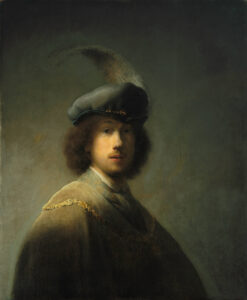
Inspired by Caravaggio (1571-1610) and his followers, the Utrechtse Caravagisten, Rembrandt made several experimental self-portraits. This is clearly one of those. Rembrandt kept the whole face in the shadow, using only two small white dots to lighten up the eyes and a glimmer of light on the nose. He tried this shadow effect earlier (B 12), but that experiment failed miserably. It is the first self-portrait signed with his full name.
The combination of the clothing is quite remarkable: the button and string on the left shoulder point at a ‘military’ shirt, yet the scarf is oriental (East Indian) and informal.


Related

RembrandtSelf-portrait at age 23 – 1629 – Isabella Stewart Gardner Museum, Boston – 90 x 74cm – Corpus 20 – Bredius 8

Biörklund points at a drawing in black chalk in reverse, now in Marseille. There is also an etching by Lievens dated 1634 of the same subject without the cap (Rov. 19).
The scarf can be seen in another etched self-portrait (B 23) and in two paintings, one in the Gemäldegalerie in Berlin (Corpus A 96, Bredius 21) and one in the Isabella Stewart Gardner Museum in Boston (Corpus A 20, Bredius 8).
The military shirt is seen in the portrait Rembrandt made in the same year of Joris de Caulerij (Corpus A53, Fine Arts Museum, San Francisco). I
t is assumed that Rembrandt was inspired by a print made in 1620 by Andries Stock after a self-portrait of Lucas van Leyden (1494-1533) at the age of 15. It shows the exact same composition, including the beret.


Copies

NH lists four copies in reverse. A is an anonymous copy, inscribed Rembrandt f, published by Hertel (two states, 118 x 107 mm, WB 1). B is by Thomas Worlidge (his nr 7, 124 x 98 mm, WB 2), C is inscribed Rb.in and dated 1773 (158 x 147 mm). D is again an anonymous copy with an inscription in German (246 x 163 mm).


Attributions and reviews

The plate was made by a pupil according to Seidlitz.


States

NH lists five states of which only the first two by Rembrandt. Most other authors list two states, Münz and Biörklund three, Wilson four. Nowell-Usticke lists two trial proofs and five states, from the 3rd state there are later impressions by Watelet, P-F. Basan, H-L. Basan, Jean, Bernard and Beaumont.
The 1st state (NH/R62/NU trial proof A) is the original large plate without the signature.
In the same state (R63/NU trial proof B) the cap and the shading at the right are retouched. Most authors consider this the same state, but NU thinks it may be older than his trial proof A.
In the 2nd state (NH/R64/NU 1st state) the plate is reduced and the signature and date are added. Crosshatching is added in many places, like on the left upper arm below the hanging ribbon, the breast, the highlights of the hair, under the eyes and on the ear. The left eye shows a clear white spot left of the pupil.
In the 2nd state (NU only) the grey patches on and over the left eye are reworked, the white spot near the centre of the right pupil is filled.
In the 3rd state (NH/BB) about six vertical lines are added on the upper part of the left eyelid. Some diagonal lines are added left of the moustache. According to NHD not by Rembrandt. Impressions by de Bary, P. and H. Basan.
In the 3rd state (NU Watelet?) the cap is entirely retouched and there is a strong line along the top of the right eyelid. The mouth is a straight line and slants up to the left. Much new work on the face, eyebrows.
In the 4th state (NH/R65?/NU Basan, Jean, Bernard) the plate seems entirely rebitten. The centre of the ear appears as a heavy triangular black spot, the face seems flat and lighter than in earlier states. In intermediate prints there are light vertical scratches in the blank tablet 1,5 cm to the right of 1633. In late prints there are about ten diagonal left-to-right scratches just right of the hair, on the level of the eyes. Impressions in the H.Basan Recueil.
In the 5th state (NH/NU Bernard, Beaumont) the entire face is reworked with diagonal crosshatching, probably by Bernard. The pupil of the right eye is much larger and the shape of both eyes is altered. The nose is straight and sharp and the lower lip is much fuller. Impressions by H.Basan and Alvin-Beaumont.


Prints and collections

Of the 1st state (NU trial proof A and B) only three impressions are known, two in the Rijksmuseum of which one cut and the other (R62, the only one with full plate?) retouched with brown wash and one, also cut, in the Albertina (R63). There is a counterproof of the 2nd state in Boston.
Nowell-Usticke considers the unchanged impressions in the Recueil de Basan, as good.


Watermarks

In the 2nd state: Arms of Wurttemberg (1634); Basel crosier (1634-35); Basilisk; Foolscap with five-pointed collar A.a (1643), K.e (1650-51) and with CM LB A.a (1650); Foolscap with seven-pointed collar;
In the 3rd state: Arms of Amsterdam D.d and G.b.


Literature

H 108, BB 33-G, G 22, M 99, Mz 18, RA 62-65, Cl 17, W 17, Bl 229, Du 17, CD 80
Rembrandt by himself 1999, p.152; Hinterding 2006, p. 245; De grote Rembrandt 2006, p. 25; Hinterding 2008, p. 53-54; Rembrandts Radierungen 2011, p. 46-47; Baas 2015, p. 48-49;


Rembrandt in Black & White: 157

NH: 2nd state of V, WB: 2nd state of II
A good, contemporary impression. The six vertical lines on the upper part of the left eyelid, typical for the 3rd state (NH) are not yet visible. However, it is very difficult to recognize these and it therefor may also be an early impression of the 3rd state. Remains of hinges in the top margins remain visible recto.
Sheet 134 x 103 mm, thread margins of 1 to 2 mm all around (+2%).
Part of an unidentified watermark vaguely visible. Horizontal chain lines.


Provenance

In the Cabinet de Molitor, according to a handwritten text verso; Sold in their auction on 10 December 1812 (lot 639).
In the collection of Franz Gawet, an amateur engraver and collector (1765-1847, Vienna, Lugt 1069). His name handwritten or stamped in brown ink with the year 1812 at the top verso; It was probably sold at the Gawet/Kölbl sale at Artaria & Compagnie in Vienna, on 9 December 1844 (lot 757).
With Palmer Art in New York according to a sticker on the protective sheet at the back.


Exhibitions

Rembrandt in Black & White, Bozar Expo (Brussels), Chateau des Penthes (Geneva), March – October 2016;
Rembrandt, fotograaf avant-la-lettre, Museum De Reede (Antwerp), January – May 2023;
Rembrandt, 17th century photographer, Daegu Art Museum (Korea), November 2023 – March 2024;
Rembrandt, de fotograaf, Westfries Museum (Hoorn), June 2024 – January 2025;