B 21

Self-portrait leaning on a stone sill

  • French title:
    Rembrandt appuyé
  • German title:
    Selbstbildnis with dem aufgelehnten Arm
  • Dutch title:
    Zelfportret, leunend op een balustrade
  • New Hollstein:
    171
  • Rembrandt in Black & White:
    46

Etching and touches of drypoint. 1639.
Size: 205 x 164 mm. Surface: 336 cm2.
Signed and dated, in the upper left corner: Rembrandt f. 1639.

NH 171 – 2nd state of II

Copper Plate

The plate was not part of any of the early sales or collections and is probably not in existence.


Rarity of impressions

  • In auctions (2000-2025): common                                          Early: 21                                        ⦿⦿⦿⊙⊙⊙

  • In collections (New Hollstein 2013): common                       Early: 68                                        ⦿⦿⦿⊙⊙⊙

  • Nowell-Usticke (1967): RR-, very scarce, a most desirable portrait                                       ⦿⦿⦿⦿⊙⊙


Picture

This etching shows Rembrandt at the age of 33. At that moment he had just bought his new house at the Breestraat, the present Rembrandthuis. He portrays himself in a self-assured, almost arrogant pose. In clothes that were certainly not used in everyday life in that period. It is probably the best known and most popular of his self-portraits, which is supported by the numerous copies made by other artists.


Related

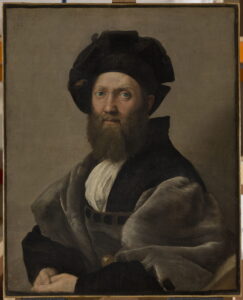
Raphael – Portrait of Balthassar Castiglione – Musée du Louvre 


On 9 April 1639 a portrait of Baldassare Castiglione by Raphael (now in the Louvre) was auctioned at the Van Uffelen sale in Amsterdam. The painting was so well respected that Rubens made a copy of it (now in the Courtauld Gallery in London). It was acquired by the Portuguese merchant Alfonso Lopez, at the staggering price of 3500 guilders, about ten times the prices paid for Dutch masters at that time. Rembrandt made a drawing of the painting during the auction (Benesch 451, now in the Albertina). Although he seldom added text to his works, he completed this drawing with the names of the painter and the buyer and the price paid. It is generally assumed that Rembrandt has been inspired by this painting to present himself in a similar, self-confident mode. Maybe Rembrandt was also inspired by another painting in the collection of Lopez, the Man in Blue, by Titian (c. 1510, National Gallery in London), considered to be a either portrait of the poet Lodivico Ariosto or of Gerolamo Barbarigo. It shows a man leaning over a sill with a lined sleeve.


Copies

NH lists no less than 23 copies. Of these only seven are in the same direction. Copy L is by Adam Bartsch, the bust only. It is used as frontispiece of his publication in 1797 (168 x 111 mm, WB 1). There two wood engravings, copies U and V, by William Harcourt Hooper (26 x 113 and 145 x 19 mm). Copy W is by William Steelink, signed and dated Wilm Steelink / 87 (147 x 99 mm). Copies G,O and P are anonymous (resp. 240 x 193 mm, 175 x 140 mm and 200 x 147 mm, WB 2, – and 3).
There are sixteen copies in reverse. Copy A is by Charles Errand, inscribed Rembrandt van Rin (168 x 138 mm, WB 9). Copy B is by N. van Til, in which Rembrandt’s face is replaced by another, signed N V Til – 1686 (179 x 139 mm). Copy C is by Thomas Worlidge (his nr 2, 158 x 135 m, WB 7).
Copy D is by Honoré Cousin, with the head only, inscribed rembran and signed h.c.f. (two states, 161 x 141 mm) Copy J is by Dominique Vivant Denon, signed Dn 1783 (two states, 168 x 111 mm, WB 6). Copy K is by Francesco Novelli, signed and dated F.Novelli Inci 1790 (his nr 7, two states, 218 x 168, WB 5).
Copy Q is an etching with engraving by Richard Girling (three states, 179 x 154 mm). Copy R is signed John Burnet (210 x 160 mm, WB 10). Copy is by Johann Wilhelm Kaiser. It is inscribed Rembrandt f 1639, signed JW Kaiser and used by Scheltema in 1859 and 1866 and by van Vloten in 1874, (230 x 158 mm, WB 4).
There five more anonymous copies in reverse.


Attributions and reviews

The etching is considered as special by Bartsch, Seidlitz, Coppier, de Claussin and Wilson.
Gersaint considered this portrait to be the finest of all self-portraits by Rembrandt.


States

Most authors, including NH, list two states. Hind and Nowell-Usticke list three states, from the 3rd state of NU there are later impressions (retouched by Watelet).
In the 1st state (NH, WB, R75-76) the band of the cap is not complete on the right side. There are four short irregular horizontal lines above and left of the left eye. Early impressions have burr on the wall left of the hand and just above the glove.
In the 2nd state (NH, WB, R77) the band is completed. The lower eyelid of the left eye is defined with a new line.
The 3rd state (H, NU) is possibly a retouch by Watelet, very well executed. There are now four regular lines above and left of the left eye.


Prints and collections

On at least six impressions of the 1st state, including one in the Rijksmuseum and one in the British Museum (R76), Rembrandt used black chalk to strengthen the print and to ‘experiment’ with additions he only partially added in the 2nd state (the band) or not at all (a balustrade). NH lists 17 impressions of the 1st state.
On one impression of the 2nd state in the British Museum, the signature has not been inked.


Literature

H 168, BB 39-E, G 26, M 137, Mz 24, RA 75-78, Cl 21, W 21, Bl 234, Du 21, CD 128, S 2
Fuchs 1968, p. 57-58; E. de Jongh, ‘The Spur of Wit’ in Delta, summer 1969, p. 49-67; Broos 1985, p. 62; Rembrandt by himself 1999, p. 170; Dickey 2004, p. 89; Rohde 2005, p. 55; Hinterding 2008, p. 59ff; Broos 2012, p. 88; Rutgers/Standring 2018, p. 66; Bikker 2019, p. 75;


Rembrandt in Black & White: 46

New Hollstein/White-Boon: 2nd state of II.
A very good, contemporary impression.
Sheet 205/208 x 162 mm, no margins, cut on or slightly inside the platemark (= 0%).
Watermark: Foolscap with five-pointed collar (Ash-Fletcher I.b.), printed between 1639 and 1650. Vertical chain lines at approx. 24 mm.


Provenance

In the collection of the Metropolitan Museum of Art, New York, their (duplicate) marks in purple and black ink verso;
In the collection of Richard H. Zinser (not in Lugt), his collectors mark (a chess tower) in black ink in the lower margin verso.


Exhibitions

The Rotunda at Exchange Square, Hong Kong, January 2008;
Rembrandt in Zwart-Wit, Westfries Museum (Hoorn), Het Markiezenhof (Bergen op Zoom), Stedelijk Museum Zutphen, Het Hannemahuis (Harlingen), Museum Gouda, Jan ten Horne Museum (Weert), Stadsmuseum Harderwijk, March 2013-August 2015; Stedelijk Museum Vianen, October 2017- January 2018;
Rembrandt in Black & White: Schloss Britz (Berlin), Bozar Expo (Brussels), Chateau de Penthes (Geneva), November 2015-October 2016;
Rembrandt, fotograaf avant-la-lettre, Museum De Reede (Antwerp), January – May 2023;
Rembrandt, 17th century photographer, Daegu Art Museum (Korea), November 2023 – March 2024;
Rembrandt, de fotograaf, Westfries Museum (Hoorn), June 2024 – January 2025;
Etsen van Rembrandt, Museum Den Briel, May-September 2026;