B 23

Self-portrait (?) with plumed cap and lowered sabre

  • French title:
    Portrait de Rembrandt en ovale
  • German title:
    Selbstbildnis mit dem Federbusch
  • Dutch title:
    Zelfportret met baret en sabel
  • New Hollstein:
    135
  • Rembrandt in Black & White:
    255

Etching and burin. 1634.
Size: in the 1st state 197 x 162 mm, then 130 x 107 mm. Surface: in the 1st state 319 cm2, later 139 cm2.
Signed and dated, in the top left corner in the 1st state and in the lower left corner in the 2nd state: Rembrandt. f. 1634.

NH 135 – 3rd state of III

Copper Plate

The copperplate was not part of any of the early sales or collections and is almost certainly not in existence.


Rarity of impressions

  • In auctions (2000-2025): rare                                                  Early: 14                                        ⦿⦿⦿⦿⊙⊙

  • In collections (New Hollstein 2013): frequent                       Early: 72                                        ⦿⦿⊙⊙⊙⊙

  • Nowell-Usticke (1967): C1+, an uncommon attractive portrait, probably by van Dorp and not by    ⦿⦿⊙⊙⊙⊙
    Rembrandt. The large state (1st state) is a great rarity.


Subject/Sitter

This etching is still considered to be a self-portrait by some authors, although the person depicted here shows little resemblance with Rembrandt. Also, we see a wart on the right cheek (warts had a negative connotation in the 17th century), not seen in any other self-portrait and the person shown seems to be much ‘bulkier’ than expected in a portrait of Rembrandt. Various other identifications have been made, like Admiral Philip van Dorp (Münz, Nowell-Usticke and Jan Six), Prince Adolf van Cleve (Middleton) and Prince Adolph of Gueldres (Blanc). The latter based on a resemblance with a painting by Rembrandt in 1635 Samson threatening his father-in-law, now in the Gemäldegalerie Berlin (Corpus A 109, Bredius 499). Biörklund suggested Joris de Caullery based on the likeliness with a portrait made in 1632 (Bredius 170, formerly in the Seligmann collection).


Related

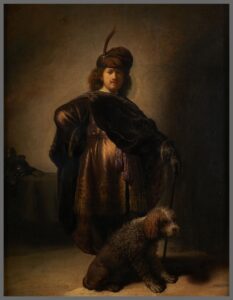
Rembrandt – Self -portrait as an Oriental – 1631 – Musée du Petit Palais – Corpus A40 – Bredius 16


According to Hinterding both the pose and attire are similar to that in Self-portrait as an Oriental of 1631, now in the Musée du Petit Palais in Paris (Corpus A 40).


Copies

NH lists eight copies, of which five in the same direction. Copy A is by Georg Leopold Hertel, inscribed Rembrandt del. and No 183 and signed G.L Hertel sculp (two states, 126 x 90 and 115 x 90 mm, WB 3). Copy B is an anonymous etching 188 x 157 mm, WB 1). Copy D is by Johann Elias Haid with mezzotint and a long inscribed text (260 x 177 mm). Copy G is a very deceptive copy by Ignace Joseph De Claussin of the 2nd state, included in the 200 Etchings in 1816 (two states, 132 x 105 mm, WB 2). Münz attributes this copy to Bretherton. Copy H is a wood engraving by Henry Linton, signed and dated Henry Linton sc 1849 (196 x 161 mm).
There are three copies in reverse. Copy C is by Costantino Cumano, signed in the 2nd state Rt.inv. and Cumano Sc (191 x 160 mm, WB 4).
Copies E and F are anonymous etchings (resp. 97 x 79, WB 5 and 107 x 88 mm).


Attributions and reviews

The etching is considered as special by Coppier.
The 2nd state was attributed to Ferdinand Bol by Barnard and to Johannes van Vliet by Münz. These attributions are generally not supported.


States

NH, as most other authors, lists three states, Nowell-Usticke four, all contemporary.
The 1st state (NH/WB/R88) is the large plate with the three quarter figure.
In the 2nd state (NH/WB/R90) the plate is drastically reduced to a bust within an irregular oval. There is additional work on the figure. The background is shaded with the burin.
In the 3rd state (NH/WB/R91) the oval is made regular.
In the 4th state (NU only) the plate is retouched, according to Nowell-Usticke in a brilliant and skilful way. The mole on Rembrandts right cheek has been removed and a black spot is placed in the centre of the mole. The white dash to the left of Rembrandts right eye is covered over. The shading around the border shows much extra scratchy work. NH does not mention this state.


Prints and collections

Only four impressions of the 1st state are known, in the Rijksmuseum, the British Museum, the Bibliothèque Nationale (R88) and in the Rothschild collection (Paris).


Watermarks

The Basilisk watermarks in the 1st and 2nd state are similar, indicating that they were printed within a short period of time (B.a, B.b and B.d, all c. 1634);
In the 2nd and 3rd state: Arms of Württemberg (c 1634-36);
In the 3rd state: Single-headed eagle with Basel crosier B.a (c 1637); Strasbourg lily E’. c (1638), ZZ,zz; Strasbourg lily with BA and LB (A.a, 1635); Foolscap with five-pointed collar A.a (1643) and K.e (1650-51); Foolscap ZZ.zz; Paschal lamb A.a with cm RC (1651);


Literature

H 110, BB 34-B, G 28, M 111, Mz 48, RA 88-91, Cl 23, W 23, Bl 232, Du 23, CD 94
Jan Six, Oud Holland XXVII, p 66 and 83; Rembrandt by himself 1999, p. 157-158; Hinterding 2008, p. 64ff;


Rembrandt in Black & White: 255

New Hollstein/White-Boon: 3rd state of III.
A good, contemporary impression.
Sheet 132 x 110 mm, octagonal. Small margins of ca 2 mm (+4%).
No watermark, vertical chain lines at approx. 26 mm.