
B 107

St. Francis beneath a tree, praying

  • French title:
    Saint Francois a genoux
  • German title:
    Der heiliger Franciscus
  • Dutch title:
    Franciscus, biddend onder een boom
  • New Hollstein:
    299
  • Rembrandt in Black & White:
    92

Drypoint and etching (in the 2nd state). 1657.
Size: 180 x 244 mm. Surface: 439 cm2.
Signed and dated, twice, in the lower right corner: Rembrandt. f. 1657 In the second signature, added in the 2nd state, the ‘d’ is reversed.

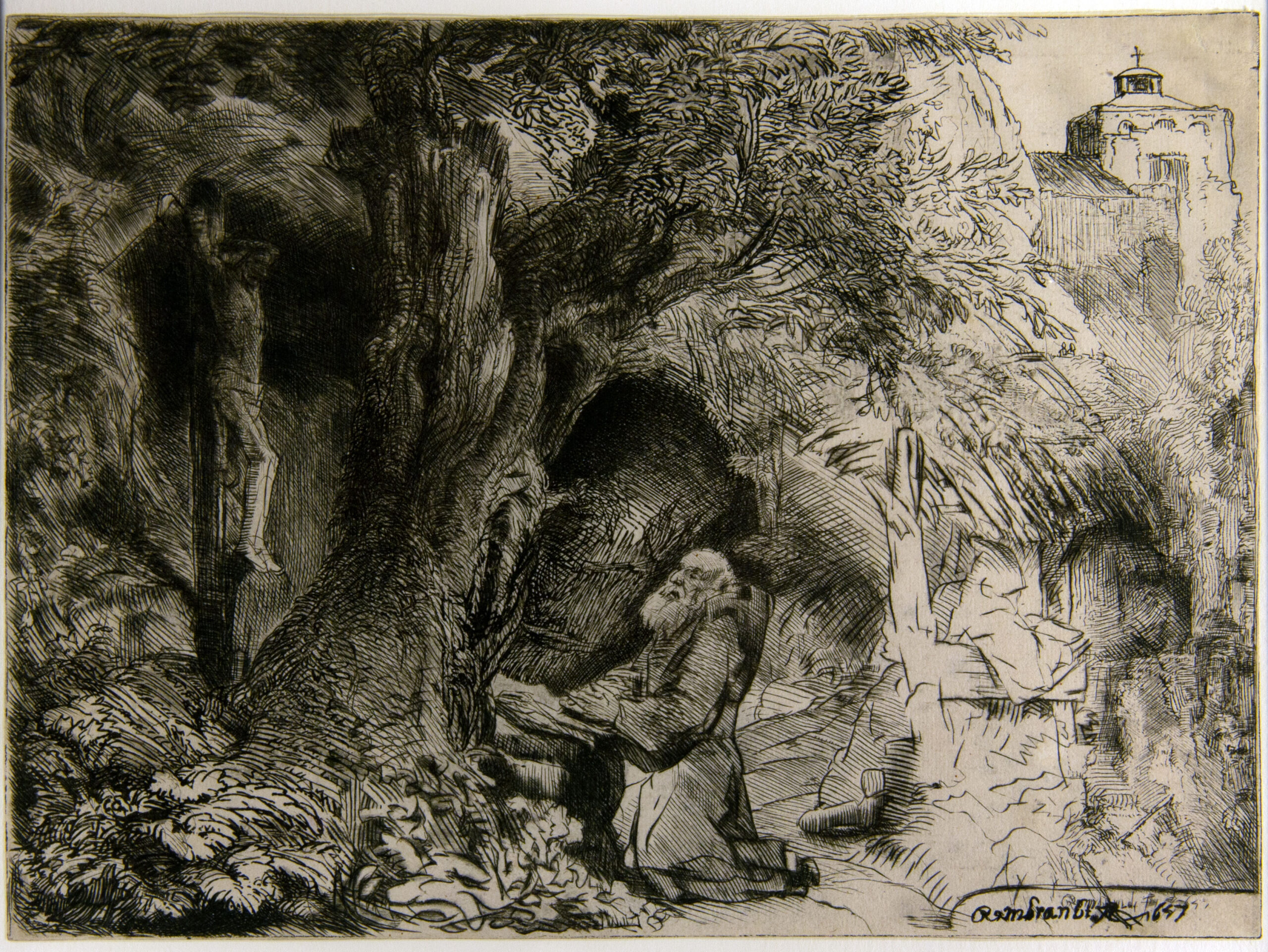
NH 299 – 2nd state of II

Copper Plate

The copperplate was not part of an early collection or sale and is almost certainly not in existence.


Rarity of impressions

  • In auctions (2000-2025): very rare                                Early: 5                                                  ⦿⦿⦿⦿⦿⊙

  • In collections (New Hollstein 2013): rare                       Early: 51                                                ⦿⦿⦿⦿⊙⊙

  • Catalogue Nowell-Usticke (1967): RR, a rare plate, especially so when fine, and much sought after    ⦿⦿⦿⦿⊙⊙


Story

St.Francis (ca. 1182-1226) is shown here praying under a tree, with a crucifix appearing in the left background. This probably refers to the story of St. Francis, who retired into the wilderness with his companion, Brother Leo. The Saint is said to have received the stigmata, the five wounds of Christ, when the crucified Jesus appeared to him during his exile.


Subject/Sitter

Rembrandt did not follow the tradition of showing the stigmata, but instead took a moment just before that. He also showed a rather old man, considering the Saint died at the age of 44. It is not surprising that in both Valerius Röver’s inventory of 1731 and the De Burgy sales of 1755 the print was identified as a picture of St.Jerome, in line with the seven other etchings Rembrandt made of him. Some authors still think that Rembrandt did start with Jerome in his mind, but changed the subject later. This could have been on commission from a (catholic?) client.


Picture

Rembrandt reversed his regular sequence of first etching and then fine-tuning the print with the drypoint. Here he first used the drypoint to draw St. Francis, the tree and the crucifix on the left side of the picture and then used the etching technique, in the 2nd state, to add the reading Brother Leo and a village on the right-hand side. This is the only plate in which Rembrandt used this unusual order.


Inspiration

Stogdon suggests that the Rembrandt may have been inspired by four series of hermits and anchorites by Maarten de Vos (New Hollstein 964 etc.).


Attributions and reviews

The etching is considered as special by Seidlitz, Rovinsky and Dutuit.


States

The New Hollstein, as all other authors, lists two states, Nowell-Usticke one trial proof and one state.
In the 1st state (R329/NU trial proof A) the landscape at the right is missing. The space between St. Francis and the tree is blank. The signature is added with the drypoint.
In the 2nd state (R330/1st state NU) the plate is finished. A second signature (now with the d reversed) is etched on top of the first one.


Prints and collections

Of the 1st state, in drypoint only, there are only five impressions known, all printed on non-western paper. Three on Japanese paper in the Rijksmuseum, the Albertina and the Bibliothèque Nationale and two on vellum in the British Museum and the Metropolitan Museum.
Impressions of the 2nd state also are on a variety of paper types.


Watermarks

In the 2nd state: Countermark PB; Foolscap with seven-pointed collar; IHS, Strasbourg lily (2 ed.); Pro Patria (1699 and later).


Literature

H 292, BB 57-A, G 107, M 252, Mz 250, RA 329-330, Cl 110, W 112, Bl 78, Du 109, CD 249, S 57
W.Stechow, Oberlin College Bulletin, 1952/3 (X), p.3; De grote Rembrandt (2006), p. 86-87; Hinterding 2008, p. 229-230; Verdi 2014, p. 120-121;


Rembrandt in Black & White: 92

New Hollstein/White-Boon: 2nd and final state
Extensive grey wash and pen and ink. A short soft crease at the upper sheet edge verso.
Sheet 182/181 x 246/245 mm. Trimmed to or just outside the borderline (+2%).
Watermark: Countermark PB (?), horizontal chain lines at approx. 24 mm.


Provenance

In the collection of Rudolf Peltzer (1825-1910, Cologne, Lugt 2231); His sale at H. G. Gutekunst (Stuttgart) May 1913 (lot 1209) to Alfred Stroehlin (not in Lugt);


Exhibitions

Rembrandt in Zwart-Wit, Jan ten Horne Museum (Weert), Stadsmuseum Harderwijk, December 2014-August 2015;
Rembrandt in Black & White, Schloß Britz (Berlin), November 2015 – February 2016;
Rembrandt, 17th century photographer, Daegu Art Museum (Korea), November 2023 – March 2024;
Rembrandt, de fotograaf, Westfries Museum (Hoorn), June 2024 – January 2025;