B 101

St. Jerome praying: arched print

  • French title:
    St. Jerome
  • German title:
    Der heilige Hieronymus im Gebet, emporblickend; oben rund
  • Dutch title:
    Hieronymus in gebed
  • New Hollstein:
    112
  • Rembrandt in Black & White:
    139

Etching. 1632.
Size: 109 x 81 mm. Surface: 88 cm2.
Signed and dated, in the lower right corner: Rembrandt. f. 1632.

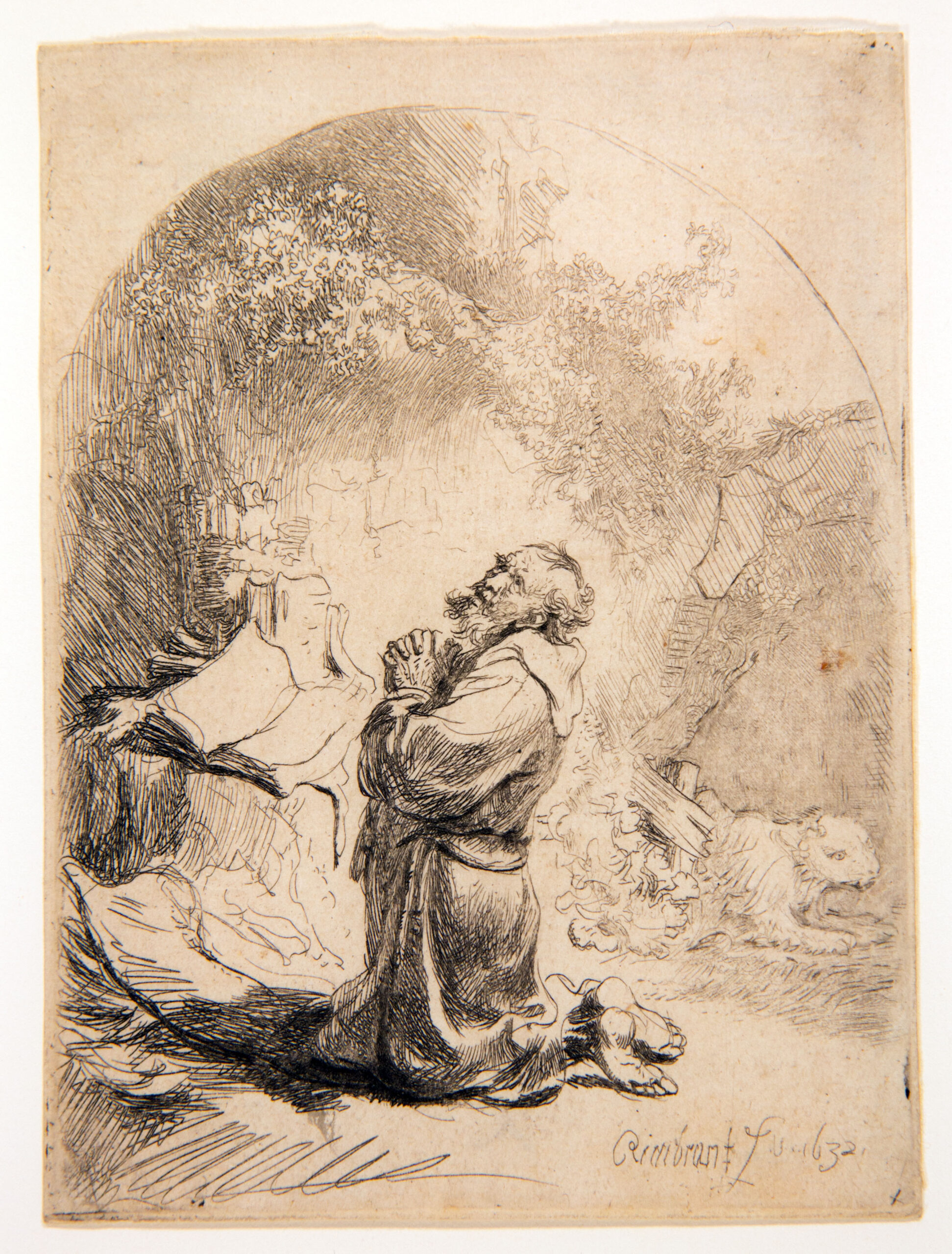
NH 112 – 2nd state of V

Copper Plate

The copperplate was probably in the sale by Clement de Jonghe (1679, as 61 biddende Hieronymus). The next, anonymous owner added two dots (ca. 1700). It later appeared in the sale by Pieter de Haan (1767, lot 36) and was sold to Cruys. It has not been seen since and is probably not anymore in existence.


Rarity of impressions

  • In auctions (2000-2025): rare                                                                 Early: 4   Mixed: 2   Late: 2         ⦿⦿⦿⦿⊙⊙

  • In collections (New Hollstein – 2013): common                                   Early: 34   Late: 30                       ⦿⦿⦿⊙⊙⊙

  • Catalogue Nowell-Usticke (1967): R-, uncommon, background always weak                                      ⦿⦿⦿⊙⊙⊙


Story

St. Jerome is one of the four Patriarchs, also known for his translation of the Bible in Latin. He lived as a hermit for four years. He was very popular in the 17th century and consequently often depicted in works of art. Almost always in the company of a lion, referring to the legend that the lion became his loyal friend when Jerome removed a thorn from its pawn. Other artefacts related to Jerome are a cardinal’s hat and a skull. Rembrandt made no less than seven etchings (B 100 till B 106), three drawings and one painting of St. Jerome.


Picture

The hermit is here seen in prayer, with his book lying in a niche of the cave, the lion resting in the background.


Inspiration

Rijkevorsel points at an etching of St. Franciscus by Willem Buytewegh (1591-1624).


Related

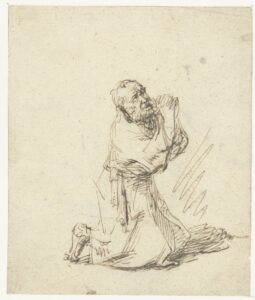
RembrandtSt. Jerome kneeling in prayer – ca 1632 – 152×130 mm – Rijksmuseum – Benesch 59

A drawing of the same subject, in reverse, in the Rijksmuseum (Benesch 59) could be a study for this etching, although its authenticity is recently doubted. A drawing in the Ossolineum (Wroclaw, Poland, Benesch 67) has some similarity, as well as a sketch (Benesch 65 verso) in the Kunstinstitut in Frankfurt.
Hinterding sees a similarity of the praying Saint with the subject in the painting of 1629 Judas repenting, returning the thirty pieces of silver, now in a private collection in the UK (Corpus A 15).


Copies

The New Hollstein lists three copies, of which two in the same direction. Copy B is an anonymous copy, inscribed Rembrandt in 1632 (106 x 78 mm, WB 2). Copy C is a (deceptive) copy by Ignace Joseph De Claussin inscribed Rembrandt ft 1632 (103 x 83 mm, WB 1).
Copy A is a woodcut in reverse by Christoffel van Sichem (103 x 81 mm).


Attributions and reviews

The etching is considered as special by Bartsch, De Claussin and Wilson. The plate was made by a pupil according to Coppier and Singer. Seidlitz, Hind and Münz think that the later states are not by Rembrandt, which is confirmed by watermark research. Hind using the word maladroit.


States

The New Hollsteinn lists five states, only the first by Rembrandt. The 2nd state, with the two dots, is new. Most other authors list three states, Biörklund and Nowell-Usticke four.
In the 1st state (NH, WB, R316, NU) the top of the arch is not continuous at the right side. The edges of the plate are inky, the lower corners square.
In the 2nd state (NH only) two dots are added in the upper right corner by an unknown owner.
In the 3rd state (NH/2nd state WB, R317, NU) the arch is now complete. Details are added to the upper part of the grotto and the lion. The plate edges are rounded. The plate is reworked by the burin, not by Rembrandt (HD).
In the 4th state (NH/3rd state WB final, R318, NU) the arch is further strengthened, the entrance to the cave is worked over and darker. The lion is also much darker.
In the 5th state (NH) diagonal cross-hatching is added in the foreground.
In the 4th state (NU only) the dividing line of the robe is strengthened, showing very fine vertical lines at the bottom


Prints and collections

There is a counterproof of the 1st state in the British Museum.


Watermarks

Very few impressions show a watermark, an impression of the 1st state in London can be dated to 1648, so there must have been several reprints.
In the 1st state: Strasbourg lily (2 ed., one dated 1648).


Literature

H 94, BB 32-B, G 101, M 183, Mz 244, RA 316-318, Cl 104, W 106, Bl 72, Du 104, CD 62
Rijkevorsel, Rembrandt en de Traditie; Hinterding 2008, p. 219-220; Verdi 2014, p110ff;


Rembrandt in Black & White: 139

New Hollstein: 2nd state of V/ White-Boon: 1st state of III
A good, somewhat later impression, probably early 18th century. The arch is still uncomplete at the right side, but the two dots are visible in the upper right corner, indicating a 2nd state (NH).
Sheet 111/110 x 81/82 mm, very thin margins, in places cut on the platemark (+3%).
No watermark, vertical chain lines at approx. 26 mm.


Exhibitions

The Rotunda at Exchange Square, Hong Kong, January 2008;
Rembrandt in Zwart-Wit, Westfries Museum (Hoorn), Stedelijk Museum Zutphen, Het Hannemahuis (Harlingen), Jan ten Horne Museum (Weert), Stadsmuseum Harderwijk, March 2013-August 2015;
Rembrandt in Black & White, Schloß Britz (Berlin), Bozar Expo (Brussels), November 2015 – May 2016;