
B 46

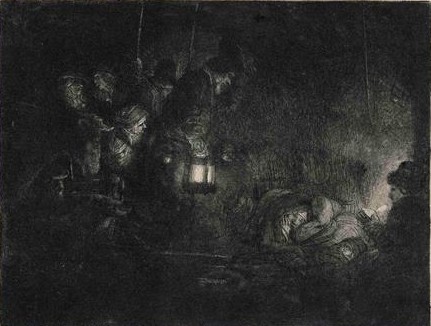
The adoration of the shepherds: a night piece

  • French title:
    L’ adoration des bergers
  • German title:
    Die Anbetung der Hirten, bei Laternenschein
  • Dutch title:
    De aanbidding van de herders: een nachtstuk
  • New Hollstein:
    300

Etching, drypoint and burin. Ca. 1657.
Size: 148 x 198 mm. Surface: 293 cm2.
Not signed, not dated.
Earlier estimates by most authors were all around 1652 with the exception of Münz, who stated 1656. Watermarks suggest that he was right.

NH 300 – 5th state of VIII

Copper Plate

The plate was part of the sale by Pieter de Haan (1767, lot 13). It was sold via Fouquet to Claude-Henri Watelet. It then became part of the set of plates subsequently owned and used for printing Recueils by Pierre-François Basan, Henri-Louis Basan (his nr 1382), Auguste Jean (ca 1809), Veuve Jean, auctioned in 1846 (lot 540) to Auguste and Michel Bernard. Sold to Alvin-Beaumont (1906) and Robert Lee Humber (1937). It was sold at the Artemis sale in London (1993) and is now probably in a private collection in Switzerland (Kornfeld?).


Rarity of impressions

  • In auctions (2000-2025): frequent                                              Early: 13 – Late: 14 – Unknown: 24      ⦿⦿⊙⊙⊙⊙

  • In collections (New Hollstein 2013): very frequent                             Early: 89 – Late: 38                      ⦿⊙⊙⊙⊙⊙

  • Catalogue Nowell-Usticke (1967): C1+, fairly common, but fine early states very rare                      ⦿⦿⊙⊙⊙⊙


Story

Luke 2, verses 15-18 describes the visit of the shepherds to the new-born Child.


Picture

This etching is considerably larger than the six works about Jesus’ childhood made in 1654. The two only sources of light are the lantern held by a shepherd and an invisible source behind his back, used by Joseph to read a book (the Bible?). In the various states Rembrandt has gradually limited the light, reaching a point where only the family and the heads of the shepherds are still visible.


Related

Rembrandt pictured a reading Joseph also in another etching (B 63). Rembrandt made two paintings with a shepherd holding a lamp in 1646 (Bredius 574, now in the Alte Pinakothek and Bredius 575, now in the British Museum. The latter is considered to be a satellite painting made in the workshop).
Münz thinks that Rembrandt has used many examples from other works of art, like a print by Annibale Carracci, a fresco by Raphael in the Loggia of the Vatican for the adoring shepherds and Rubens’ Adoration of the shepherds (now in the Louvre) for the group of animals in the foreground. Rembrandt probably knew the latter painting from an engraving. Schwarz does not support these views.


Copies

There is a copy in the same direction, signed J. Burnet (1849, two states, 148 x 197 mm).


Attributions and reviews

The etching is considered as special by Coppier and Singer.


States

The New Hollstein lists eleven states of which the final three not by Rembrandt. Most other authors list eight states, Nowell-Usticke ten, from his 8th state there are later impressions by Watelet, P.Basan, Basan, Jean, Bernard and Beaumont.
This etching is a good example of one that Rembrandt has obviously worked on very intensely, since there are approx. eight contemporary states. The states are sometimes difficult to identify. The early ones because of the darkness of the prints, the later ones because of the differences in inking.
There are slight differences between the descriptions by the various authors. An important dividing line is the addition of a plank partition behind the Virgin and the Child, in the 6th state of NH and White-Boon, the 5th state of Nowell-Usticke.
In the 1st state (NH, WB, R155, NU) the pillow and the Child’s face are almost white.
In the 2nd state (NH, WB, R156, NU) there is crosshatching on the pillow, the Virgin’s sleeve, the Child’s face and in the background. NH lists many other modifications.
In the 3rd state (NH, WB, R157, NU) a narrow white band appears across the Virgin’s forehead. Many other small changes (NH).
In the 4th state (NH, WB, R158) the outline of Joseph’s head is altered by burnishing. An ear-flap is added.
In the 5th state (NH, WB, R159/4th state NU) the outline of the Virgin’s sleeve is doubled and shading added to her nostril.
In the 6th state (NH, WB/5th state NU) the plank partition is added and the Virgin’s left eye is enlarged.
In the 7th state (NH/6th state NU) curved shading lines are added to the pillow just left of the Child’s head. The lines on the Virgin’s pillow closest to the Child does not (yet) cross the newly added lines.
In the 8th state (NH only) the lower curved line on the pillow next to the child’s face is extended upwards, now crossing three of the new curved lines added in the 7th state (difficult to see).
In the 9th state (NH/7th state WB, R160) the partition is more distinct, especially the nail heads. Not by Rembrandt.
In the 10th state (NH/9th state NU, Bernard) cross-hatching is added to the background, creating a clear portioning above the wooden plank. The blanket just above Mary’s head is darkened by vertical lines.
In the 11th state (NH/10th state NU, Beaumont) the plate is completely retouched. Most notable is a stripe of light between the man with the lamp and the one behind him. Usually very dark, with only the lamp white.
In the 8th state (WB final, R161) the cap of St. Joseph is redrawn.
Hind mentioned an 8th state which is probably a print (in the British Museum) retouched with ink.


Prints and collections

Only two impressions of the 1st state are known, in the Rijksmuseum and in the British Museum (R155) and three of the 2nd state, in the Rijksmuseum, in the British Museum (R156) and in the Kupferstichkabinett in Berlin and again three of the 3rd state, in the Rijksmuseum, in the Bibliothèque Nationale and in the Kunsthalle in Bremen (on Japanese paper). There are also impressions on Japanese paper of the 4th, 5th, 6th, 7th and 8th state and on Chinese paper of the 5th state.
Of the 5th state, the first ‘finished’ state at least 25 impressions are identified so far. Rembrandt used a variation of inking to leave plate tone, making each print almost unique.
The etching appears in the Recueil de Basan, impression fairly strong (NU).


Watermarks

In the 3rd and 5th state: Strasbourg lily ZZ.zz;
In the 5th state: Double-headed eagle D.a (c. 1656-57);
In the 6th state: Strasbourg lily B.zz;
In the 9th state:. Strasbourg lily B.c and with GR A.a, Strasbourg bend J.a and various later ones.


Literature

H 255, BB 52-1, G 45, M 230, Mz 237, RA 155-161, Cl 50, W 51, Bl 19, Du 51, CD 217, S 13.
Münz, Die Kunst Rembrandts und Goethes Sehen, 1934; Rembrandts Passie 2006, p. 61-64; Hinterding 2008, p. 104ff; Late Rembrandt 2015, p. 178-179