B 44

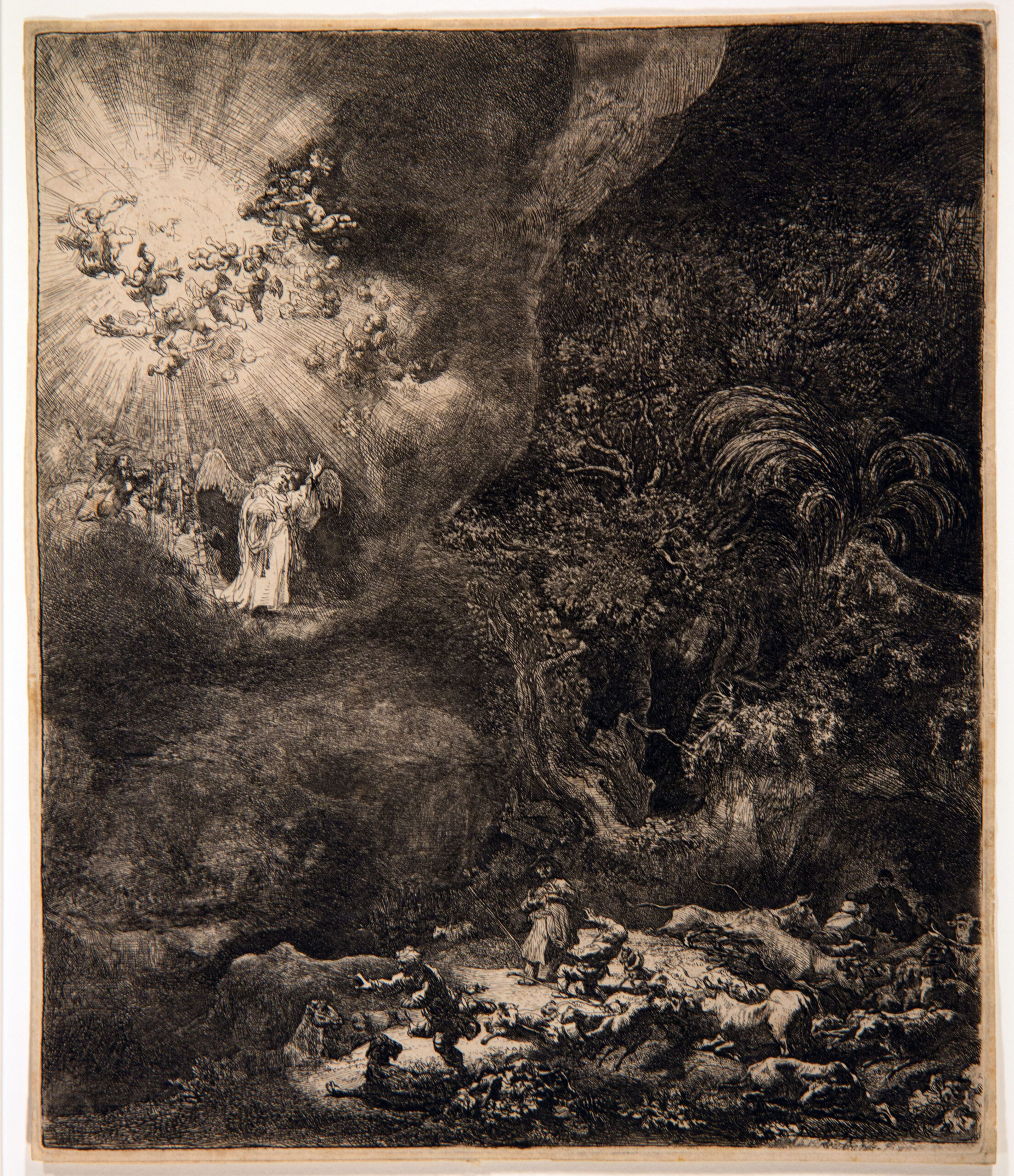
The Angel appearing to the shepherds

  • French title:
    L’annonciation des bergers
  • German title:
    Die Verkundigung an die Hirten
  • Dutch title:
    De verkondiging aan de herders
  • New Hollstein:
    125
  • Rembrandt in Black & White:
    162

Etching, burin and some drypoint. 1634.
Size: 262 x 218 mm. Surface: 571 cm2.
Signed and dated in the lower left corner (from the 2nd state): Rembrandt. f. 1634 

NH 125 – 3rd state of VI

Copper Plate

The plate was probably in the collection of Clement de Jonghe (1679, as 32 stammetjen)). It was in the sale of Jean de Bary (1759, lot 35) and sold to Claude-Henri Watelet. In then became part of the set of plates subsequently owned and used for printing Recueils by Pierre-François Basan, Henri-Louis Basan (his nr 1380), Auguste Jean (ca 1809), Veuve Jean, Auguste and Michel Bernard (1846), Alvin-Beaumont (1906) and Robert Lee Humber (1937). It was sold at the Artemis sale in London (1993) and is now probably in a private collection in the USA.


Rarity of impressions

  • In auctions (2000-2025): very frequent                  Mixed: 52     Late: 5     Unknown: 42     ⦿⊙⊙⊙⊙⊙

  • In collections (New Hollstein 2013): very frequent         Early: 5     Mixed: 94     Late: 4      ⦿⊙⊙⊙⊙⊙

  • Nowell-Usticke (1967): C2-, a common print, but fine clear impressions are rare              ⦿⊙⊙⊙⊙⊙


Story

Luke 2, verses 9-14
An angel appeared to the shepherds to announce them the birth of Christ. The angel arrives in striking light, almost blinding the shepherds and their herd. But the Angel says “Fear not”.


Picture

The stark contrast between the light parts, the Angel and the shepherds illuminated by the Angel and the dark parts of the surrounding area, makes this Baroque picture one of Rembrandt’s finest etchings. Note the various reactions of men and beasts. Some are bewildered, some are paralyzed by fear, some start running and some seem to be completely unaware of what is happening.
Although he painted some night pieces before, this is Rembrandt’s first night piece in print. He will make several more in later years, introducing a new, great technique in which he combined etching and drypoint to achieve an effect very similar to mezzotint.
It is also the first of the larger prints.


Animal Farm

As can be expected when a group of herdsmen is pictured, there are a lot of animals around them. Not only cows and sheep, but also dogs and goats.


Inspiration

Münz thinks that Rembrandt may have been inspired by a Stradanus design, engraved by Theodor Galle, which shows a similar angel standing at rest.
The composition may also be based on an engraving by Jan Saenredam, designed by Abraham Bloemaert, in itself based on a painting by Francesco Bassano.
For the landscape, the herd and the running shepherd in the foreground Rembrandt may have looked at a painting by Moses van Uytenbrouck in 1626 Landscape with two scenes from the history of Mercury and Bathus (now in Berlin).
The shepherd in the foreground may be derived from a figure in Raphael’s Heliodorus fresco.


Related

RembrandtSermon of John the Baptist – 1634-35 – Gemäldegalerie Berlin – Corpus A 106 – Bredius 555

Hinterding points at similarities of the landscape in the background with that in the painting of 1634-36 JSermon of John the Baptist (Corpus A106, now in the Gemäldegalerie in Berlin).
He also sees a relationship in composition with a painting Rembrandt made for Frederik Hendrik in 1636, The ascension of Christ (Corpus A118, now in the Alte Pinakothek).
Schwarz points at the similarity in the landscapes by Elsheimer and Goudt and the prints by Jan van de Velde.

In turn this etching has inspired many others. Govert Flinck (1639, now in the Louvre), Adam Colonia (1662, now in the Boymans-van Beuningen), Berghem (also in the Louvre) and Pieter Bout (in Brunswick) have all made paintings based on this print.


Copies

There is a contemporary copy in reverse by Melchior Küsel, inscribed Luc.Cap.II,8. Angelus et Pastores (1679, 92 x 142 mm).


Attributions and reviews

The etching is considered as special by Bartsch, Middleton, Seidlitz, Coppier, De Claussin, Blanc and Dutuit.
Wilson calls this print “an exceedingly fine print, producing an admirable effect”.
According to Singer the plate is not by Rembrandt.


States

The New Hollstein lists six states, the final three not by Rembrandt. Most other authors list three states, Nowell-Usticke three trial proofs and five states, from his 1st state there are later impressions by P.Basan, H.Basan, Jean, Bernard and Beaumont.
The 1st state (NH, WB, R149/NU trial proof A) is unfinished in the sky and in the foreground.
In the 2nd state (NH, WB, R150/NU trial proof B) the plate is finished. The signature and date are added. The trunk of the tree remains unshaded.
In the 3rd state (NH, WB final, R151/1st state NU Basan) the trunk of the tree is now shaded as are the upper part of the tree left white, a branch to the right and the wooden paling left of it. Shading is also added to the second man from the left, the ground around him, the cows and the wings of the angel. A small house is added on the bridge. In early impressions the landscape is very sharp. In later impressions, by Basan, the plate is worn, the distant landscape foggy. This is by far the most frequent state.
In the 4th state (NH/2nd state NU Basan/R152) the entire plate is retouched, with much roulette in the shadows. The bridge is indistinct.
In the 5th state (NH/3rd state NU Jean) the dark portions are worn out. The distant landscape is worked over and lost. The branch in the centre is swollen out of recognition. There is roulette work in the background below the angel.
In the 6th state (NH/4th state NU Bernard) the plate is reworked by Bernard. The bridge has a sharp cone-shaped protuberance in the centre. Vertical lines are added to the white spot above the cows°.
The 5th state (NU, Bernard, Beaumont) is again reworked. There is strong diagonal crosshatching behind the frightened man to the right.
Nowell-Usticke mentions a falsified version (his trial proof C) in the British Museum, before extra details were added in the distant landscape. It shows three towers to the left, whereas the 1st state only has two, but several small towers more to the left shown in the 1st state are missing here. This state was also recognised by Wilson and Blanc. It is not listed in NH.


Prints and collections

Of the 1st state only two impressions are known, in the Kupferstichkabinett in Dresden (R149) and in the British Museum.
Of the 2nd state (NU trial proof B) three impressions are known, in the British Museum, the Albertina (R150) and the Rijksmuseum.


Recueils

The etching appears in the Recueil de Basan, in the early versions without reworking, in later versions with a very weak background.
B&W 54 – Recueil de Basan – Page 34
NH: 4th state of VI/WB: 3rd and final state
A weak impression, the bridge is not visible.

B&W 206 – Recueil de Beaumont –  Sheet 11
NH: 6th and final state/WB: 3rd and final state
A strong, dark impression, better than the Basan version. The plate is completely reworked, the bridge is again visible.
The white spot above the cows is filled in.


Watermarks

In the 1st state: Basel crosier (1633-34).
In the 2nd state: IHP A.a, with cm R (1633-35).
In the 3rd state: Arms of Württemberg (c. 1634-36); Basel crosier (c. 1634-35); Strasbourg lily (3 ed. of which 2 dated 1634); Foolscap with five-pointed collar (4 ed., 1641 and 1650); Foolscap with seven-pointed collar with cm IAB; Arms of Amsterdam; Arms of Ravensburg ; Grapes (3 ed.); Seven Provinces (> 1749); Words.


Literature

H 120, BB 34-J, G 43, M 191, Mz 199, RA 149-152, Cl 48, W 49, Bl 17, Du 49, CD 83, S 12.
Veth, Oud Holland 33, 1915; Rembrandts passie p. 56-60; Rembrandts engel 2006, p. 172; Hinterding 2008, p. 100ff; Rijke traditie 2015, p. 65-66; Bikker 2019, p. 69;


Rembrandt in Black & White: 162

New Hollstein: 3rd state of VI/White-Boon: 3rd state of III
A good, well-inked impression of the 3rd state, possibly by Basan before the rework in the 4th state. The bridge and distant village are not well visible.
Sheet: 263/264 x 223/222 mm, narrow margins of approx. 3 mm all around (+3%).
Watermark: Crowned shield with Pascal Lamb (? not in NH). Horizontal chain lines at approx. 27 mm.


Exhibitions

Rembrandt in Zwart-Wit, Jan ten Horne Museum (Weert), Stadsmuseum Harderwijk, December 2014-August 2015;
Rembrandt in Black & White, Bozar Expo (Brussels), Chateau des Penthes (Geneva), March – October 2016;
Rembrandt, 17th century photographer, Daegu Art Museum (Korea), November 2023 – March 2024;
Rembrandt, de fotograaf, Westfries Museum (Hoorn), June 2024 – January 2025;