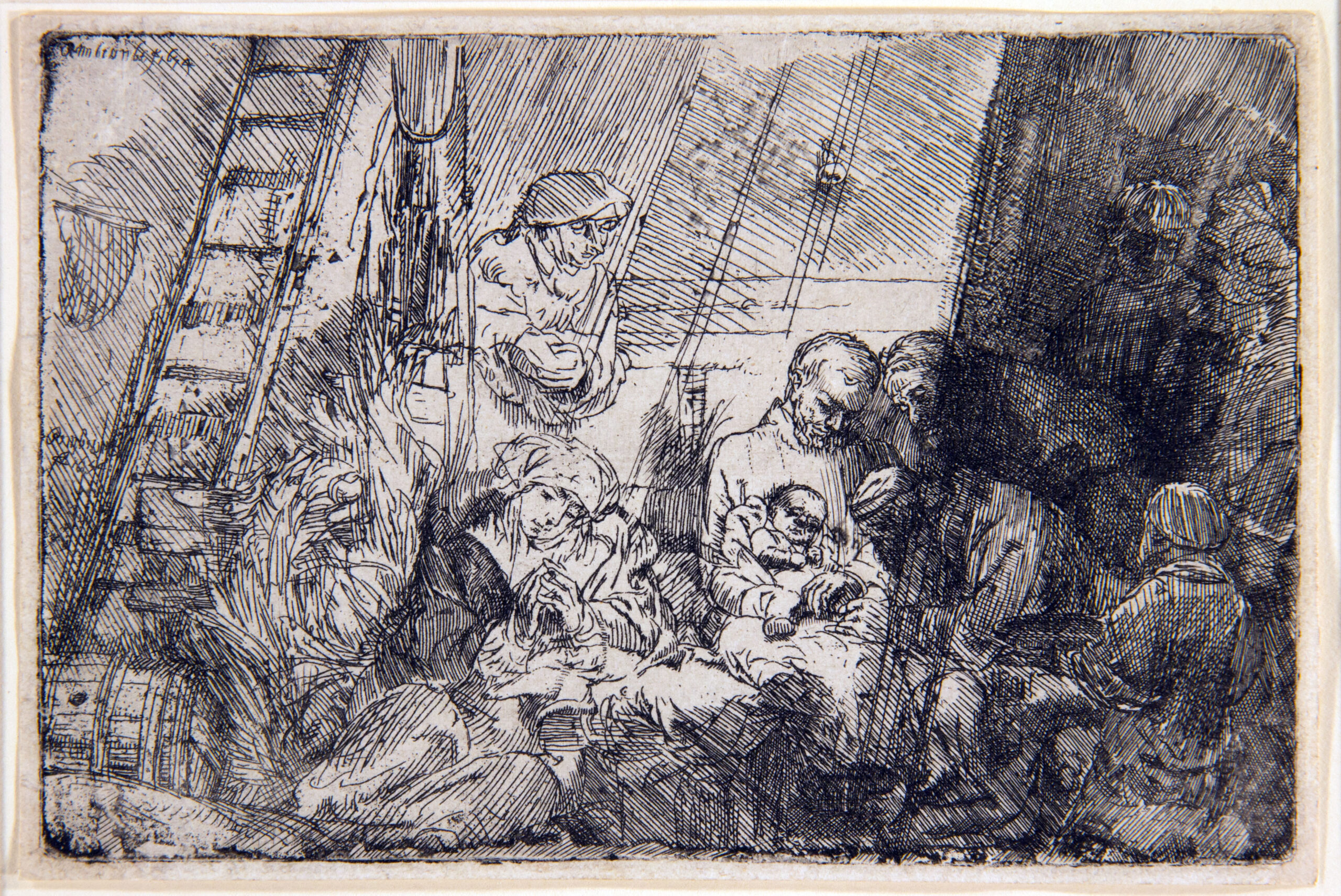
Etching. 1654.
Size: 94 x 144 mm. Surface: 135 cm2.
Signed and dated, twice, one in the upper left corner and one close to in the middle left margin: Rembrandt 1654 (a and d reversed).
The plate was part of the inventory of Clement De Jonghe (1679, as 56 de geboorte met een ladder) and later Jean de Bary (1759, lot 44). It was sold to Busserus and later to Claude-Henri Watelet (1786, lot 365). It then became part of the set of plates subsequently owned and used for printing Recueils by Pierre-François Basan, Henri-Louis Basan (his nr 1383), Auguste Jean (ca 1809), Veuve Jean, Auguste and Michel Bernard (sale 1846 lot 540), Alvin-Beaumont (1906) and Robert Lee Humber (1937). It was sold at the Artemis sale in London (1993) and is now in the collection of the Rijksmuseum.
Rarity of impressions
In auctions (2000-2025): very frequent Early: 29 – Late: 20 – Unknown: 24 ⦿⊙⊙⊙⊙⊙
In collections (New Hollstein 2013): very frequent Early: 74 – Late: 36 ⦿⊙⊙⊙⊙⊙
Catalogue Nowell-Usticke (1967): C2-, a common print ⦿⊙⊙⊙⊙⊙
Story
Luke 2, verse 21
The circumcision of Jesus, took place eight days after his birth. The scene is traditionally placed in the temple, as Rembrandt does in B 48, and often combined with the presentation of the child. But, since the bible does not indicate the location and women were not allowed in the temple within forty days after giving birth, the apocryphal books locate the event in a stable. Which makes some sense since the same laws order that the circumcision should take place within eight days of birth. The circumcision was often considered to be the first moment of suffering (and bloodletting) of Jesus. In the Contra-Remonstrant version of the story the child is in the hands of a priest, in the Remonstrant version in the hands of Maria or Josef, as is the case here.
Related
In 1654 Rembrandt made a series of six etchings about the childhood of Jesus, of which this is one. They all have a roughly similar size, are stylistically comparable and follow the scripture quite strictly, as Tümpel pointed out.
Attributions and reviews
The etching is considered as special by Coppier.
States
The New Hollstein lists five states, of which the 1st and 3rd are ‘new’. The next two states are by Rembrandt, but with posthumous impressions. The final two states are not by Rembrandt. Earlier authors identified two states (WB/BB), Nowell-Usticke three states, from his 2nd state there are later impressions by P. Basan, H. Basan, Jean, Bernard and Beaumont.
In the 1st state (NH only) the corners are sharp.
In the 2nd state (NH/1st state WB, BB, R162, NU) the corners are rounded. The diagonal shading above Joseph’s right eyebrow is sharp and clear.
In the 3rd state (NH) the small spots of grain in the middle are burned out°. The shoulder of the left standing man in the right background is reduced in volume.
In the 4th state (NH/2nd state WB final, BB, R163, NU, H) the blank spaces at the top left and centre are covered by diagonal hatching with the burin°. Some fine horizontal shading is added above the man bending over (left of the standing man looking back). Not by Rembrandt (NH).
In the 5th state (NH/3rd state NU) the plate is heavily reworked and probably rebitten. The shading on Joseph’s head is worn out. Hind and Münz identify an intermediate state between the 2nd and 3rd in which the oblique parallel lines are strengthened and the corners are rounded.
Prints and collections
Five impressions of the (new) 1st state (NH) are known, in the Rijksmuseum, in the Petit Palais in Paris (Dutuit Collection), in the Georg August Universität (Göttingen), in the British Museum and in the Teylers Museum (Haarlem).
An impression of the 1st state (NH 3rd state) in the Lugt Collection (Paris) is on 18th century silk.
There are two counterproofs of the 2nd state. One is in the Albertina , the other was in the Josefowitz collection (Lausanne) and auctioned at Christie’s London in 2024 (£ 14.000).
Many impressions of the 3rd state are by de Bary.
The etching appears in the Recueil de Basan without rework, impression fairly strong (NU).
Watermarks
In the 2nd state: Arms of Amsterdam (3 ed.); Paschal lamb; Countermarks AD and VA.
In the 3rd state: Foolscap with seven-pointed collar (2 ed.) and with cm PEH’; Countermark AD; Pro Patria (> 1669).
In the 4th state: Grapes.
Literature
H 274, BB 54-B, G 46, M 239, Mz 227, RA 162-163, Cl 51, W 52, Bl 20, Du 52, CD 230, S 15/16. Rembrandts etsen, p. 8-9; Rembrandts engel 2006, p. 176; Hinterding 2008, p. 106ff; Late Rembrandt p. 186;
Rembrandt in Black & White: 79
New Hollstein: 2nd state of V/White-Boon: 1st state of II
A very good, early impression, on laid paper, the blank spaces clearly visible. The shoulder of the man at right still untouched, and the grains spots clearly visible. But the corners are rounded, confirming a 2nd state. There is a backed tear across the lower left sheet corner.
Sheet 100 x 149/150 mm, narrow margins of approx. 2 to 3 mm all around (+11%).
No watermark.
Exhibitions
Rembrandt in Zwart-Wit, Stedelijk Museum Zutphen, Jan ten Horne Museum (Weert), Stadsmuseum Harderwijk, (November 2013- August 2015); Stedelijk Museum Vianen, October 2017 – January 2018; Rembrandt in Black & White, Schloß Britz (Berlin), Bozar Expo (Brussels), Chateau des Penthes (Geneva), November 2015 – October 2016; Rembrandt, de fotograaf, Westfries Museum (Hoorn), June 2024 – January 2025;