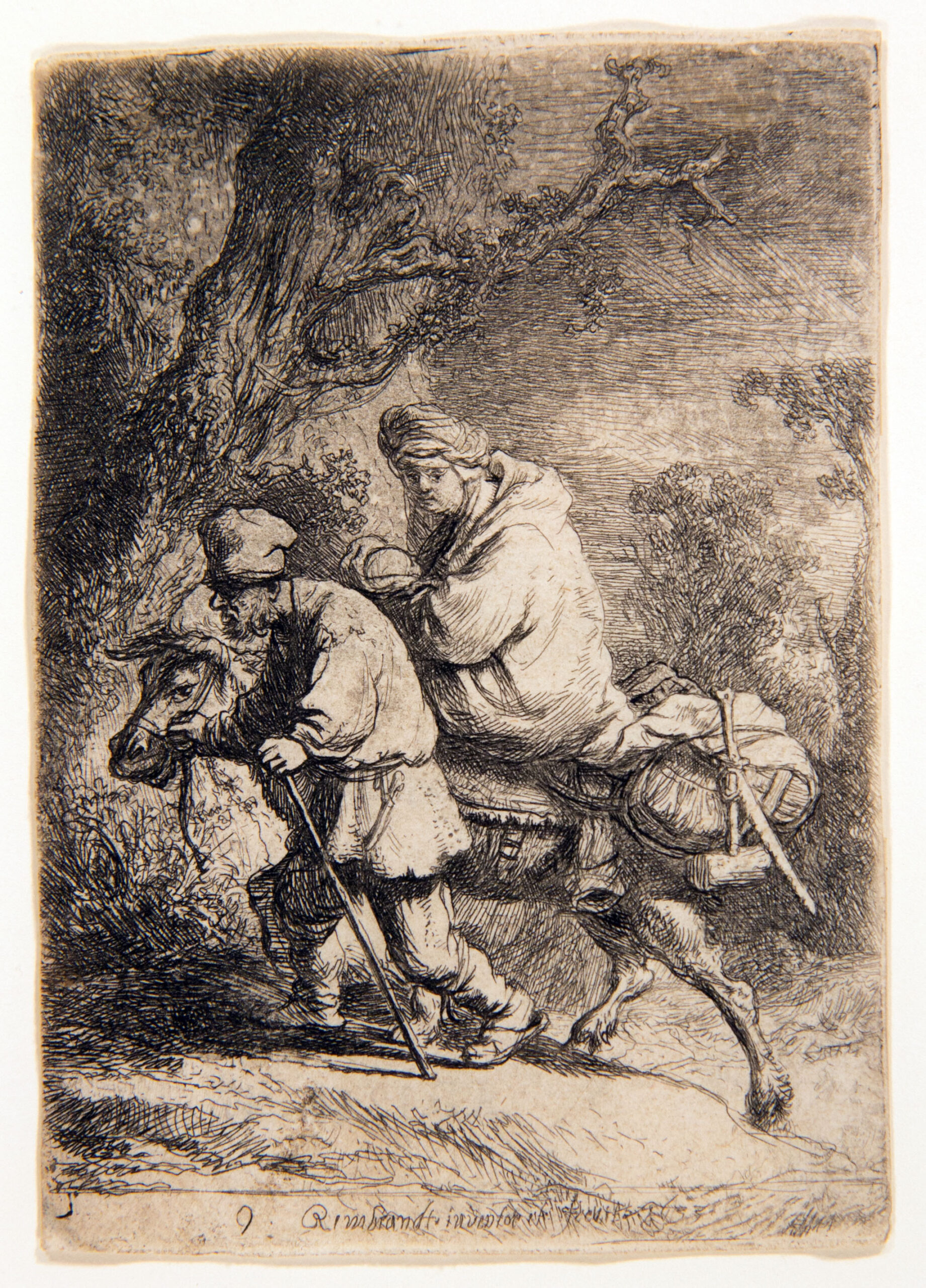
The copperplate may have been in the sale by Clement de Jonghe (1679, as 4 Vlucht naar Egypte). It was later in the hands of an unknown owner who added two dots. It then was part of the sale by Pieter de Haan (1767, lot 15) and sold to Sluyter. It has not been seen since and is probably not in existence anymore.
Rarity of impressions
In auctions (2000-2025): common Early: 12 – Late: 5 ⦿⦿⦿⊙⊙⊙
In collections (New Hollstein 2013): common Early: 46 – Late: 16 ⦿⦿⦿⊙⊙⊙
Catalogue Nowell-Usticke (1967): R-, a very uncommon underbitten plate, usually very weak looking ⦿⦿⦿⊙⊙⊙
Story
Matthew 2:13-15
The flight into Egypt was one of Rembrandts favourite subjects of which he made a series of eight etchings over a rather long period, from 1629 till 1655 (Bartsch numbers 52 to 59). Most of these have a similar size.
Picture
The most striking feature of this print is the grain found in the upper part of the background. It is not clear if this effect is intentional, as if to suggest darkness, or the result of foul biting.
Animal Farm
A curious detail is the head of the donkey which was originally in profile. It was later turned towards the viewer.
Related
Rembrandt – The Flight to Egypt – c. 1630 – Musée des Beaux-Ars, Tours – Corpus C5 – Bredius 532a
The same scene (in reverse) is visible in a painting of c. 1830, which is recently re-attributed to Rembrandt (now in the Musée des Beaux-Arts in Tours).
There is a drawing in the same direction, dated 1629/1630, now in the Louvre (Benesch 18).
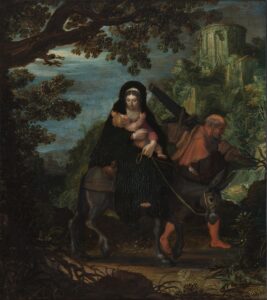
Pieter Lastman – The Flight into Egypt – 1608 – Boymans van Beuningen
Rembrandt may have been inspired by the painting of this subject that his tutor Pieter Lastman made in 1608 (now in the Boymans van Beuningen).
Copies
B&W 321 – David Deuchar – NH 117 Copy F
The New Hollstein lists no less than fifteen copies, of which only two in the same direction.
Copy F is by David Deuchar, included in the collection ‘Rembrandt in Black & White’, nr 321 (94 x 63 mm, WB 1).
Copy H is anonymous, inscribed Rembrandt in fecit (two states, 89 x 60 mm, WB 5).
There are thirteen copies in reverse. Copy A is by Conrad Meyer (110 x 150 mm). Copy B is a woodcut by Christoffel van Sichem (107 x 85 mm).
Copy E is attributed to C.H.Watelet. It is included in the collection ‘Rembrandt in Black & White’, nr 375 (five states, 89 x 62 mm, WB 6). The 5th state was used in the Recueils of P. and H. Basan, without Watelet’s signature.
Copy G is also by David Deuchar (96 x 88 mm, WB 2). Copy H is anonymous, inscribed Rembrandt in fecit (two states, 89 x 60 mm, WB 5). Copy I is by Francesco Novelli (two states, his nr 37, 106 x 76 mm, WB 3). For more details see NH.
B&W 375 – Possibly Watelet – NH 117 Copy E, in reverse
Attributions and reviews
The plate was made by a pupil according to Middleton, Seidlitz and Coppier. The plate is not by Rembrandt according to Michel and Singer.
Seymour Haden attributed the plate to Ferdinand Bol, based on a design by Pieter Lastman, but Hind and Münz rejected this.
States
Most authors list two states, New Hollstein four, only the first by Rembrandt. The 2nd and 3rd state are ‘new’.
In the 1st state (NH, WB, R171) the grain in the upper background is clearly visible.
In the 2nd state (NH only) two dots are added in the upper right corner by an unknown owner.
In the 3th state (NH only) much of the background is shaded by roulette work around the tree and in the upper left corner. The Virgin’s face is redrawn. It is likely that this state is not by Rembrandt (Hind, Münz, Hinterding, ao).
In the 4th state (NH/2nd state WB final, R172) extra shading is added with a mezzotint rocker.
Prints and collections
In early impressions of the 1st state there is strong sulphur tinting.
There is only one impression of the 3rd state, in the National Gallery in Washington.
Watermarks
In the 1st state: Double-headed eagle (1632-34); Arms of Württemberg; Basel crosier (1634-35).
Literature
H 105, BB 33-D, G 52, M 184, Mz 195, RA 171-172, Cl 56, W 57, Bl 25, Du 57, CD 78, S 19. Rembrandts passie, p. 75-79; Hinterding 2006, p. 256; Hinterding 2008, p. 117-118; Rembrandts Radierungen 2011, p. 44-45; Verdi 2014, p. 38-61;
Rembrandt in Black & White: 138
New Hollstein: 1st state of IV/ White-Boon: 1st state of II.
A superb, well-inked impression with the sulphur tinting and the uncleaned upper part in the background clearly visible. Before the two dots in the upper right corner, typical for the 2nd state. Inky plate edges.
Sheet: 88 x 62 mm. Cut on and slightly inside the platemark (-7%).
No watermark, vertical chain lines at approx. 27 mm.
Provenance
In the collection of the University of Cambridge Library (Lugt 2475) their stamp verso with the mark: AD 12.40-547. It may have been in their sale of doubles with Sotheby’s in London in April 1878.
In the collection of Marsden Jasael Perry (1850-1935, Providence RI, Lugt 1880), his collector’s mark verso; Probably in his sale with H. Gutekunst in Stuttgart in May 1908.
Exhibitions
Rembrandt in Zwart-Wit, Westfries Museum (Hoorn), Het Markiezenhof (Bergen op Zoom), Stedelijk Museum Zutphen, Het Hannemahuis (Harlingen), Jan ten Horne Museum (Weert), Stadsmuseum Harderwijk, March 2013-August 2015; Rembrandt in Black & White, Schloß Britz (Berlin), Bozar Expo (Brussels), Chateau des Penthes (Geneva), November 2015 – October 2016; Rembrandt, de fotograaf, Westfries Museum (Hoorn), June 2024 – January 2025