B 90

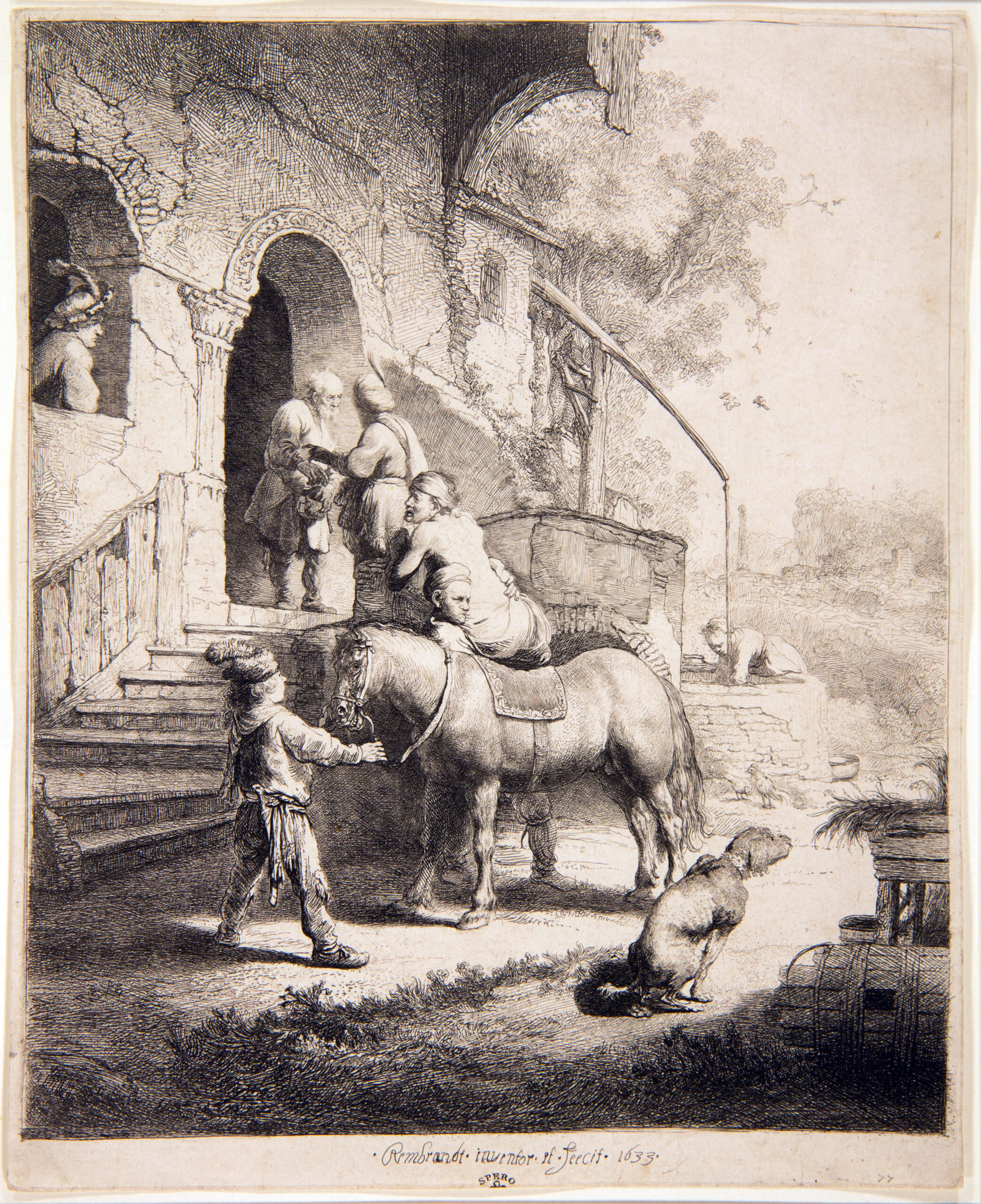
The good Samaritan

  • French title:
    Le bon Samaritain
  • German title:
    Der barmherzige Samariter
  • Dutch title:
    De barmhartige Samaritaan
  • New Hollstein:
    116
  • Rembrandt in Black & White:
    17

Etching, drypoint and burin. Ca 1633.
Size: 258 x 218 mm, in the 4th state 257 x 208 mm. Surface: 560 cm2, in the 4th state 535 cm2.
Signed and dated in the lower margin (only in the 4th state): Rembrandt. Inventor et. Feecit. 1633 

NH 116 – 4th state of IV

Copper Plate

The plate was not part of any early collection or sale and is probably not in existence.


Rarity of impressions

  • In auctions (2000-2025): common                                                          Early: 20                                       ⦿⦿⦿⊙⊙⊙

  • In collections (New Hollstein 2013): frequent                                       Early: 78                                        ⦿⦿⊙⊙⊙⊙

  • Catalogue Nowell-Usticke (1967): R+, a scarce plate, seldom found in fine condition                        ⦿⦿⦿⊙⊙⊙


Description

In 1989 J.R.Voute pointed at the fact that the head of the horse was originally in a more forward position (remains of the ‘old’ head are still visible) and the helping man (the only person to notice the dog and showing his embarrassment) was originally placed more to the right. Rembrandt has ‘forgotten’ to move his leg to the left, so it is still at its ‘old’ position under the belly of the horse.


Story

Luke 10, verses 25 – 37
A Jewish merchant was robbed on his way to Jericho and left behind for dead. A priest and a Levite pass by and leave the man behind. But a passing Samaritan (not exactly friends of the Jews) takes care of the victim and brings him to an inn. As he often did, Rembrandt combines two moments in one scene, the arrival at the inn and the payment for the lodgings and the meals by the Samaritan. In the original text of the Bible the payment was made a day later.


Picture

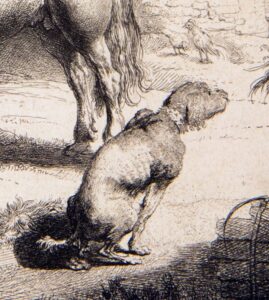
To many viewers this etching is best remembered because of the shitting dog. In the background we see a woman getting water out of the well. Rembrandt made two etchings (B 70 and B 71) of the meeting between Jesus and a Samaritan woman, near a well.
Note that the dog is the lower right corner of a triangle of which the innkeeper and the man holding the horse are the other two corners.


Animal Farm

Apart from the very prominent horse, the shitting dog can hardly be missed. According to many experts in the 19th and early 20th century the dog must have been an addition made by a pupil, simply based on the assumption that Rembrandt would not draw such vulgar scenes. Watermark research has proven that it is in fact authentic.
In front of the well we see two chicken and right above them some birds. Are they peace-doves? In the Biblical number of three?
Kenneth Clarke noted that the dog can also be found in a painting by Michelangelo, The Rape of Ganymedes, of which Rembrandt supposedly owned a copy, etched by Nicole Barbizet.


Inspiration
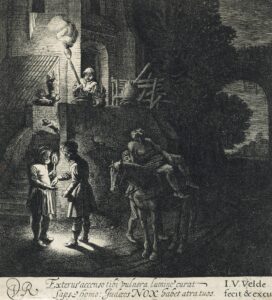
B&W 329 – Jan van de VeldeThe Good Samaritan – c. 1620

It is well possible, as Vosmaer suggested, that an etching with the same title, made around 1620 by Jan van de Velde (1593-1641, Hollstein 12) served as a prototype. It shows the same composition. An impression is included in the collection Rembrandt in Black&White as number 329.


Related

Rembrandt ?The good Samaritan – 1630 – The Wallace Collection in London – Corpus C48

There is a painting signed RHL 1630, now in the Wallace Collection in London (Corpus C48, Bredius 545) which portrays the same subject in the same way, but without the dog and the barrel. Partly because of this difference, there was serious doubt whether the painting is by Rembrandt or by one of his pupils, possibly Govert Flinck (1615-1660). The discovery of a signature and date (1630) led to a re-attribution to Rembrandt.
Benesch has pointed at a drawing of a stair and well (Benesch 462, Hamburger Kunsthalle) which supposedly was used as an example for both the painting and the etching. But some experts date the drawing much later. Voute’s suggestion that the painting was made after the etching is weird, since it does not explain the reversal of the picture. It is now assumed that both painting and etching may be made after a grisaille of 1632 that has been lost.
Rembrandt made two other (undated) drawings of the subject, probably many years later. In one of these (Benesch 518a, British Museum) he separates the arrival from the payment, in the other one (Benesch 518b, Boymans-van Beuningen) the two moments coincide as they do in the etching.


Copies

B&W 321Cabinet du Duc de Choiseul – Copy

The New Hollstein lists eight copies of which three in the same direction. Copy B, in which the bird is missing, is signed S.Savri Excut. Rembrandt van Rijn | in venter (261 x 203 mm, WB 1). Copy E is anonymous, inscribed Rembrandt in. (268 x 218 mm, WB 2). Copy H is also anonymous (284 x 199 mm). Another anonymous copy, included in the Cabinet of the Duc de Choiseul (152 x 108 mm) is not listed in NH. It is included in the collection Rembrandt in Black & White, nr 321.
There are five copies in reverse. Copy A is by Conrad Meyer (1643, 110 x 150 mm). Copy C is by Charles Errard with an elaborate inscription (2 states, 405 x 276 mm, in NH erroneously listed as ‘same direction’, WB 3) It is included in the collection Rembrandt in Black & White, nr 324.
Copy D is by Melchior Küsel (1679, 92 x 141 mm). Copy F is anonymous (102 x139 mm). Copy G is inscribed Francesco Novelli 1791 | Venezia, (two states, 240 x 197, WB 4).
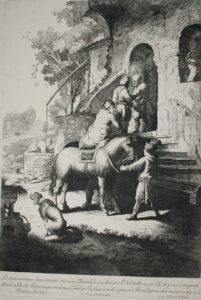
B&W 324Charles Errard – The good Samaritan – Copy in reverse

Attributions and reviews

The etching is considered as special by Bartsch, Seidlitz, De Claussin and Wilson. It even received praise from others, like Goethe. In his essay Rembrandt, the Thinker, he refers to this etching, calling it a “proof of Rembrandt’s understanding of human emotions, intellect and body-language”.
The plate was made by a pupil according to Singer and Coppier. According to van Dyke (p.147) this etching is made after a painting by Simon de Vlieger and is not made by Rembrandt, nor by de Vlieger.
According to Seymour Haden (p 36) the etching is made by Ferdinand Bol, although it is highly unlikely that Bol has been in Rembrandt’s studio before 1640.
According to Middleton the work is made by the same hand as The Flight to Egypt (H 105).
Hind mentions that the authorship of the etching is questioned, although he himself is convinced it is by Rembrandt.
Münz thinks that the work is executed with the assistance of pupils.


States

The New Hollstein, as most other authors, lists four states, only Biörklund lists five states.
In the 1st state (NH, WB, R289, NU) the plate measures 258 x 218 mm. The tail of the horse and the wall above it are without shading. BB separates a 2nd state, but WB attributes the change in the shading to inking and wear.
In the 2nd state (NH, WB, R290, NU) the tail of the horse is shaded. Shading is added in many more places.
In the 3rd state (NH, WB, R291, NU) the wall above the horse is covered with shading, using drypoint and burin.
In the 4th state (NH, WB, R292, NU) the plate is reduced to 257 x 208 mm. The signature and date are added.


Prints and collections

Of the 1st state Hinterding has traced at least 28 impressions, which led him to conclude that Rembrandt must have considered this state to be a finished product.
Of the 2nd state only four impressions are known, in the Rijksmuseum (signed Rembrandt. f. cum priv.l. 1633), the British Museum, the Rothshild Collection (Paris) and the Albertina. Of the 3rd state only seven impressions are known.


Watermarks

All impressions of the 1st state are on paper with an identical watermark (Arms of Burgundy and Austria with cm NH c.1632). Hinterding assumes that this 1st state was already printed in Leiden, the later states in Amsterdam.
In the 2nd and 3rd state: Basel Crosier (c. 1632-1633).
In the 4th state: Double-headed Eagle (1632-34); Arms of Württemberg (2 ed. 1634-1636); Strasbourg Lily with BA (1635); Foolscap with five-pointed collar (6 ed. 1639-1645, 1648 and 1650-51); Arms of Amsterdam with cm IFD’; Star.


Literature

H 101, BB 33-A, G 77, M 185, Mz 196, RA 287-292, Cl 94, W 95, Bl 41, Du 75, CD 69
Tümpel 2006, p. 67; Tromp & Maas 1999, p. 105-115; J.R.Voute 1988; Hoekveld-Meijer 2005, p. 125-126; Schwartz 2006 p. 16-18; Hinterding 2006, p. 274; De grote Rembrandt 2006, p. 16, Rohde 2006, p. 13; Rembrandt’s Nose 2007, p. 10; Hinterding 2008, p. 198ff; Rembrandts Radierungen 2011, p. 42-43; Dat kan beter! 2013, p. 26-27;


Rembrandt in Black & White: 17

New Hollstein/White-Boon: 4th and final state
A good, contemporary impression with delicate tones. A vertical crease halfway, only visible verso.
Sheet 257 x 208 mm, no margins (=0%).
An unidentified watermark in the lower part. Thin horizontal chain lines at approx. 23 mm.


Exhibitions

The Rotunda at Exchange Square, Hong Kong, January 2008;
Rembrandt in Zwart-Wit, Westfries Museum (Hoorn), Het Markiezenhof (Bergen op Zoom), Stedelijk Museum Zutphen, Het Hannemahuis (Harlingen), Museum Gouda, Jan ten Horne Museum (Weert), Stadsmuseum Harderwijk, March 2013-August 2015; Stedelijk Museum Vianen, October 2017 – January 2018;
Rembrandt in Black & White, Schloß Britz (Berlin), Bozar Expo (Brussels), Chateau des Penthes (Geneva), November 2015- October 2016;
Op Reis!, Stedelijk Museum Zutphen, July-November 2021
Rembrandt, fotograaf avant-la-lettre, Museum De Reede (Antwerp), January – May 2023;
Rembrandt, 17th century photographer, Daegu Art Museum (Korea), November 2023 – March 2024;
Rembrandt, de fotograaf, Westfries Museum (Hoorn), June 2024 – January 2025;