B 124

The pancake woman

  • French title:
    La faiseuse de Kouks
  • German title:
    Die Pfannkuchenbäckerin
  • Dutch title:
    De pannenkoekenbakster
  • New Hollstein:
    144
  • Rembrandt in Black & White:
    186

Etching. 1635.
Size: 109 x 77 mm. Surface: 84 cm2.
Signed and dated, in the lower margin: Rembrandt. f. 1635.

NH 144 – 2nd state of VII

Copper Plate

The copperplate was in the sale by Clement de Jonghe (1679, as 7 Wijfjen met boeckende Koecken). It later appeared in the sale by Pieter de Haan (1767, lot 38) and was sold via Fouquet to Claude-Henri Watelet (1718-1786). It then became part of the set of plates subsequently owned and used for printing Recueils by Pierre-François Basan (1723-1797), Henri-Louis Basan (his nr 1411), Auguste Jean (ca 1809), Veuve Jean, Auguste and Michel Bernard (1846), Alvin-Beaumont (1906) and Robert Lee Humber (1937). It was sold at the Artemis sale in London (1993) and is now in a private collection in the USA.


Rarity of impressions

  • In auctions (2000-2025): very frequent                   Early: 16     Late: 17     Unknown: 18     ⦿⊙⊙⊙⊙⊙

  • In collections (New Hollstein – 2013): very frequent            Early: 52      Late: 32                 ⦿⊙⊙⊙⊙⊙

  • Catalogue Nowell-Usticke (1967): C2, fairly common, much reworking.                               ⦿⊙⊙⊙⊙⊙


Subject/Sitter

Baking pancakes was a trade exercised by women in the open air. It was a familiar scene in 17th century daily life. As such this print fits in the series of sketches of street life that Rembrandt made in the ‘30’s.
The term ‘pancake’ is somewhat misleading since it suggests a modern crêpe, made with flour. But these pancakes are in fact drie-in-de-pan. They are smaller and made with buckwheat. The sketchy lines in the background are considered by some as the cover of the woman’s stall.


Picture

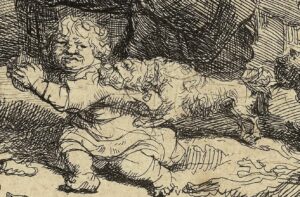
Note the child in the foreground, trying to protect his cake against a hungry dog. Another fine example of Rembrandt’s snapshots.


Inspiration

Between 1620 and 1630 Jan van de Velde (1593-1641) made an engraving with a woman in a similar position, but with less children surrounding her. Rembrandt copied his Good Samaritan two years earlier.
Buytewech and Adriaen Brouwer also depicted this common scene. Rembrandt owned a painting by Brouwer (ca. 1605-1638).
The pose of the toddler turning away from the pestering dog is inspired by one of the putti’s in Raphael’s Triumph of Galatea, reproduced in print by Marcantonio Raimondi and Hendrick Goltzius.


Related

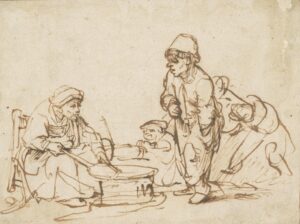
RembrandtThe pancake woman – Rijksmuseum – Benesch 409

Rembrandt made a similar drawing (Benesch 409, now at the Rijksmuseum), but probably it was not a study for this etching. A study for the boy and the dog can be seen in a drawing Elijah with the widow of Zaraphath (Benesch 112, now in the Louvre). Its attribution to Rembrandt has been doubted.
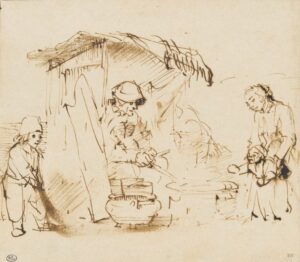
Aert de Gelder ?The pancake woman – Musée du Louvre

Another drawing in the Louvre shows a similar scene. It was originally attributed to Rembrandt, but later rejected. Peter Schatborn attributed it to Aert de Gelder.


Copies

New Hollstein lists five copies of which two copies in the same direction. Copy D is by Andrew Geddes (125 x 95 mm). Copy E is a woodcut by Ernest Philippe Boetzel in Blanc’s catalogue (105 x 77 mm, WB 1).
There are three copies in reverse. Copy A is anonymous, signed Rembrandt f. 1635 (two states, 111 x 81 mm, WB 4). Copy B is published by Hertel (his nr 19, 103 x 79 mm, WB 3). Copy C is by Francesco Novelli (his nr 39, three states, 100 x 75 mm, WB 2).


Attributions and reviews

The etching is considered as special by Seidlitz and Singer.


States

The number of states is quite confusing. The NewDollstein lists seven states, only the first two by Rembrandt. White-Boon list three states, Hind and Münz six, Seidlitz eight, Biörklund five, Nowell-Usticke one trial proof and six states. From his 3rd state there are later impressions by Watelet, P.Basan, Basan, Jean, Bernard and Beaumont.
In the 1st state (NH, WB, R363/NU trial proof a) the plate is still unfinished. The face is barely outlined, the hat and the dress nearly white.
In the 2nd state (NH, WB, R364/NU 1st state) the plate is rebitten. There is crosshatching added to the skirt of the woman holding a child on the extreme left and on the ground below her. Shading is added to the woman’s hat, the dress, the boy, the cat and the basket at her feet and the area of ground to its left.
In the 3rd state (NH, WB final, R365/2nd state NU) there is crosshatching added to the basket on the right.
The 4th state (NH, H/3rd state NU) is inscribed No 122 in the upper left corner,
The 5th state (NH/4th state NU P.Basan) is inscribed page 122 in the upper right corner and Tome 2 in the upper left corner. Both states appear in the Recueil de Basan of 1789.
In the 6th state (NH/5th state NU H.L. Basan, Jean,) the inscriptions are erased. This state appears in the Recueil de Basan of 1809.
In the 7th state (NH/6th state NU Bernard, Beaumont) the entire plate is rebitten and partly redrawn.


Prints and collections

Of the 1st state only two impressions are known, in the Rijksmuseum and in the British Museum.
The etching appears in the Recueil de Basan, impressions very good (NU).


Recueils

The etching appears in the Recueil de Basan, impressions very good (NU).
Recueil de H.L. Basan – Page                     NH: 6th state of VII/WB: 3rd and final state.
A pretty good impression, the inscriptions at the top no longer visible.

 Recueil de A. Beaumont –  Sheet 42        NH: 7th and final state/WB: 3rd and final state.
A good impression. Much darker than the Basan version.


Watermarks

In the 2nd state: Strasbourg lily (2 ed. c. 1648); Seven Provinces; Foolscap with seven-pointed collar.
In the 3rd state: Countermark AD.


Literature

H 141, BB 35-I, G 120, M 264, Mz 257, RA 363-365, Cl 126, W 128, Bl 93, Du 125, CD 101
Rembrandt’s Women 2001, p. 128; Rohde 2005, p. 127; Hinterding 2008, p. 257ff; Dat kan beter! 2013, p. 28; Bikker 2019, p. 73;


Rembrandt in Black & White: 186

New Hollstein: 2nd state of VII/White-Boon: 2nd state of III.
A contemporary impression on laid Japanese paper, before the cross-hatching on the basket, indicating a 2nd state.
Sheet 117/118 x 88 mm, broad margins of approx. 5 mm all around (+24%).


Exhibitions

Rembrandt in Black & White, Bozar Expo (Brussels), February-May 2016;
Rembrandt, 17th century photographer, Daegu Art Museum (Korea), November 2023 – March 2024;
Rembrandt, de fotograaf, Westfries Museum (Hoorn), June 2024 – January 2025;