B 116

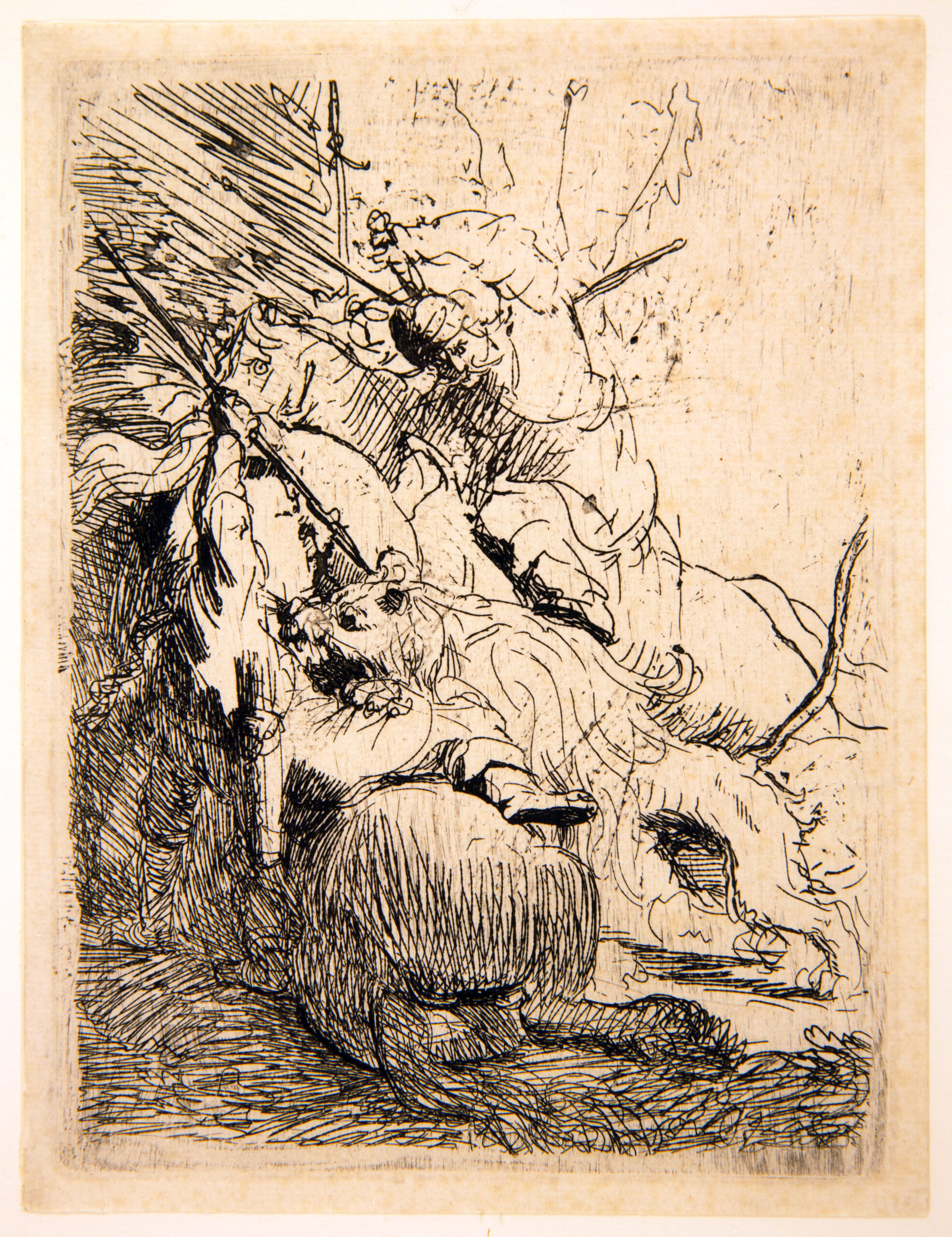
The small lion hunt (with one lion)

  • French title:
    Chasse aux lions, petite
  • German title:
    Die Löwenjagd mit einem Löwen und zwei Reitern
  • Dutch title:
    De kleine leeuwenjacht (met één leeuw)
  • New Hollstein:
    29
  • Rembrandt in Black & White:
    116

Etching. Ca. 1629.
Size: 158 x 117 mm. Surface: 185 cm2.
Not signed, not dated.

NH 29 – Only state

Copper Plate

The plate was not part of any of the major collections and is probably not in existence.


Rarity of impressions

  • In auctions (2000-2025): rare                                                   Early: 18                                       ⦿⦿⦿⊙⊙⊙

  • In collections (New Hollstein – 2013): rare                             Early: 48                                       ⦿⦿⦿⦿⊙⊙

  • Catalogue Nowell-Usticke (1967): RR-, very scarce                                                                     ⦿⦿⦿⦿⊙⊙


Picture

Hunting scenes were very popular in the 16th century, well-known through the prints by Philips Galle and Adriaan Collaert. The free style that Rembrandt uses in various etchings of this period (see also B 115 and B 117) is typical for this stage of development in which he had just acquired his own printing press and was experimenting, in particular with a new, softer coating.


Animal Farm

RembrandtYoung lion resting – ca 1645 – 1024 x 781 mm.

Rembrandt made the three lion-hunt etchings (B114-B115 and B116) when still in Leyden. He had probably not seen any real lions at that time. After moving to Amsterdam he made at least seven drawings of lions in 1642 and in 1648-50. Compared with the etchings, the drawings are more natural and authentic. By that time Rembrandt must have been able to see them alive. Several of these wild animals were imported by VOC-ships and shown to the public.

One of the drawings was in the Leyden collection of Thomas Kaplan. It was auctioned at Sotheby’s New York on 4 February 2026 and sold for ca. $ 18 mill.

Lions are also visible in five etchings, in combination with Saint Jerome. With the same ‘steps in maturity’. In three early works (B100, B101 and B102, 1632-1635) they are hardly recognizable as lions, in the two later ones (B 103 and 104, 1648 and 1653) they resemble the lions in the drawings.


Inspiration
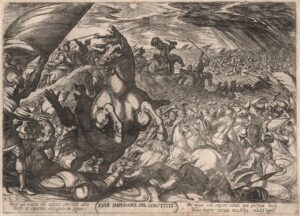
B&W 344 – Antonio TempestaHorse battle scene

As is the case for two other etchings of this subject (B 114 and 115) the composition is almost certainly based on a series of engravings by Antonio Tempesta (1555-1630). The inventory-list of 1656 proves that Rembrandt had four albums with the works of Tempesta in his possession.
He may also been inspired by the paintings and drawings of lion hunts by Peter Paul Rubens.


Attributions and reviews

The plate is not by Rembrandt according to Coppier and Singer.
Some authors, like Hind, have suggested that Rembrandt was probably not satisfied with the result and never used this style again. But this conclusion is contradicted by the fact that reprints were made as late as in 1652 (see ‘Watermarks’).


States

All authors list one state only.


Watermarks

Double-headed eagle (1632-34); Arms of Württemberg (c. 1634-36); Foolscap with five-pointed collar (4 ed. 1639-40 and c. 1650-51); Foolscap with five-pointed collar with cm PDB’(c. 1648); Foolscap with five-pointed collar with cm LB (c. 1650); Strasbourg lily with cm WK’ (c. 1652). Paschal lamb;


Literature

H 6, BB 29-3, G 113 (3), M 274, Mz 251, RA 345, Cl 118, W 120, Bl 88, Du 117, CD 149
N.Beets, Herscheppingen in the Feestbundel Bredius, 1915, p. 1-7; Hinterding 2008, p. 245ff; Zeist 2012, p. 26-27; Rutgers/Standring 2018, p. 21;


Rembrandt in Black & White: 116

New Hollstein/White-Boon: Only state
A very nice, contemporary print with some small repairs. A horizontal crease, only visible verso.
Sheet 168/169 x 128/127 mm, margins of 5 mm all around (+16%).
No watermark, vertical chain lines at approx. 23 mm.


Provenance

In the collection of Baron Charles Marochetti (Torino 1805-1867 London, Lugt 392), his collector’s mark in brown ink vaguely visible verso;
Probably in the posthumous sale of the collection with Sotheby’s London in March 1868.


Exhibitions

Rembrandt in Zwart-Wit, Westfries Museum (Hoorn), Het Markiezenhof (Bergen op Zoom), Stedelijk Museum Zutphen, Het Hannemahuis (Harlingen), Museum Gouda, Jan ten Horne Museum (Weert), Stadsmuseum Harderwijk, March 2013-August 2015;
Rembrandt in Black & White, Chateau des Penthes (Geneva), June – October 2016;