B 120

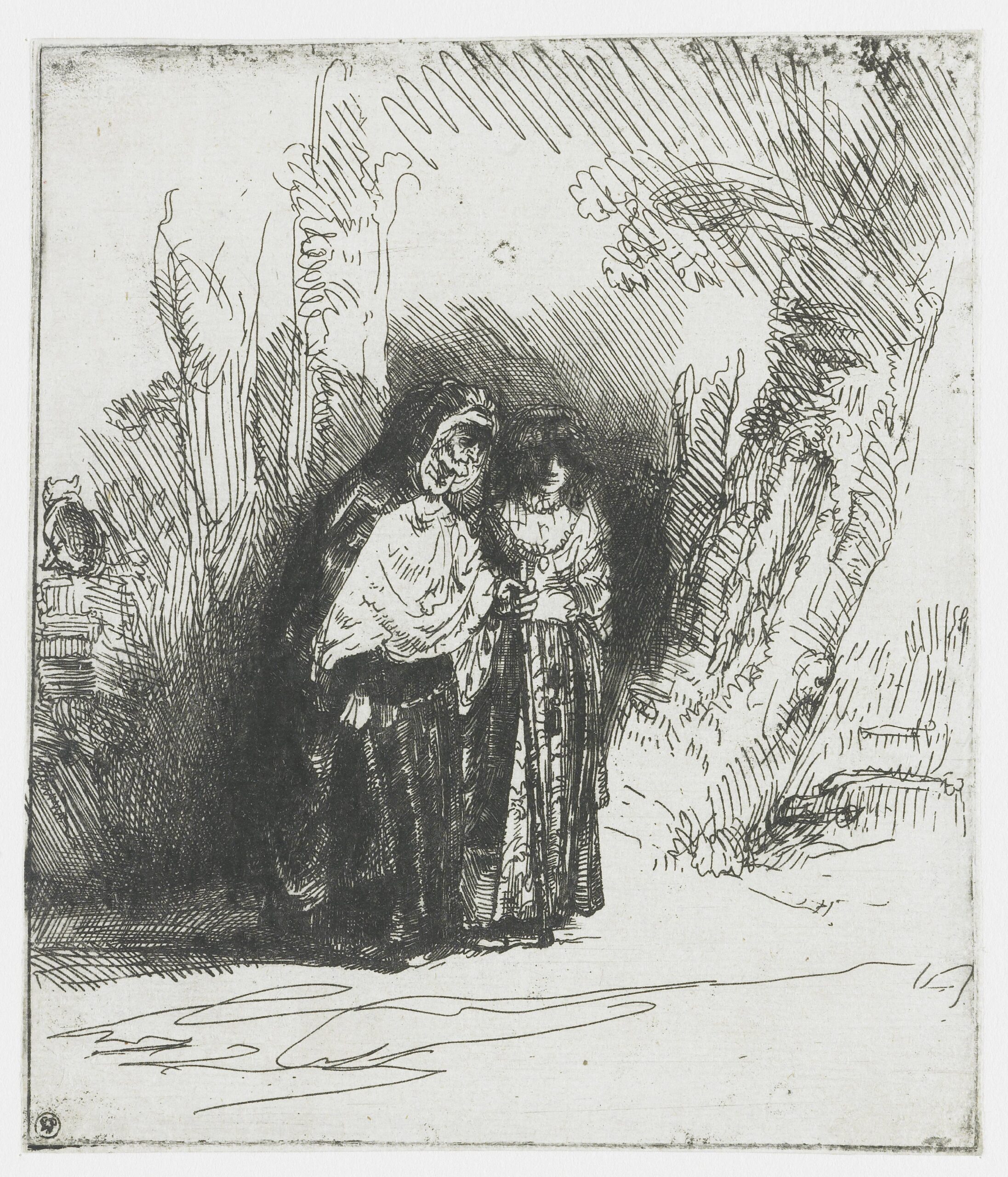
The Spanish gypsy (Preciosa)

  • French title:
    La petite Bohemienne Espagnol
  • German title:
    Preciosa
  • Dutch title:
    Majombe en Preciosa
  • New Hollstein:
    205
  • Rembrandt in Black & White:
    Not included

Etching. Ca. 1642.
Size: 133 x 113 mm. Surface: 150 cm2.
Not signed, not dated.

NH 205 – Only state

Copper Plate

The plate may have been part of the sale by Clement De Jonghe, described as Wandelende besjes (strolling old ladies).
It was called het Spaans heidinnetje en Majombe in Valerius Röver’s inventory in 1731. The plate was not part of any later collection or sale and is almost certainly lost.


Rarity of impressions

  • In auctions (2000-2025): not seen in auctions

  • In collections (New Hollstein – 2013): very rare                   Early: 30                                      ⦿⦿⦿⦿⦿⊙

  • Catalogue Nowell-Usticke (1967): RRRR+, of the greatest rarity                                            ⦿⦿⦿⦿⦿⦿


Subject/Sitter

There have been many suggestions regarding the identity and the meaning of this print. Blanc was the first to suggest that the subject referred to Cervantes’ book Preciosa, based on the title in the De Burgy sales catalogue of 1756, where the print is called La petite Bohemienne Espagnole auprès de Majombe, Cervantes’ Preciosa describes how Constanza (Preciosa) is kidnapped by an old gypsy woman, Majombe, who teaches her the gypsy way-of-life and gypsy wisdom. The book was also the basis for a play called La Gitanilla de Madrid (1613). Two playwriters, Catherina Verwers and Mattheus Tengnagel, made their own versions of the play, which both premiered in 1643.
According to J. Six the print may have been intended as an illustration for the Tengnagel version, called Het leven van Konstance, waar af volgt het tooneelspel de Spaensche Heidin. It includes  were several plates by P.Nolpe and Simon de Vlieger, but not by Rembrandt.
Earlier, in 1637, Jacob Cats made his own version of the Cervantes story which was very popular.


Animal Farm

Near the left margin a dog is sitting (or is it a cat?), his rather fat back turned towards us.


Related

Rembrandt made a similar drawing in the same year (Benesch 737, now in the Musée des Beaux-Arts in Brussels). The figures in that drawing are normally identified as Ruth and Naomi. This was the reason for the interpretation by Jordan that the scene is in fact about Ruth and Naomi (as described in Ruth 1, verses 15 – 19). This view received some support from Astrid Tümpel and Julia Lloyd-Williams, but has not led to a new name.
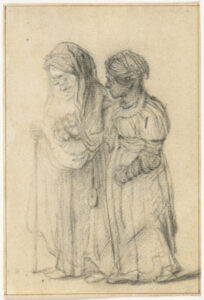
RembrandtRuth and Naomi – 204 x 300 mm – Koninklijke Museum voor Schone Kunsten, Brussels – Benesch 737

Copies

There is a copy in the same direction by P.F.Basan in his Recueil (nr 116, 130 x 114 mm, WB).


Attributions and reviews

The etching is considered as special by Rovinsky and Wilson.


States

All authors list one state only.


Watermarks

Foolscap with five-pointed collar.


Literature

H 184, BB 42-2, G 16, M 285, Mz 267, RA 355, Cl 122, W 124, Bl 83, Du 121, CD 144, S 60.
J. Six in Oud Holland, 1909; Rembrandt’s Women 2001, p. 176; Hinterding 2008, p. 251ff; Regie: Rembrandt 2024, p. 57;


Rembrandt in Black & White: Not included