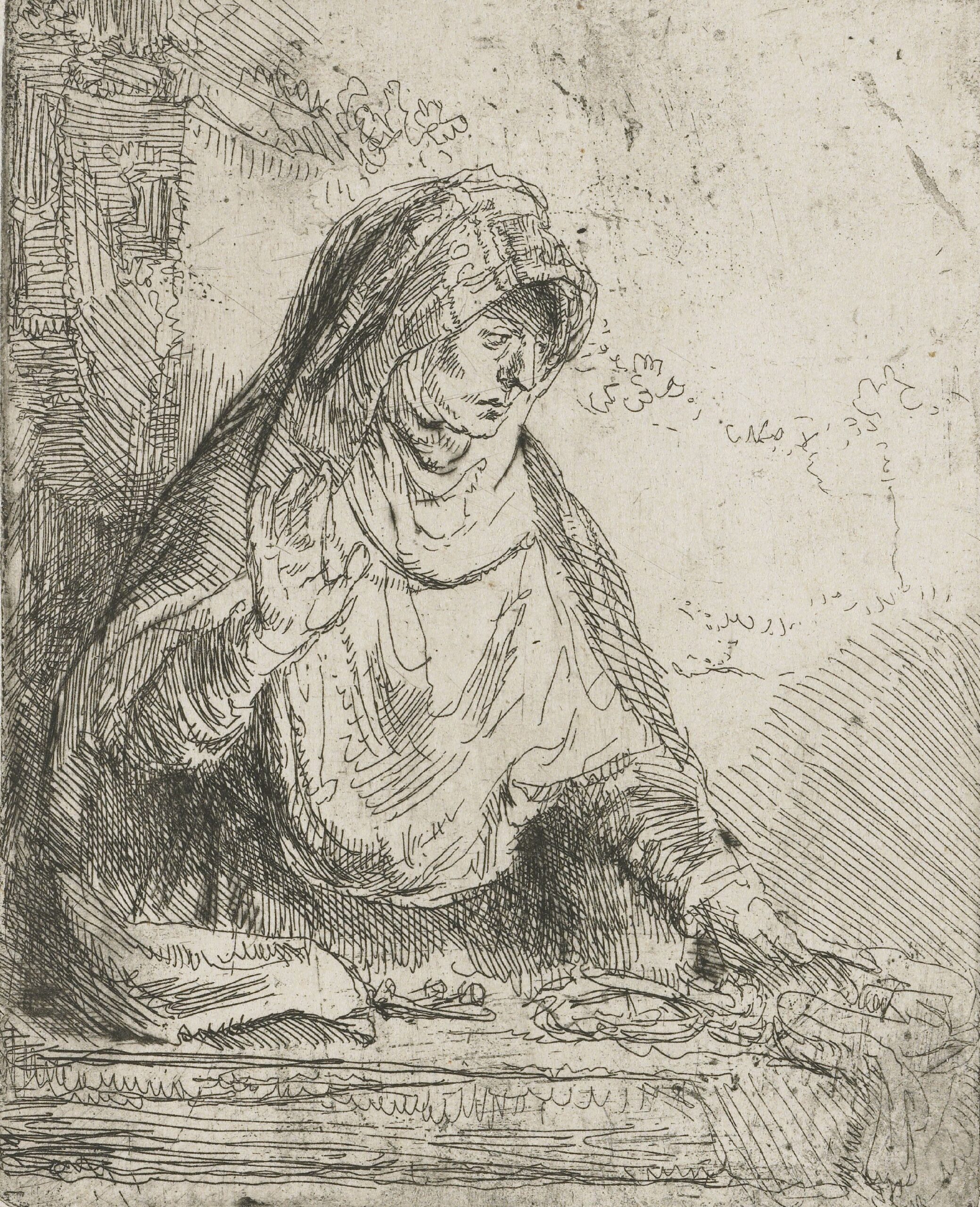
Etching and drypoint. Ca. 1642.
Size: 110 x 89 mm. Surface: 98 cm2.
Not signed, not dated. Estimates of the date vary from 1636 (Middleton) via 1641 (Hind, Biörklund and Hinterding) to 1652-53-54 (White-Boon and Münz).
The plate was not part of any of the early auctions or major collections and is almost certainly not in existence anymore.
Rarity of impressions
In auctions (2000-2025): not seen in auctions
In collections (New Hollstein 2013): extremely rare Early: 12 ⦿⦿⦿⦿⦿⦿
Catalogue Nowell-Usticke (1967): O-, unobtainable
Subject/Sitter
This emotional, saddening picture shows Mary with the instruments used to torture Christ, the crown of thorns and the nails used to fasten His body to the cross.
Inspiration
Hind and Münz assume that the Mater Dolorosa by Titian served as an example to Rembrandt.
Copies
There is one copy in the same direction by W.J.Smith (1824, 110 x 87 mm, WB, ).
Attributions and reviews
The etching is considered as special by Rovinsky.
The plate was made by a pupil according to Blanc.
The plate is not by Rembrandt according to Middleton, Seidlitz, Coppier and Singer.
States
Almost all authors list one state only. In later impressions the burr is gone and the ground is cleaned. Some (e.g. Hind and Münz) consider this a separate state.
Prints and collections
Presently, only twelve impressions of this rare print are known. Early impressions show burr under the Virgin’s arm, on her neck and on her veil.
Watermarks
Foolscap; Foolscap with five-pointed collar.
Literature
H 193, BB 41-5, G 89, M 202, Mz 234, RA 272-274, Cl , W , Bl , Du , CD Rembrandt’s Women 2001, p. 200;