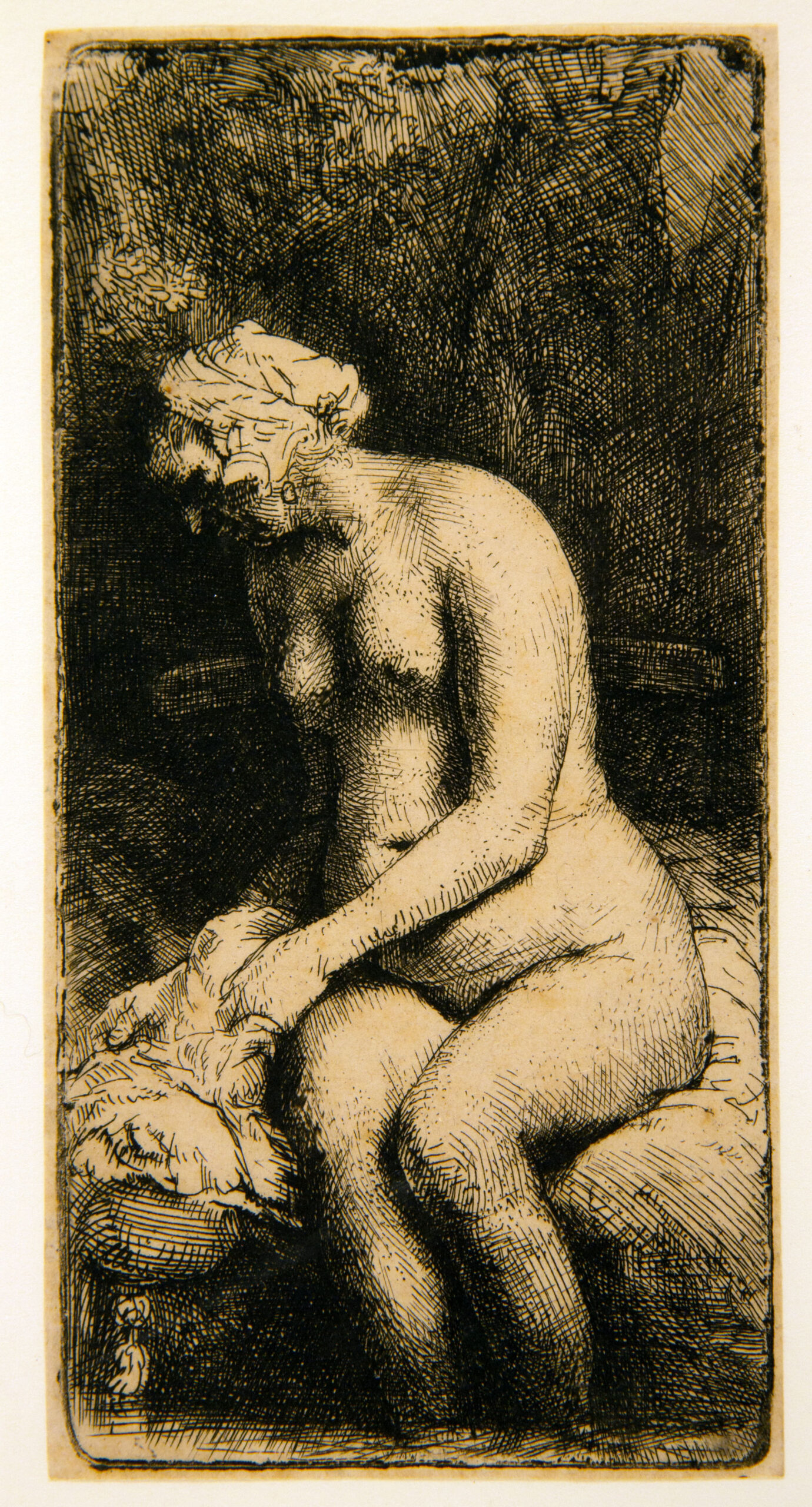
The copperplate may have been in the sale by Clement de Jonghe (1679) as 29 naackte Cleopatra. It later appeared in the collection of Claude-Henri Watelet (1718-1786). It then became part of the set of plates subsequently owned and used for printing Recueils by Pierre-François Basan (1723-1797), Henri-Louis Basan (his nr 1431), Auguste Jean (ca 1809), Veuve Jean, Auguste and Michel Bernard (1846) and Robert Lee Humber (1937). It was sold at the Artemis sale in London (1993) and is now in the Bibliothèque Nationale in Paris.
Rarity of impressions
In auctions (2000-2025): very frequent Mixed: 16 Late: 26 Unknown: 28 ⦿⊙⊙⊙⊙⊙
In collections (New Hollstein – 2013): frequent Early: 71 Late: 15 ⦿⦿⊙⊙⊙⊙
Catalogue Nowell-Usticke (1967): C1, not uncommon ⦿⦿⊙⊙⊙⊙
Picture
This is one of the three etchings of nude women Rembrandt made in 1658, just after his bankruptcy. Although the title suggests that the scenery is outdoors, neither the feet nor the brook are visible. It is also clear that the model sits in a well-cushioned armchair. So it is possible that the picture was made in a studio and that Rembrandt added the tree trunk and some bushes in the background later.
As he has done in many other etchings of nudes, Rembrandt pictures the model as he sees her.
Rembrandt probably used the empty upper part of the plate of Christ and the woman of Samaria (B 70) for this etching. Hinterding has proven that both the size and the thickness of the plates are identical.
Title
In the de Burgy sale (1755) the print was called Het raare naakte Vrouwtje in ‘t Bad (the rare naked woman in a bath) which may be a more accurate title.
Attributions and reviews
The etching is considered as special by Coppier.
States
NH list two states, the second state not by Rembrandt. Most other authors list one state only. Hind, Münz and Nowell-Usticke list two states. From NU’s 1st state there are later impressions by P.F and H.L. Basan, Jean, Bernard and Beaumont.
Early impressions of the 1st state have inked edges and round squares. There is some burr on the shoulders and in the corner right under, before the diagonal line appeared. In intermediate impressions (H.L. Basan) there is a diagonal scratch of almost 25 mm below the middle of the top margin. Hind and Münz consider this to be a 2nd state. In even late impressions, the scratch has disappeared, but there are two short new one (8 mm), somewhat lower. In impressions by Jean the dark shading left of the woman is worn out.
In the 2nd state (NH, NU) the plate is completely reworked by Bernard. On the left side the belly of the woman is clearly visible instead of fading into the shading. In later impressions the fine lines of shading are very weak, just as the shading on the right breast.
Prints and collections
There are many impressions of the 1st state on Japanese and Chinese paper and on parchment.
Nowell-Usticke considers the impressions in the Recueil of Basan to be strong.
Watermarks
In the 1st state: Foolscap.
Literature
H 298, BB 58-D, G 192, M 297, Mz 140, RA 556, Cl 197, W 197, Bl 164, Du 197, CD 255 Rembrandt’s Women 2001, p. 225; Rohde 2005, p. 140; Hinterding 2008, p. 361-363; Blaazer 2009, p. 49-60;
Rembrandt in Black & White: 45
NHD: 1st state of II/WB: only state.
Excellent early impression on Japanese paper, with burr on the right breast and under the left knee. The edges are inky, an indication of the early date of the print.
Sheet 204/206 x 122 mm, very wide margins of 20 mm or more all around (+83%).
Exhibitions
Rembrandt in Zwart-Wit, Westfries Museum (Hoorn), Het Markiezenhof (Bergen op Zoom), Stedelijk Museum Zutphen, Het Hannemahuis (Harlingen), Museum Gouda, Jan ten Horne Museum (Weert), Stadsmuseum Harderwijk, (March 2013 – August 2015); Stedelijk Museum Vianen, October 2017 – January 2018; Rembrandt in Black & White, Schloß Britz (Berlin), Bozar Expo (Brussels), Chateau des Penthes (Geneva), November 2015- October 2016; Rembrandt, 17th century photographer, Daegu Art Museum (Korea), November 2023 – March 2024; Rembrandt, de fotograaf, Westfries Museum (Hoorn), June 2024 – January 2025;