Four illustrations to Menasseh ben Israel’s ’Piedra Gloriosa’
French title:
Quatre sujets pour un livre Espagnol
German title:
Vier Darstellungen zu einem Spanischen Buche
Dutch title:
Vier illustraties
New Hollstein:
288
Etching, drypoint and burin. 1655.
Size: 280 x 160 mm. Surf. 448 cm2.
Signed and dated, in the lower right corner: Rembrandt f. 1655 (from the 2nd state).
The copperplate was cut into four separate ones, each representing one part of the story. These four plates were not part of any of the major collections or sales and are almost certainly not in existence anymore.
Rarity of impressions
In auctions (2000-2025): the uncut plate: not seen in auctions
In collections (New Hollstein 2013): the uncut plate: extremely rare Early: 12 ⦿⦿⦿⦿⦿⦿
Nowell-Usticke (1967): RRR+: All four subjects are very rare ⦿⦿⦿⦿⦿⊙
Description
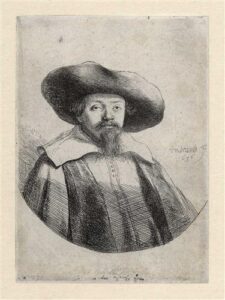
B 269 – Portrait of Menasseh ben Israel – 1636 – Rembrandthuis
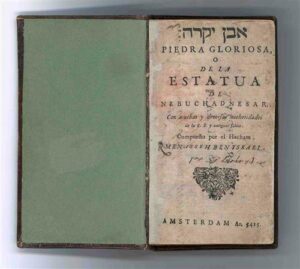
These four etchings were made as illustrations for a book published in Amsterdam in 1655, Piedra Glorioso o the la estatua the Nebuchadnezzar, by Menasseh ben Israel. The author was well acquainted with Rembrandt, who made an etching of his portrait almost twenty years earlier (B 269). The plate was cut at a later stage. Of all four separate plates various states exist, some already applied before the plate was cut.
Story
Daniel, chapter 2, verses 31-35
The book of Daniel covers the coming of the Messiah. This theme was very important for the Jewish community in Amsterdam. Since members of the Jewish faith were persecuted in many countries, they were hoping for the early arrival of the Messiah as the ultimate salvation. The central element in the story is a rock that was cut loose of the mountain without the use of hands (zunder handen). It was the very rock that destroyed the statue Nebuchadnezzar saw in his dream. The same rock also served as cushion for Jacob’s head when he had his vision of the ladder between heaven and earth. And it was the stone used by David to defeat Goliath. Those were the visions of Daniel in his dream. Gary Schwarz suggested that the changes Rembrandt made in the early states proved that he did not fully understand the Spanish texts, which he could not read. He may even have received instructions to change some elements in the pictures in order to bring them more in line with the actual texts.
Subject/Sitter
Menasseh ben Israel – Piedra Glorioso – 1655 – Rembrandthuis
The book ‘Piedra Gloriosa’
Apparently Menasseh ben Israel was satisfied with the unorthodox illustrations, since he did include them in his book. That is to say, in the first edition only. In a later edition, published after Rembrandts death, the prints were replaced by engraved copies by Salomon d’ Italia, a Jewish engraver working in Amsterdam between 1637 and 1660. The reason for this is probably purely technical. The drypoint technique Rembrandt used quite extensively is not suited for printing many copies. After the first edition of the book, the plates were probably too much worn to be of further use.
The individual prints were printed separately and then inserted in the book. In some books the four illustrations were kept together, just after the introduction, in other versions they were spread over the book. It may well be that some books did not even contain the illustrations, as Dubiez suggested in 1992.
Related
Benesch suggested that Rembrandt looked at a book by Hugh Broughton, published in 1590, in which the related Bible stories are described and illustrated. Münz pointed at ‘The image seen by Nebuchadnezzar by Matthias Merian’ (1593-1650). Tümpel saw a link with illustrations by Tobias Stimmer’s picture of David and Goliath.
Copies
There is one copy in the same direction by Flameng in Blanc’s catalogue (97 x 74 mm).
States
The uncut plate: New Hollstein, as most authors, lists three states, Nowell-Usticke two. He considered the 1st state to be a trial proof. In the 1st state (NH, WB, R118/trial proof A NU) only the 1st state of the A plate is etched. In the 2nd state (NH, WB, R116/1st state NU)) the A plate is a 2nd state, the others are in their 1st state.
In the 3rd state (NH, WB, R117/2nd state NU) the A plate is a 3rd state version, the others are in their 2nd state.
Prints and collections
Of the uncut plate only one impression is known of the 1st state (in the Bibliothèque Nationale, R118), five of the 2nd state and six of the 3rd state, for a total of twelve. Five of these are printed on Japanese paper and one impression of the 3rd state in the Albertina is on vellum. There is a maculature of the 2nd state in the British Museum.
Of the complete book, including the prints, only six copies are known, in the Rembrandthuis, in the University Libraries in Amsterdam and Leiden, in the Petit Palais (Dutuit Collection), the Lugt Collection and the Bibliothèque Nationale in Paris. Based on the number of complete impressions and the number of individual impressions of early states, obviously cut from the original complete one, Hinterding concludes that at least 28 impressions of the complete plate were made,
Literature
H 284, BB 55-C, G 34, M 247, Mz 183, RA 116-129, Cl 40, W 40, Bl 8, Du 47, CD 242. H. van de Waal, ‘Rembrandts Radierungen zur Piedra Gloriosa des Menasseh ben Israel’, in Imprimatur, Jahrbuch fur Bucherfreunthe 1854-55, p 52; Fuchs 1968, p. 43-44; Tümpel 1970, p.39; White 1999, p. 51-53; Tümpel 2006, p. 106-109; De ‘joodse’ Rembrandt 2006, p. 24-26; Hinterding 2008, p. 80-86; Rosenberg 2017, p. 90-101.
Although the four prints are printed on separate sheets, the states (2nd state of B 36 A and 1st state of the three others) are similar to the uncut prints of the 2nd state. Consequently, it is quite likely that the prints were printed in the uncut state and then separated.
Provenance
In the collection of Fürst Waldberg Wolfegg (Wolfegg – Würtenberg, Lugt 2542), his collection stamp in black ink, verso.
In the collection of Richard H. Zinser, an art dealer in New York (1884-1983), his collector’s mark, a chesstower, in black ink verso (not in Lugt); These marks are found on all four individual prints.
Exhibitions
Rembrandt in Zwart-Wit, Westfries Museum (Hoorn), Het Markiezenhof (Bergen op Zoom), Stedelijk Museum Zutphen, Het Hannemahuis (Harlingen), March 2013 – July 2014; Rembrandt in Black & White, Schloß Britz (Berlin), Bozar Expo (Brussels), Chateau des Penthes (Geneva), November 2015 – October 2016; Rembrandt, fotograaf avant-la-lettre, Museum De Reede (Antwerp), January – May 2023;