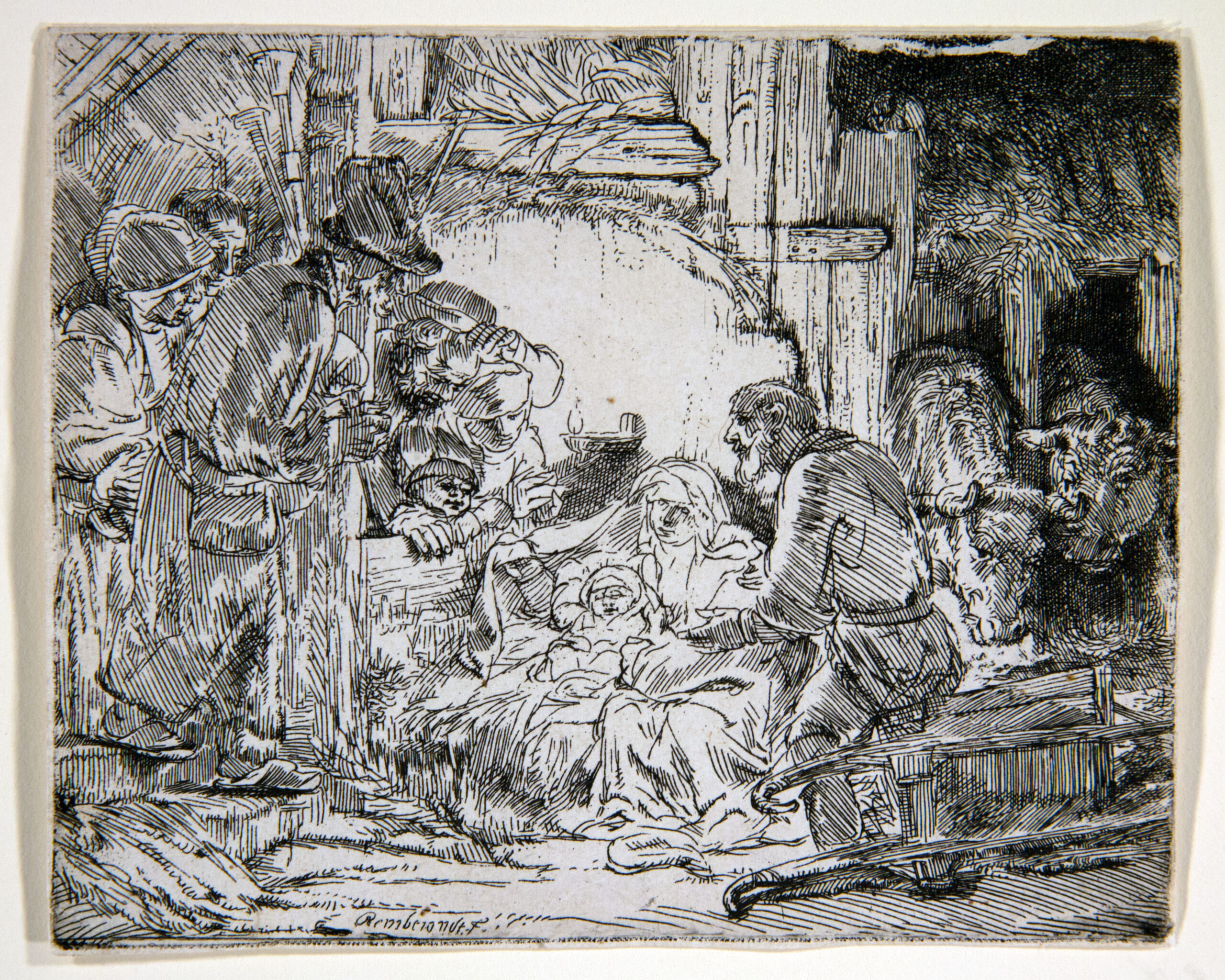
The plate was probably in the collection of Clement de Jonghe (1679, as 65 geboorte)). The next, anonymous owner added two dots. It later appeared in the sale of Pieter de Haan (1767, lot 12) and was sold via Fouquet to Claude-Henri Watelet. It then became part of the set of plates subsequently owned and used for printing Recueils by Pierre-François Basan, Henri-Louis Basan (his nr 1381), Auguste Jean (ca 1809), Veuve Jean, Auguste and Michel Bernard (1846), Alvin-Beaumont (1906) and Robert Lee Hunter (1937). It was sold at the Artemis sale in London (1993) and is now probably in a private collection in Germany.
Rarity of impressions
In auctions (2000-2025): very frequent Early: 10 – Late: 47 ⦿⊙⊙⊙⊙⊙
In collections (New Hollstein 2013): very frequent Early: 45 – Late: 54 ⦿⊙⊙⊙⊙⊙
Catalogue Nowell-Usticke (1967): C2-, a common print ⦿⊙⊙⊙⊙⊙
Story
Luke 2, verses 15-19
In 1654 Rembrandt made a series of six etchings about the childhood of Jesus, of which this is one. They all have a roughly similar size, are stylistically comparable and follow the scripture quite strictly, as Tümpel pointed out.
Picture
The central position of the oil lamp, illuminating the semi-circle in which Mary and the Child are positioned, gives this etching more spontaneity than that of the same subject etched two years earlier (B 46).
Animal Farm
As can be expected, the ox and the ass are present on the right side. Although it looks as if we see two oxen, no donkey.
Related
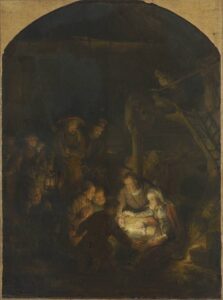
Rembrandt – Adoration by the shepherds (Nativity) – 1646 – 92 x 71 cm – Alte Pinakothek – München – Corpus V11 – Bredius 574
Rembrandt made two paintings of the same subject in 1646, albeit in a very different composition. The first (Bredius 574, in the Alte Pinakothek) was part of the series bought by Frederik Hendrik. The second (Bredius 575, in the British Museum) is considered a satellite painting made in the workshop.
According to Münz the link may be a drawing by Nicolas Maes (HdG 680, now in the Louvre) which is one of a group of drawings made by Maes in Rembrandt’s atelier.
Rembrandt may also have been inspired by an etching by Annibale Carracci, Adoration (B2). Some details in the etching, like the archway and the lamplight, can also be found in Rubens’ Adoration of the Magi (Oldenburg 166, now in the Musée des Beaux-Arts in Marseille) and in two engravings that Lucas Vorsterman made of this painting (in mezzotint, H6 and especially H7).
Attributions and reviews
The etching is considered as special by Coppier.
States
The New Hollstein lists three states, only the first state is by Rembrandt. The 2nd state (two dots) is ‘new’. Most other author’s list two states, Nowell-Usticke three states, from his 2nd state there are later impressions by Watelet (?), P.Basan, Basan, Jean, Bernard and Beaumont.
The 1st state (NH, WB, R153) shows a white strip at the right of the top border due to failure of biting°.
In the 2nd state (NH) two dots are added in the upper left corner by a later owner.
In the 3rd state (NH/2nd state WB (final), R154, NU Watelet? P.Basan, Basan, Jean, Bernard) the white strip is worked over by the burin°. According to Hinterding, certainly not by Rembrandt.
In the 3rd state (NU Bernard) the two worn patches above the cows are partly reworked. The left-hand patch is covered by diagonal right-left shading.
Prints and collections
There are several impressions of the 1st state on Japanese and Chinese paper (a.o. in the Rijksmuseum).
The etching appears in the Recueil de Basan, without any rework, impressions fairly strong (NU).
Watermarks
In the 1st state: Foolscap with seven-pointed collar with countermark PEH; Fleur-de-lis; Paschal lamb; Strasbourg Lily;
In the 2nd state: Seven Provinces (> 1665);
Literature
H 273, BB 54-1, G 44, M 238, Mz 226, RA 153-154, Cl 49, W 50, Bl 18, Du 50, CD 231 Rembrandts Passie p. 61-64; Hinterding 2006, p. 254; Hinterding 2008, p. 102-103; Late Rembrandt p. 185-186;
Rembrandt in Black & White: 152
New Hollstein: 1st state of III/ White-Boon: 1st state of II
A strong, early impression. The white strip clearly visible, confirming a 1st state.
Sheet 106/105 x 130/128 mm, margins of 1 mm all around, partially cut at the plate mark on the left side (+1%).
Watermark: Foolscap with seven pointed collar, listed but not dated in Hinterding 2006 (p. 254). Horizontal chain lines.
Provenance
In the collection of André-Jean Hachette (1873-1952, Paris, Lugt 132), his collector’s mark verso;
It was probably in the posthumous sale of his collection with M. Rousseau in Paris in May 1953.
Later in the collection of Shawn Merriman, Colorado (USA, not in Lugt);
Exhibitions
Rembrandt in Zwart-Wit, Het Markiezenhof (Bergen op Zoom), Stedelijk Museum Zutphen, Jan ten Horne Museum (Weert), Stadsmuseum Harderwijk, July 2013-August 2015; Stedelijk Museum Vianen, October 2017 – January 2018; Rembrandt in Black & White, Schloß Britz (Berlin), Bozar Expo (Brussels), Chateau des Penthes (Geneva), November 2015 – October 2016; Rembrandt, de fotograaf, Westfries Museum (Hoorn), June 2024 – January 2025;