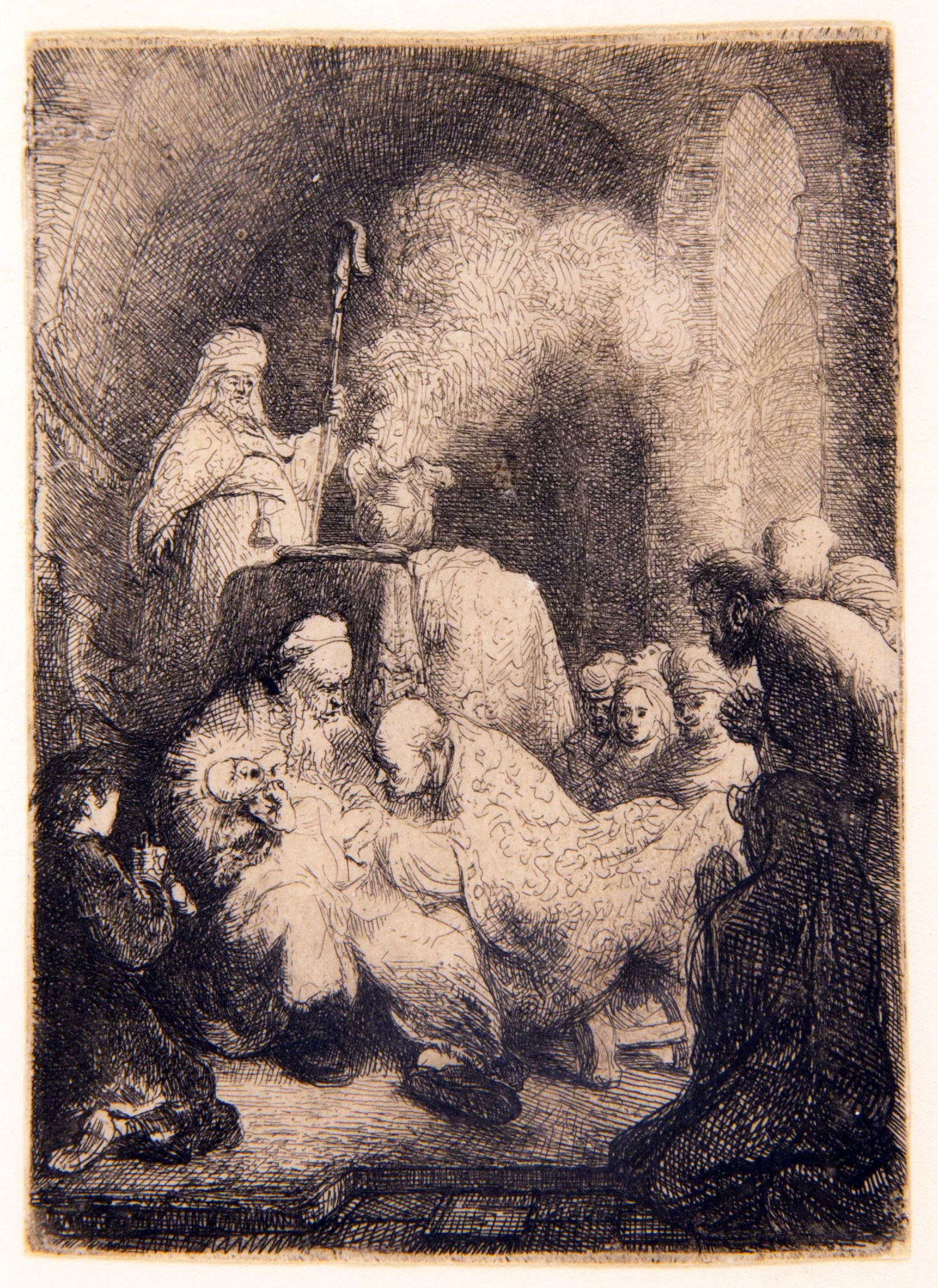
Etching and touches of drypoint. Ca. 1630.
Size: 88 x 64 mm. Surface: 56 cm2.
Not signed, not dated. Date assumed 1630, but it may be slighter later.
Münz thinks the heads and shadows were reworked by Rembrandt in 1632-33.
The plate was not part of any of the early auctions or collections and is probably not anymore in existence.
Rarity of impressions
In auctions (2000-2025): common Early: 24 ⦿⦿⦿⊙⊙⊙
In collections (New Hollstein 2013): rare Early: 50 ⦿⦿⦿⦿⊙⊙
Catalogue Nowell-Usticke (1967): R1, a scarce little print. Fine impressions are rare ⦿⦿⦿⊙⊙⊙
Story
Luke 2: 21
According to the Bible, the circumcision of Jesus took place eight days after his birth. Rembrandt follows the tradition of placing the event in the temple, although women were not allowed there within forty days after giving birth. Is that the reason the Virgin is positioned in the foreground, in the shadow of Joseph?
Picture
The light comes in from the window in the top right corner, illuminating the two priests, Jesus and the pontiff on the altar.
Related
There is a drawing by Rembrandt of the same subject, made in 1635 (Benesch 110, now in Lwow). According to Valentiner Rembrandt was inspired by an engraving by Hendrick Goltzius (B18,). Rijkevorsel suggests that a woodcut by Dürer (B 86) was the prototype. Münz rejects both views and refers to Merina’s Picture Bible.
Copies
B&W 340 – Francesco Novelli – Copy C of NH 55 – B 48 – The circumcision
The New Hollstein lists eight copies, of which one (B) in the same direction, by David Deuchar, included in his album (90 x 66 mm, WB 1).
There are seven copies in reverse. Copy A is a rectangular plate with the subject in an oval. By an anonymous artist, inscribed Renbrandt invent (90 x 70 mm). Copy C is by Francesco Novelli, included in the collection Rembrandt in Black & White, number 340 (two states, his nr 36, 115 x 80 mm, WB 3,).
Copy D is anonymous (88 x 63 mm, WB 4). Copy F is attributed to Johannes van Vliet (86 x 58 mm, WB).
Copy E is by A.Thery, inscribed Rimbrant (90 x 63 mm). Copies G and H are anonymous (resp. 88 x 63 mm and 83 x 63 mm).
Attributions and reviews
The etching is considered as special by Bartsch, De Claussin and Blanc. Wilson calls the plate a “beautiful little piece, highly finished, in a very good taste”.
The plate was partly made by a pupil according to Coppier and is not by Rembrandt according to Singer.
States
All authors list one state only. An impression in the Dutuit Collection (Petit Palais, Paris) in which various shaded areas have been reworked, was considered a 2nd state since 1986, but Hinterding pointed out that these additions are in pen and ink and are most likely made posthumous.
Prints and collections
Early impressions of the 1st state are lightly bitten, in later impressions the background gets weaker and greyish. Blanc lists a badly retouched state with Joseph’s head completely changed.
Watermarks
Basilisk (c. 1632); Foolscap.
Literature
H 19, BB 30-8, G 47, M 179, Mz 194, RA 164, Cl 52, W 53, Bl 21, Du 53, CD 19 Tümpel p. 44; Tümpel p. 44; W.R.Valentiner, Rembrandt und seine Umgebung, Strasbourg 1905; Rembrandt creates Rembrandt, p.104-105 (1st of II?); Rembrandts Passie p. 65-66; Hinterding 2008, p. 108ff;
Rembrandt in Black & White: 108
New Hollstein/White-Boon: only state
A good, well-inked contemporary print, with burr on the child’s mouth, arms and head.
Sheet 88/89 x 65/64 mm, thread margins of less than 1 mm, cut on the platemark on the right side (+3%).
No watermark, horizontal chain lines at approx. 24 mm.
Exhibitions
Rembrandt in Zwart-Wit, Stedelijk Museum Zutphen, Jan ten Horne Museum (Weert), Stadsmuseum Harderwijk, November 2013- August 2015; Rembrandt, de fotograaf, Westfries Museum (Hoorn), June 2024 – January 2025;