B 53

The flight into Egypt: a night piece

  • French title:
    Fuite en Egypt, effet de nuit
  • German title:
    Die Flucht nach Ägypten, Nachtstuck
  • Dutch title:
    De vlucht naar Egypte bij nacht
  • New Hollstein:
    262
  • Rembrandt in Black & White:
    231

Etching and drypoint. 1651.
Size: 127 x 110 mm. Surface: 140 cm2.
Signed and dated, in the lower right corner: Rembrandt. f. 1651 (the 6 reversed).

NH 262 – 6th state of X

Copper Plate

The copperplate was in the sale by Clement de Jonghe (1679), as 48 Nachjen vlucht naa Egypte. It was in the sale of Jean de Bary (1759, lot 45), where sold to Ottens. It was then in the collection of Claude-Henri Watelet (1786) and became part of the set of plates subsequently owned and used for printing Recueils by Pierre-François Basan, Henri-Louis Basan (his nr 1385), Auguste Jean (ca 1809), Veuve Jean, Auguste and Michel Bernard (1846), Alvin-Beaumont (1906) and Robert Lee Humber (1937). It was sold at the Artemis sale in London (1993) to an unidentified bidder.


Rarity of impressions

  • In auctions (2000-2025): very frequent                                 Early: 6     Mixed 22     Late: 29    ⦿⊙⊙⊙⊙⊙

  • In collections (New Hollstein 2013): very frequent             Early: 41     Mixed: 79     Late: 17    ⦿⊙⊙⊙⊙⊙

  • Catalogue Nowell-Usticke (1967): C2+, a common night effect print, but fine early proofs very rare  ⦿⊙⊙⊙⊙⊙


Story

Matthew 2:14-15
The flight into Egypt was one of Rembrandts favourite subjects of which he made a series of etchings over a rather long period, from 1629 till 1655 (Bartsch numbers 52 to 59). Most of these have a similar size.


Related

Pieter LastmanThe Flight into Egypt – 1608 – Boymans van Beuningen


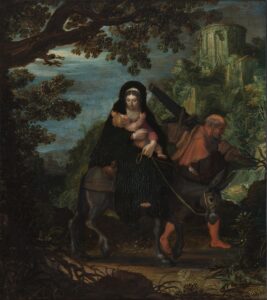
Rembrandt may have been inspired by the painting of this subject that his tutor Pieter Lastman made in 1608 (now in the Boymans van Beuningen). Most likely, as Münz suggested, the example for this plate was an engraving made in 1613 by Hendrick Goudt after a painting by Adam Elsheimer (1578-1610).

Hind mentions a study in a private collection in Paris in which Joseph walks in front of the ass and the Virgin is seen in profile.
Rijkevorsel mentions a picture by Peruzzi in the St. Onofrio (Rome) as the source of the composition.


Copies

New Hollstein lists six copies in reverse. Copy B is by Claude Henri Watelet (151 x 116 mm). Copy C is by Francesco Novelli (his nr. 10, two states, 149 x 126 mm, WB).
Copy E is by Dirck Jan Singendonck, signed DJS 1813 (106 x 86 mm). Copy F is a woodprint by John Jackson (1839, 98 x 82 mm). Copies A and D are anonymous.


Attributions and reviews

The etching is considered as special by Coppier.


States

The New Hollstein lists ten states, the four final ones not by Rembrandt. Most other authors list five states, White-Boon six, Nowell-Usticke nine. From his 6th state there are later impressions by Watelet, P.Basan, H. Basan, Jean, Bernard and Beaumont.
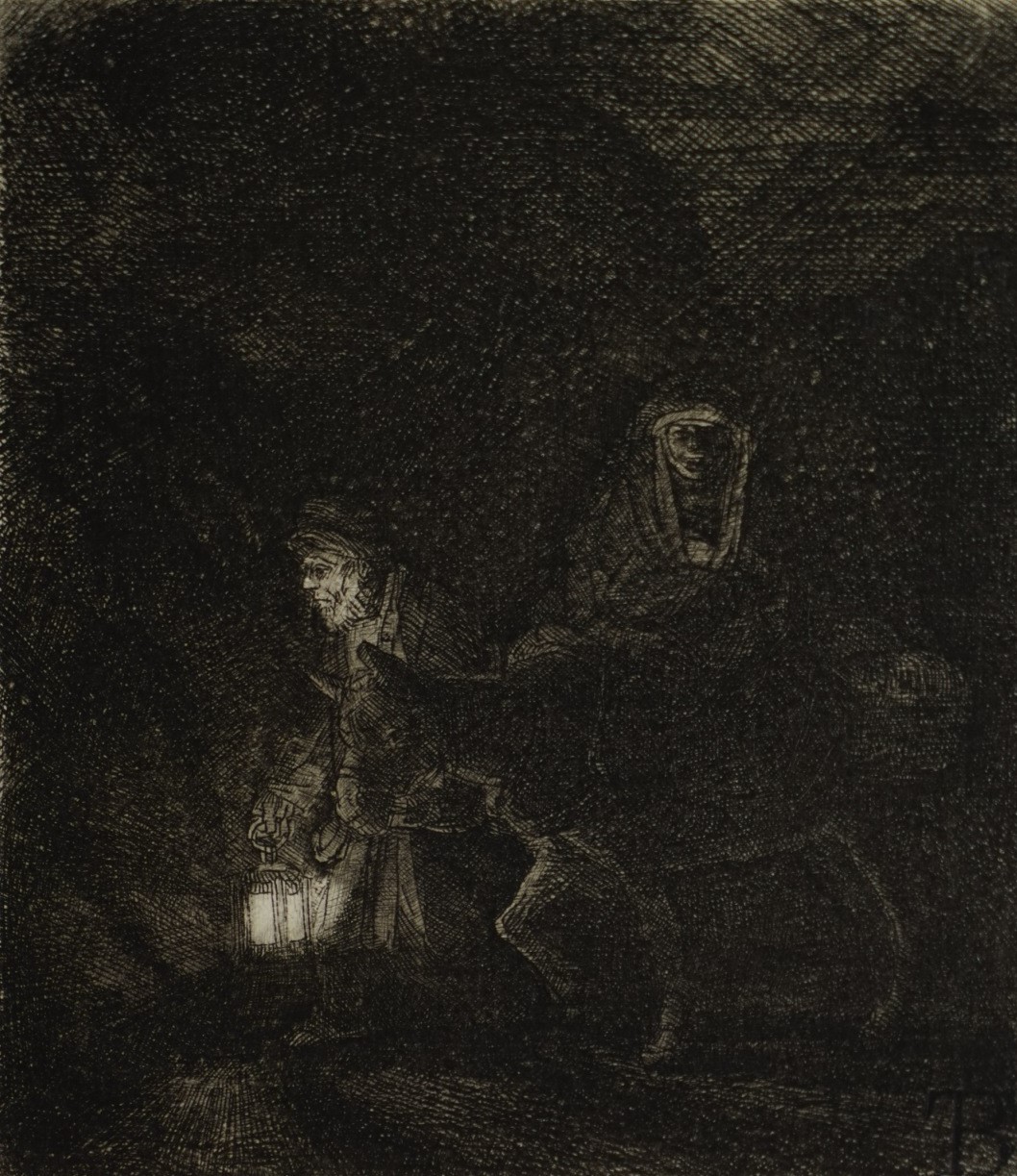
In the 1st state (NH, WB, R173) the figures of Joseph and Mary are almost white. The right hand of Joseph is unshaded. As is the front of the ass of which the head, neck and left front leg are shaded by left-right diagonals.
In the 2nd state (NH, WB, R174) the right hand and arm of Joseph are horizontally shaded.
In the 3rd state (NH, WB, R175) a lot of shading is added in drypoint. The hind legs of the donkey are separated. The upper left part of the sky is open, but there is cross hatching on the cloaks and the donkey.
In the 4th state (NH, WB, R176) the upper right part of the sky, the foliage in the left and the lower right foreground are covered by shading in drypoint.
In the 5th state (NH, WB, R177) again more shading is added, like on the ears of the donkey and on Joseph’s right shoulder. Shading added to the sky, especially in the upper right corner.
In the 6th state (NH, WB final, R178) the nose of the ass and Joseph’s right hand and sleeve are covered with light cross hatching. Diagonal hatching on Joseph’s breast.
In the 7th state (NH/NU 6th state Basan, Jean) there is much rework, probably by Basan. There is a ray of light from the lantern running upward to the left. Upper left and right there are still lighter portions. Later impressions show rust spots around Mary. There is reworking all over the plate.
The 8th state (NH/NU 7th state, H.L.Basan) is reworked again. Shading is added to the Virgin’s dress, to Joseph’s cheek and to the pack on the donkey.
The 9th state (NH/NU 8th state) is heavily worked over. vertical shading is added on the body of the donkey and in the background above Joseph and besides the Virgin. Generally very dark impressions.
The 10th state (NH) is again heavily worked over.


Prints and collections

Of the 2nd state only one impression is known, in the British Museum.
There are counterproofs of the 1st state (in the Bibliothèque Nationale) and the 3rd state (Rijksmuseum and British Museum).
The 6th state is the most frequently printed state. NH lists 79 impressions, at least twenty of these are impressions by De Bary (18th century).
There are several forgeries. One with a crescent moon (in the British Museum, in the Kupferstichkabinett Berlin and in the Bibliothèque Nationale), one with a part of the landscape from B 72 (Kupferstichkabinett, the British Museum and the Albertina) and one with a lighter area of sky in the shape of a wedge (the Bibliothèque Nationale and the Albertina).
The etching appears in the first edition of the Recueil de Basan, impression strong (NU).


Watermarks

In the 3rd state: Foolscap with five-pointed collar.
In the 4th state: Paschal Lamb (1651); Seven Provinces.
In the 5th state: Strasbourg lily with LC. In the 6th state: Arms of Amsterdam (3 ed.); Countermark AD; Foolscap with seven-pointed collar (2 ed. one with cm PEH); Seven Provinces; Strasbourg lily; Pro Patria (1699 or later).


Literature

H 253, BB 51-E, G 53, M 227, Mz 221, RA 173-178, Cl 57, W 58, Bl 26, Du 58, CD 207, S 20-22.
Rembrandt’s Women 2001, p. 199; Rembrandts passie, p. 75-79; Hinterding 2008, p. 119-120; Zeist 2012, p. 20-21; Dat kan beter! 2013, P. 50-51;Verdi 2014, p. 38-61;


Rembrandt in Black & White: 231

New Hollstein: 6th state of X/ White-Boon: 6th state of IX
A contemporary, somewhat dark impression on thin laid paper. It could be a later impression of the 5th state (NHD, WB), as listed in the catalogue.
Sheet: 132/133 x 117 mm. Narrow margins of approx. 4 mm all around (+ 11%).
Part of a watermark, not well visible, probably Arms of Amsterdam, listed in NH for this state. Horizontal chain lines at approx. 23 mm.


Provenance

In the collection of Thomas Blayds (Lugt 2422, 1797-1849, Castle Hill, Englefield Green) an English banker and collector. It could have been in his sale on 29 March 1849.
Then probably in the collection of Harrington Dale (1833, not in Lugt).
In the collection of Dr. Franz Winzinger (Lugt 2600a, b. 1910 Hofberg) a German art historian and writer, specialising in early German artist like Altdorfer and Dürer. His collector’s mark (a W in a circle in purple ink) verso
In the collection of Pierre Sentuc (Bayonne 1929 – 2017 Montrouge, Lugt 3608). His collectors mark (PS in a circle) in black ink verso.


Exhibitions

Rembrandt, fotograaf avant-la-lettre, Museum De Reede (Antwerp), January – May 2023;
Rembrandt, 17th century photographer, Daegu Art Museum (Korea), November 2023 – March 2024;
Rembrandt, de fotograaf, Westfries Museum (Hoorn), June 2024 – January 2025