B 65

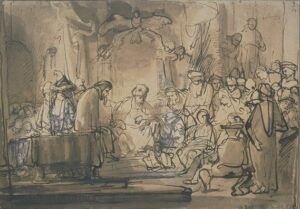
Christ disputing with the doctors: a sketch

  • French title:
    Jesus Christ disputant avec les docteurs de la loi
  • German title:
    Der steuende Jesus Knabe inmitten der Schriftgelehrten
  • Dutch title:
    Christus en de schriftgeleerden (schets)
  • New Hollstein:
    267
  • Rembrandt in Black & White:
    88

Etching. Ca. 1652.
Size: 116 x 87 mm. Surface: 101 cm2.
Not signed, not dated. Date estimated to be ca. 1652. There is no evidence for this date, but it fits the other prints from that period.

NH 88 – 1st state (b) of II

Copper Plate

The plate was in the sale by  Jean de Bary (1759, lot nr 37) and sold to Hendrik Busserus. It was then reworked in mezzotint, according to Hinterding probably by Pieter Louw (1725-1800) and not by Capt. Baillie as other authors suggested. The plate was not seen since then and is probably lost.


Rarity of impressions

  • In auctions (2000-2025): common                                                         Early: 9     Mixed: 21                     ⦿⦿⦿⊙⊙⊙

  • In collections (New Hollstein 2013): frequent                                      Early: 73     Late: 8                        ⦿⦿⊙⊙⊙⊙

  • Catalogue Nowell-Usticke (1967): C2+, not uncommon                                                                                 ⦿⊙⊙⊙⊙⊙


Story

Luke 2: 41-52
Rembrandt must have been much impressed by the well-known scene when Christ, as a twelve-year old boy, accompanied his parents to Jerusalem for Passover and was left behind when they returned. He was found three three days later in the temple, in discussion with the teachers.. Rembrandt made the first etching of this story in 1630 (B66). In the early ’50s he returned to the subject with three more etchings (B60, B64 and this one).


Picture

A group of some twenty men is surrounding the young boy. Other than in B64, Jesus is now standing and clearly attracting the attention from the scholars and from the viewer. Similar to B64 several men are positioned behind a partitioning. According to many authors (like Seidlitz) the print should be considered an unfinished one (thus the subtitle ‘sketch’). In other ‘later’ etchings, like in The flight into Egypt (B53), Rembrandt first etched the lines and then completed the picture with drypoint and burin. He did not in this one.


Inspiration

Based on the way the onlookers in the upper right corner are positioned Tümpel thinks that Rembrandt used a print by Lucas van Leyden, Joseph interpreting the Pharao’s dreams (H 23) as an example.
Hinterding points at the fact that this arrangement is far from unique in Rembrandt’s works, as in B 69, Christ driving the money changers out of the temple.


Related

RembrandtChrist with the Doctors – c. 1652 – Le Louvre – Benesch 885

Rembrandt made drawings of the same subject probably about the same time that he made the three later etchings (Benesch 936, now at the Nationalmuseum in Stockholm and Benesch 885, now in the Louvre).
Salomon Koninck made a picture with a similar composition about the same time (now in the Alte Pinakothek in Munich).


Copies

There are two copies in reverse. One by I.G.Hertel, signed Rembrandt fecit (his nr 282, 120 x 210 mm) and one in the 200 Etchings, possibly by Denon, signed in reverse Rembrandt f. 1651 (125 x 210 mm).


Attributions and reviews

The etching is considered as special by Singer.


States

The New Hollstein list two states, the second not by Rembrandt. All other authors list three states.
The 1st state (WB 1st and 2nd state, R208) has inky edges. Early impressions show much burr, like on the tall hat in the centre. In later impressions there are rust spots along the upper border and a ‘wobbly’ scratch is visible in the upper left corner. Münz considers this ‘state’ not to be by Rembrandt, but he does not explain this.
WB also considers it a 2nd state (R209). NH does not since there are no (planned) alterations.
The 2nd state (NH/3rd state WB) is the reworked mezzotint version.


Watermarks

In the 1st state: Foolscap with five-pointed collar, Paschal lamb.
In the 2nd state: Arms of Amsterdam, Pro Patria, Seven Provinces, Words.


Literature

H 257, BB 52-B, G 64, M 231, Mz 222, RA 208-209, Cl 69, W 69, Bl 36, Du 68, CD 212, S29.
Rembrandts passie, p. 84-85; Hinterding 2008, p. 136ff; Kroniek 2016, p. 62-64;


Rembrandt in Black & White: 88

New Hollstein: 1st state (b)of II/ White-Boon: 2nd state of III
A very good, well-inked impression, remargined with a thin support sheet. The rust spots in the top and the scratch in the left upper corner are well visible, indicating a somewhat later impression of the 1st state (NH, 2nd state WB, BB, NU). A small paper loss in the top margin and in the right margin. Some discoloration and stains in the upper left corner.
Sheet 124 x 212 mm, trimmed on or slightly within the platemark all around (-3%).
No watermark, horizontal chain lines at approx. 25 mm.


Provenance

In the collection of the Albertina in Vienna (Lugt 5g, in the Swann catalogue erroneously listed as 5d), their duplicate stamp in red ink verso. This stamp was used from 1922 onwards, probably until 1947.
According to the Swann catalogue it was possibly sold at the auction of Gutenkunst & Klipstein in Bern on 27 November 1948 which is unlikely, since that sale was focused on modern prints and Helvetica. It was more likely in the sales with Boerner (Leipzig) in 1923, 1924 or 1932.


Exhibitions

Rembrandt in Zwart-Wit, Stedelijk Museum Zutphen, Stadsmuseum Harderwijk, November 2013 – August 2015;