The copperplate was probably with Hendrick Uylenburg (his address is found on the plate in the 3rd state) and later with Justus Danckerts (1667: Op roijaal Pampier… 1 plaat ‘t kruijs van rembrant zelf geest). It then appeared in the sale by Jean de Bary (1759, lot 34), where sold to Kleinhens. It was later in the collection of Claude-Henri Watelet (1718-1786) and became part of the set of plates subsequently owned and used for printing Recueils by Pierre-François Basan (1723-1797), Henri-Louis Basan (his nr 1398), Auguste Jean (ca 1809), Veuve Jean, Auguste and Michel Bernard (1846), Alvin-Beaumont (1906) and Robert Lee Humber (1937).
It was sold at the Artemis sale in London (1993) and is now in a private collection in the USA.
Rarity of impressions
In auctions (2000-2025): very frequent Early: 14 Late: 78 ⦿⊙⊙⊙⊙⊙
In collections (New Hollstein 2013): very frequent Early: 58 Late: 34 ⦿⊙⊙⊙⊙⊙
Catalogue Nowell-Usticke (1967): C1+, a not very common large plate ⦿⦿⊙⊙⊙⊙
Story
John 19, verses 38-40
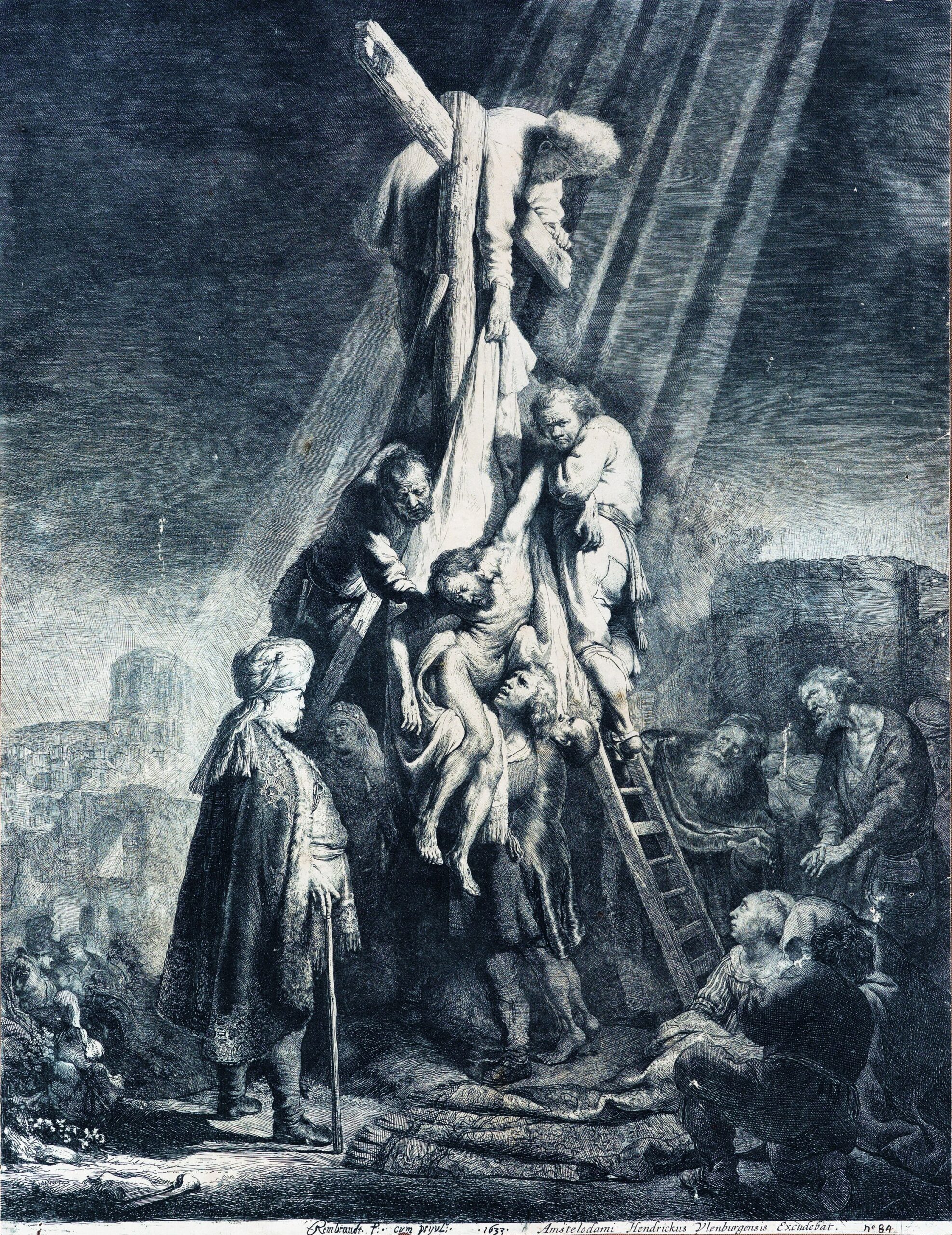
Joseph of Arimethea, a secret follower of Jesus, got permission from Pilatus to remove the body of Jesus from the cross to bury Him. Here the action is seen when the body is wrapped in linen and taken off by a group of followers.
Picture
The man on the left is probably Nicodemus, a wealthy follower of Jesus.
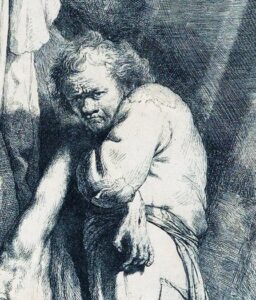
Detail – Self-portrait?
It may well be that Rembrandt pictured himself in the man on the right side of the ladder.
In earlier days this plate, the second largest by Rembrandt, was considered to be a later state of the previous one (B81-I), but Mariette was the first to notice (around 1851) that there were too many differences.
Inspiration
It is generally assumed that Rembrandt based the composition on an altarpiece by Rubens in the cathedral of Antwerp or, more likely, on the engraving after it, made in 1620 by Lucas Vorsterman (Hollstein 31). Fuchs noted not only the similarity in composition, but also the difference in the way Christ is pictured. Rubens (and Vorsterman) made Him look like a well-muscled man, almost a Superman. In Rembrandt’s version Christ is visible as a truly dead corpse, probably much closer to reality.
Rembrandt not only copied the composition but also the concept of making an etching that could be widely distributed. It may explain why he tried to protect his ‘copyrights’ by adding the words cum pryvl (short for privilegio) to the 3rd state, although he never actually applied for one.
Broos points at a woodcut by Albrecht Altdorfer (1480-1538).
Münz states that the etching also served as prototype for another painting from 1634, which was later identified by the RRP as made in the workshop (Corpus C49, Bredius 551, now in the Hermitage).
Related
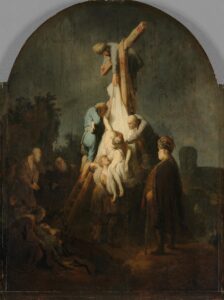
Rembrandt – The Deposition – ca 1635 – 89×65 cm – Der Alte Pinakothek – Corpus A65
The same year Rembrandt painted this subject in a very similar composition for Stadholder Frederik Hendrik (Corpus A65, Bredius 550, now in Der Alte Pinakothek in Munich). X-rays of that painting have indicated that the original composition bore an even stronger resemblance.
Copies
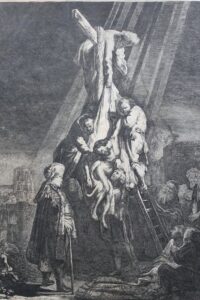
B&W 348 – Johan Jacob Hertel – Copy C of NH 119 / B 81-2 The descent from the cross, second plate – 1st state
The New Hollstein lists eleven copies of which three in the same direction;
Copy C is by Johan Jacob.Hertel, inscribed in the 2nd state Johan Jacob Hertel, pictor augsburgensis sculpebat et ostevebat Fructidor anno XI (two states, 528 x 414 mm, WB 1). Included in the collection Rembrandt in Black & White, nr 348.
Copy D is by George Bickham (WB 2, not traced by NH). Copy F is a wood-engraving by Charles-Jean Baptiste Carbonnneau (202 x 156 mm), included in the Blanc catalogue.
There are eight copies in reverse. Copy A is inscribed IOSEPHATTEM MERCATIS A paris chez B.Moncornet. Rembrandt inventor (405 x 287 mm, WB 4). Copy B is anonymous (518 x 406 mm, WB 5). Copy E is by Jacques Philippe Le Bas, included in the Recueil de P.F. Basan (295 x 217 mm, WB 3). Copies G, H and I are all by Edmund Girling.
Attributions and reviews
It is generally assumed that this plate was partially made by Johannes Van Vliet or even completely made by him under close supervision by Rembrandt. The moiré technique used in the sky is typical for Van Vliet but never used by Rembrandt. The same applies for the way the burin is used in the shadow above the tower at right.
The plate was made by a pupil according to Seidlitz and Coppier.
The plate is not by Rembrandt according to Singer.
States
The New Hollstein lists eight states, of which the first four by Rembrandt. All other authors list five states, Nowell-Usticke one trial proof and five states, from his 4th state there are later impressions by P.Basan, Basan, Jean, Bernard and Beaumont.
The 1st state (NH, WB, R265/NU trial proof a) is without the shading on the legs.
In the 2nd state (NH, WB, R266,H/1st state NU) horizontal shading is added to the legs of the two bearers. The area on the costume of the man with the turban is shaded over.
In the 3rd state (NH) an inscription is added: Amstelodami Hendricum Vlenburgensis excudebat, which, in combination with the addition to the signature ‘cum privilegio’ may have been an attempt to establish some sort of copyright (Hind).
In the 4th state (NH/3rd state WB/2nd state NU) the inscription is slightly altered: Hendrickus.
In the 5th state (NH/4th state NU/3rd state NU) the inscription is changed to: Amstelodami Justus Danckers Excudebat. Danckers is believed to have worked in Amsterdam between 1684 and 1686, so Nowell-Usticke dates this state around 1685. The New Hollstein and Biörklund also consider this state to be posthumous.
In the 6th state (NH/5th state WB final/4th state NU P.Basan, Basan) the inscription is almost gone (vaguely visible) and the plate is heavily reworked.
In the 7th state (NH/5th state NU) the text Imp.Lamoureux r. S. Jean de Beauvais 12 Paris is added in the lower right corner. This is the address of the Basan workshop.
In the 8th state (NH/5th state NU, Jean, Bernard, Beaumont) the plate is again entirely reworked.
In the catalogue of the Watelet sale in 1786 it is mentioned that the plate is original, but that he (Watelet) has started retouching it.
Prints and collections
Of the 1st state only two impressions are known, in the Rijksmuseum and in the Albertina (R265).
A counterproof of the 2nd state is in the Bibliothèque Nationale.
Of the 3rd state only one impression is known, in the Albertina.
On 13 March 1637 an impression was sold at an auction by Jan Bassé for 1 guilder and 12 stuivers (=60 cents).
Recueils
B&W 54 – Recueil de Basan – Page 39 NH: 7th state of VIII/WB: 5th and final state.
A good impression over two pages. Wear is showing in several places, like the face of the man at the top of the cross.
It should be the 7th state, but the address of the Basan workshop, as mentioned in NH, is not visible.
B&W 206 – Recueil de Beaumont – Sheet 29 NH: 8th and final state/WB: 5th and final state.
A dark impression over two pages. The plate is completely reworked, destroying much of the finer details.
Watermarks
In the first five states: Strasbourg lily (one edition 1634-1641 and two not dated).
In the 2nd and 4th state: Arms of Bern; Paschal lamb in a circle.
In the 4th state also: Anchor with cm R; Grapes.
In the 6th state: Cross in a crowned shield with cm FBA’.
Literature
H 103, BB 33-C, G 84(II), M 187, Mz 198, RA 265-266, Cl 83, W 84, Bl 56, Du 88, CD 77 W.Stechow, Jahrbuch der Pr.K.S., Volume 50, 1929; Fuchs 1968, p. 30-31; Gerson 1969, p. 7; B.Broos, Rembrandt borrows from Altdorfer, Simiolus IV, 1970, p. 100-108;, p. 217; Rembrandt & Van Vliet 1996, p. 73-75; Tümpel 2006 p. 84-85; Hinterding 2008, p. 178ff; Dat kan beter! 2013, p. 20-21;
Rembrandt in Black & White: 202
New Hollstein: 4th state of VIII/White-Boon 3rd state of V
A good, dark impression on thick laid paper. With the inscription Hendrickus Uilenburg. confirming the 4th and last contemporary state. Several small pin holes, especially on the right side.
Sheet: 530 x 406/408 mm, no margins, cut slightly within the platemark (-1%).
No watermark, horizontal chain lines at approx. 30 mm.
Exhibitions
Rembrandt in Zwart-Wit, Stedelijk Museum Vianen, October 2017 – January 2018; Rembrandt, 17th century photographer, Daegu Art Museum (Korea), November 2023 – March 2024; Rembrandt, de fotograaf, Westfries Museum (Hoorn), June 2024 – January 2025;